
Maximum Medical Improvement (MMI) in Orthopedic Cases
After a serious accident, many patients are left wondering whether they are still healing or whether recovery has begun to level off. In an orthopedic injury claim, that uncertainty can influence everything from treatment decisions to day-to-day function and even the overall value of the case. Injuries involving the knee, shoulder, spine, or other joints often evolve over months, not weeks, which is why Maximum medical improvement in orthopedic cases often depends on accurate timing and careful evaluation. Maximum medical improvement (MMI) is one of the most important milestones in orthopedic injury cases.
In practical terms, maximum medical improvement is the point at which the treating physician determines that the patient’s condition has stabilized and that additional curative treatment is unlikely to result in significant further recovery. This does not mean the patient is pain-free or finished with all medical care. Rather, it indicates that the injury has reached a medical plateau, allowing physicians to more accurately evaluate permanent limitations, future treatment needs, and overall prognosis.
What Maximum Medical Improvement Means in Orthopedic Cases
Orthopedic injuries often behave very differently from short-term or self-limiting conditions. While a simple fracture may heal cleanly and predictably, injuries involving the spine, ligaments, nerves, or weight-bearing joints can lead to ongoing symptoms and functional limitations even after active treatment has slowed or concluded.
Orthopedic care is not only about identifying and treating an injury; it is also about understanding how that injury affects daily life. A patient may continue to experience pain with walking, lifting, reaching overhead, bending, or prolonged sitting even after surgery, injections, therapy, and medication have produced most of the expected improvement. These functional limitations are often the most meaningful aspect of the injury from both a medical and legal standpoint.
At this stage, a detailed orthopedic evaluation becomes especially important. It allows the physician to document measurable impairment, define functional restrictions, and outline expectations for future care. This type of evaluation provides a clearer picture of how the injury will affect the patient moving forward.
From a legal perspective, MMI is often the point at which a case can be evaluated with greater confidence. Rather than speculating about future treatment or recovery outcomes, physicians can provide more reliable opinions about whether symptoms are likely to persist, whether additional procedures may be necessary, and whether a permanent loss of function exists.
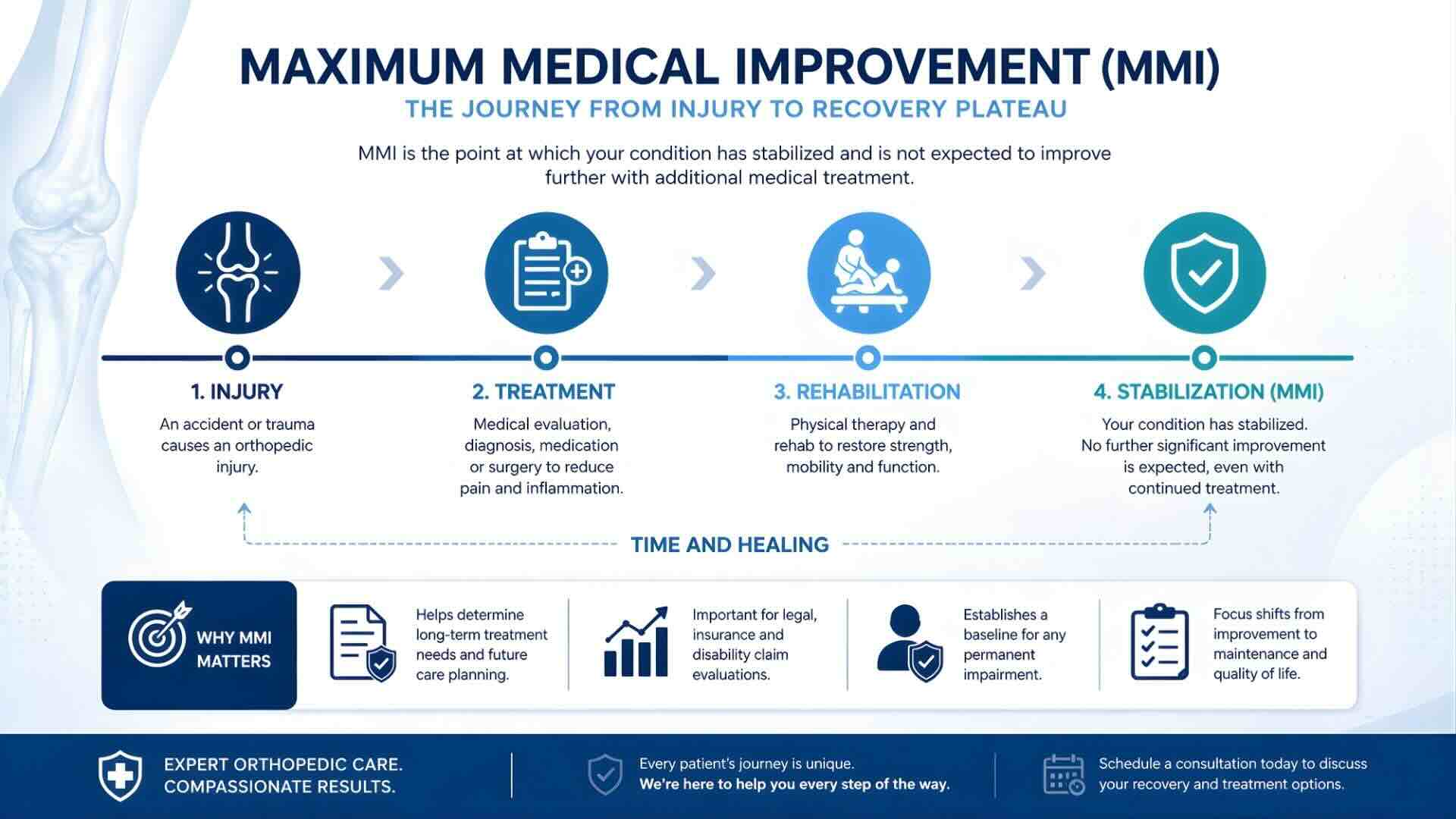
How Doctors Determine Whether a Patient Has Reached MMI
There is no single laboratory test, imaging study, or diagnostic tool that definitively determines whether a patient has reached maximum medical improvement. Instead, the determination is based on the treating physician’s clinical judgment, informed by a comprehensive review of the patient’s medical course.
A thorough MMI assessment generally focuses on several key questions:
- Has the patient completed the primary phase of treatment, such as physical therapy, medication management, injections, or recovery from surgery?
- Have symptoms and objective findings plateaued rather than continuing to improve in a meaningful or measurable way?
- Are the patient’s current limitations supported by objective findings, such as imaging abnormalities, reduced range of motion, weakness, instability, or neurologic deficits?
In addition to these factors, physicians consider whether any further treatment is likely to be curative or primarily supportive. This distinction is important. A patient can be at maximum medical improvement and still require ongoing care, including pain management, periodic injections, follow-up visits, or work-related restrictions.
Common Signs the Case Is Approaching a Plateau
Patients and attorneys often want to understand what a true plateau looks like in practical terms. Although the exact presentation can vary, there are several common patterns that suggest a patient may be approaching maximum medical improvement.
One of the most consistent indicators is a lack of meaningful functional change over time. Follow-up visits may show that symptoms fluctuate slightly but do not improve in a sustained or measurable way. In other words, the patient’s condition remains relatively stable despite ongoing care.
Another important sign is the presence of objective findings that explain the patient’s symptoms, combined with limited potential for further improvement. Imaging studies and physical examination results may clearly identify the source of the problem, but additional treatment is unlikely to significantly alter the outcome.
At this point, physicians are typically able to describe permanent impairment, anticipated future care, and any necessary work or activity restrictions with a reasonable degree of confidence. This level of clarity is what makes the MMI stage so important in both clinical care and legal evaluation.
Why MMI Affects Settlement Timing and Case Value
This issue matters because MMI and settlement timing are often closely connected. When a claim resolves before the medical picture is reasonably clear, the risk of undervaluation increases.
That is why many personal injury claims are easier to value after MMI. By then, the record usually shows the patient’s remaining symptoms, any measurable impairment, work restrictions, and likely future care needs.
This is especially important in cases where future medical costs, ongoing treatment, and documented functional loss significantly affect claim value. Those issues become easier to quantify once an orthopedic MMI evaluation has been completed with enough supporting evidence.
What MMI Can Clarify for the Legal Side of the Case
Once maximum medical improvement has been reached, the medical record can provide a clearer picture of the patient’s long-term condition. Physicians can better explain whether symptoms are likely to improve, remain stable, or require ongoing supportive care.
For attorneys, MMI helps clarify permanent impairment, future treatment needs, functional limitations, and possible work or activity restrictions. These details are especially important when an injury affects mobility, strength, range of motion, or daily function.
By this stage, the case can be evaluated with less uncertainty because the medical record is supported by documented findings, treatment history, and the physician’s opinion regarding prognosis.

What MMI Does Not Mean
Patients sometimes assume that reaching maximum medical improvement means they have fully recovered. In most orthopedic cases, this is not the case. Reaching MMI simply means that the condition has stabilized; it does not mean that all symptoms have fully resolved.
A patient at maximum medical improvement may continue to experience chronic pain, reduced strength, limited range of motion, gait abnormalities, or permanent work restrictions. These limitations can persist even after appropriate and thorough treatment has been completed.
It is also important to recognize that reaching MMI does not mean that treatment ends. Many patients require ongoing maintenance care, such as home exercise programs, medication management, interventional procedures, or periodic follow-up with a specialist.
The key distinction is that these treatments are aimed at managing symptoms and maintaining function rather than achieving significant additional recovery.
Why Documentation Matters at the MMI Stage
As a case approaches maximum medical improvement, precise and detailed documentation becomes increasingly important. Orthopedic claims are significantly stronger when the medical record clearly connects symptoms to objective findings and outlines the full course of treatment.
An effective MMI evaluation should do more than simply state that the patient has reached a plateau. It should provide a clear and comprehensive explanation of the patient’s condition, including:
- The diagnosis and mechanism of injury
- The treatment provided and the patient’s response over time
- Current symptoms, measurable deficits, and functional limitations
- Recommendations for future care and whether that care is curative or supportive
This level of detail allows both patients and legal professionals to evaluate the case with greater confidence. It also supports more informed discussions regarding settlement by grounding the conversation in objective medical evidence.
Practical Questions Patients and Attorneys Should Ask
When a physician indicates that a patient may be nearing maximum medical improvement, the focus of the conversation should shift accordingly. Rather than focusing solely on ongoing treatment, it becomes important to evaluate what the medical record already establishes and what additional information may still be needed.
Patients and attorneys should consider whether the condition is truly stable, whether future treatment is anticipated, whether permanent restrictions apply, and whether causation has been clearly addressed. In some cases, unresolved symptoms may require further diagnostic evaluation before MMI can be determined with confidence.
Questions to Address Before Moving Forward
Before a case is valued or resolved, several key questions should be clearly answered:
- Has the physician definitively determined whether the patient has reached MMI or remains in active recovery?
- Are future care needs documented with sufficient specificity to support the claim?
- Do the medical records clearly explain how the injury affects work, mobility, and daily function?
Answering these questions helps prevent premature decisions and ensures that the case is evaluated based on a complete and accurate understanding of the patient’s condition.

Final Takeaway
Maximum medical improvement is an important milestone in orthopedic injury cases. It helps clarify where recovery stands, whether lasting limitations remain, and what future care may be needed.
For patients, MMI can provide a clearer understanding of ongoing symptoms and long-term care needs. For attorneys, it offers important medical context for evaluating the long-term effects of an orthopedic injury.
When recovery has plateaued or permanent limitations need to be documented, a focused orthopedic evaluation can help provide the clarity needed to move forward.