
Medical Injury Ratings in Personal Injury Cases
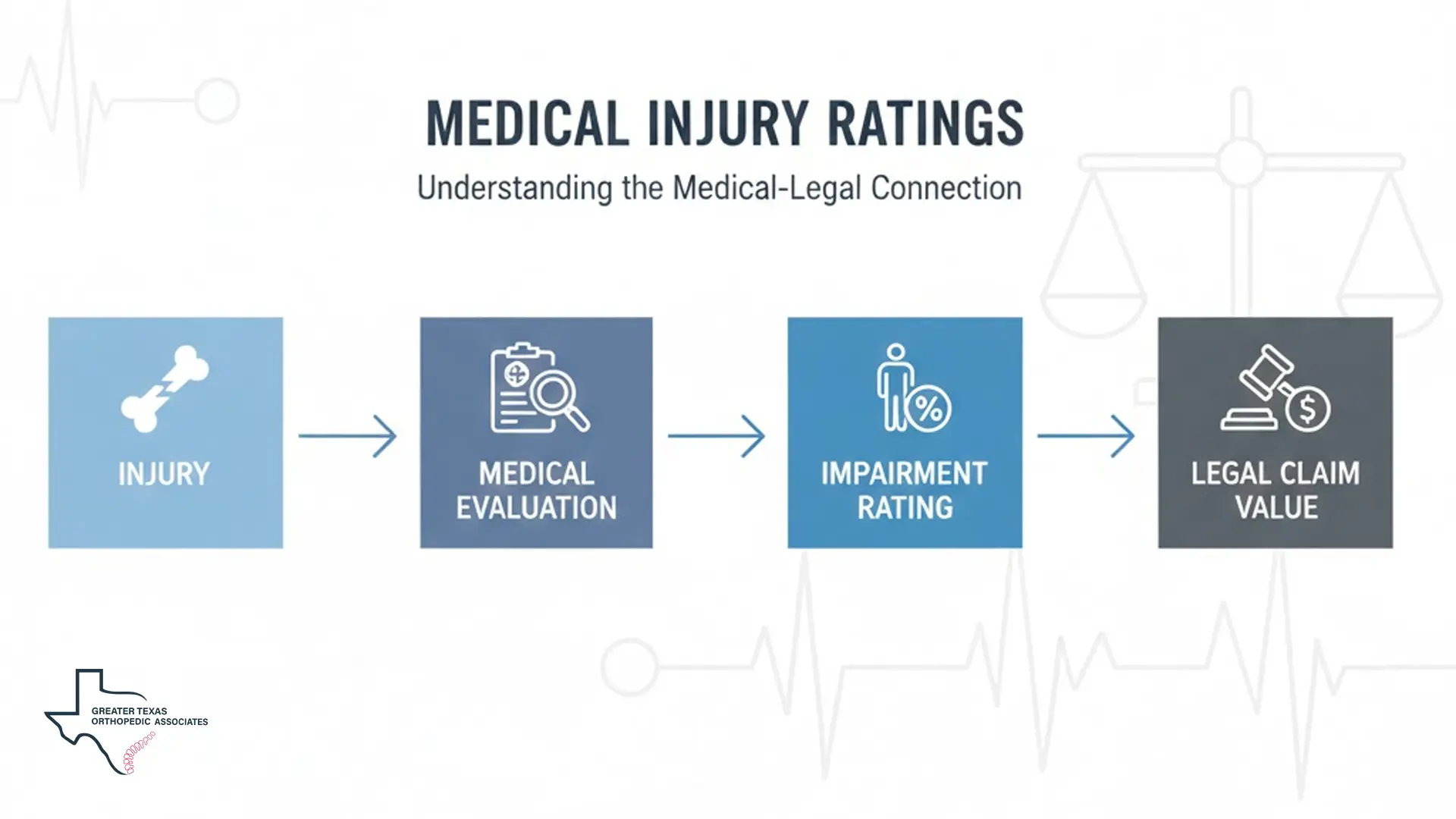
The bridge between clinical medicine and legal recovery is built on objective evidence. In the complex world of litigation, medical injury ratings serve as a vital tool for quantifying the impact of physical and psychological trauma. For attorneys, these ratings are not merely numbers; they represent a patient’s permanent loss of function, which directly dictates the financial valuation of a claim.
A precise personal injury medical evaluation is the cornerstone of any defensible legal outcome. This guide provides a clear, evidence-based overview of how these ratings are established, why they matter in litigation, and how attorneys can evaluate their reliability under forensic scrutiny.
Medical Injury Ratings: Key Concepts
To understand the weight of these assessments, one must distinguish between “impairment” and “disability”.
Impairment refers to a significant deviation, loss, or loss of use of any body structure or body function in an individual with a health condition. It is a medical finding determined by a physician through an objective clinical assessment.
Disability, however, is a broader administrative or legal term that describes how an impairment limits an individual’s ability to perform activities, meet social requirements, or engage in employment.
The most established standard for evaluating permanent impairment is the American Medical Association (AMA) Guides to the Evaluation of Permanent Impairment. For over 50 years, these guides have provided a reliable and repeatable measurement framework. More than 40 states rely on the AMA Guides as the accepted authority to rate permanent loss of function. Using medical injury ratings based on these standards ensures that the documentation provided for legal proceedings is consistent and evidence-based.
Whole-Person vs. Body-Part Impairment Ratings
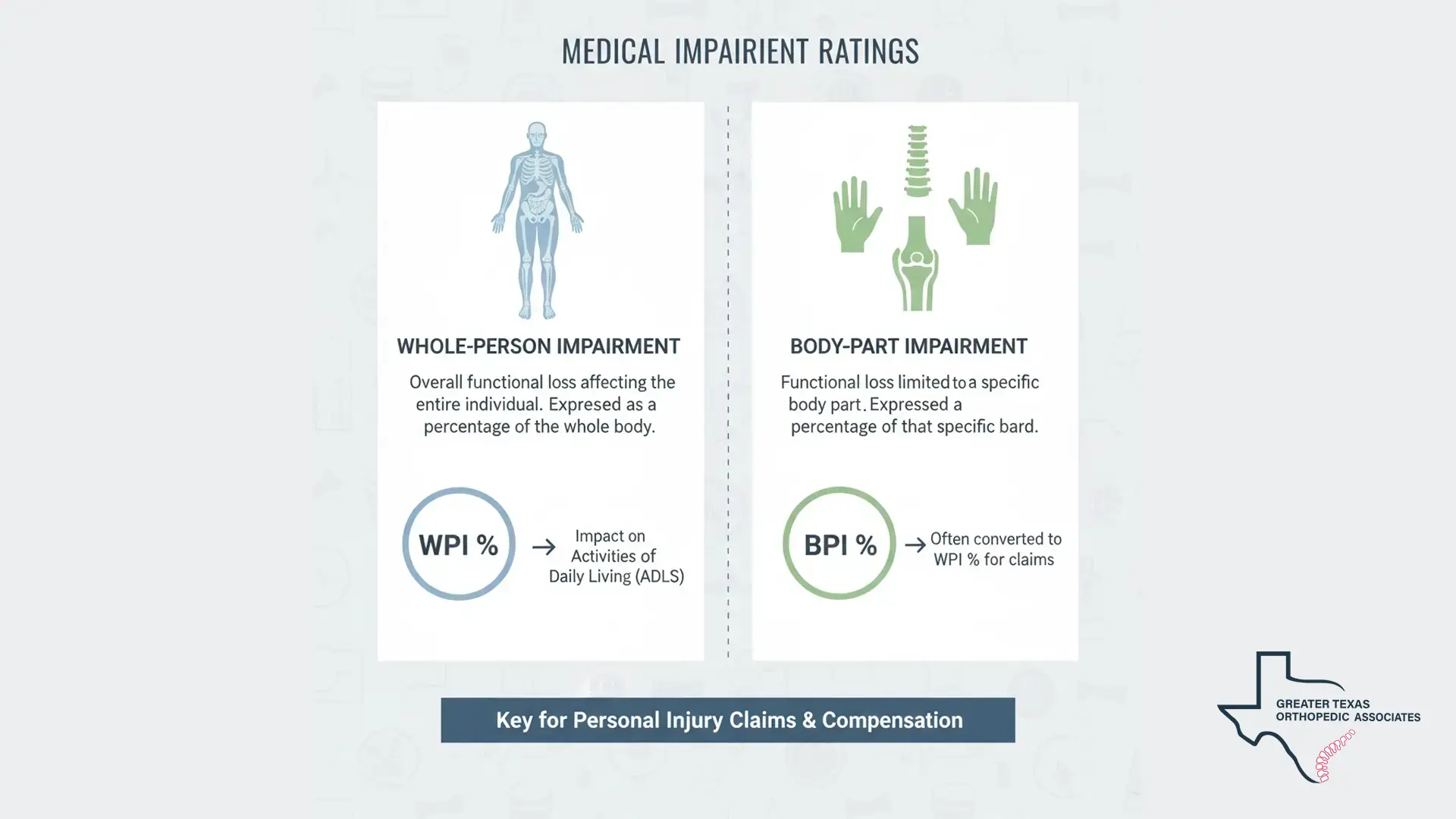
There are two primary ways to express impairment in a legal context. A whole-person impairment rating assesses the injury’s effect on the body as a whole, typically used when dealing with systemic or core body injuries like spinal trauma. For instance, a 30% whole-person rating indicates that an individual has lost nearly a third of their overall bodily function.
Conversely, a body-part impairment rating focuses on a specific anatomical structure, such as a hand or a foot. This is often used in “schedule loss of use” calculations, where the loss is tied to a specific value based on the injured extremity.
Why Maximum Medical Improvement (MMI) Matters
A critical component of understanding impairment ratings for attorneys is the timing of the evaluation. A rating cannot be assigned until a patient has reached Maximum Medical Improvement (MMI). MMI occurs when a patient’s condition has stabilized and is unlikely to improve significantly with further medical treatment. At this stage, the patient’s recovery has plateaued, and any remaining functional deficits are considered permanent.
Once MMI is reached, a physician uses standardized scales to document the permanent impact of the injury. If an attorney requests a rating too early, the valuation may be inaccurate, as the full recovery process or long-term complications, such as post-traumatic arthritis, may not yet be manifest. Therefore, patience in the treatment timeline is often required to secure the most defensible evidence for the case.
Calculating Injury Severity: Methods Explained
In addition to the AMA Guides, various scoring systems exist to categorize the intensity of trauma in an acute setting. These are frequently used to establish the immediate gravity of an incident in injury severity ratings legal cases. Two of the most common systems are the Abbreviated Injury Scale (AIS) and the Injury Severity Score (ISS).
The Abbreviated Injury Scale (AIS)
The AIS is an anatomically based system that ranks injuries on a scale from 1 (minor) to 6 (maximum, possibly lethal). It categorizes thousands of injuries across nine anatomical regions, including the head, neck, face, and vertebral column. While useful for ranking individual injuries, its non-linear correlation with mortality risks in multiple-trauma cases led to the development of the ISS.
The Injury Severity Score (ISS)
The ISS provides a platform for documenting patients with multiple injuries by grouping the body into six regions. The score is calculated as the sum of the squares of the highest AIS scores for the three most severely injured regions. This ordinal scale ranges from 1 to 75 and is considered a reliable predictor of mortality and long-term outcomes. In injury severity ratings legal cases, these scores help establish the baseline of physical trauma immediately following an accident, providing a clear narrative of the incident’s impact.
Medical Evaluations and Diagnostic Tools
Precise ratings depend on a multifaceted diagnostic approach. At GTOA, we utilize advanced imaging and specialized physical examinations to ensure that every personal injury medical evaluation is exhaustive. Our orthopedic evaluations typically include high-resolution imaging such as MRI and CT scans to detect soft-tissue damage, fractures, and joint instability that may be missed by general exams.
Impairment Rating Evaluations (IRE)
An IRE is a clinical procedure where a physician applies the AMA Guides to determine the percentage of permanent impairment. The doctor reviews the patient’s medical history, assesses the range of motion, and performs strength and neurological testing. The resulting number is the medical opinion upon which legal claims for permanent partial or total disability are built.
Functional Capacity Evaluations (FCE)
While an impairment rating is a medical number, a Functional Capacity Evaluation (FCE) is a performance-based test. This objective assessment usually lasts around four hours and measures a patient’s ability to perform work-related tasks, such as lifting, carrying, and squatting. The FCE highlights the gap between what the patient could do before the accident and their current capabilities, bridging the gap between medical impairment and real-world disability. Including an FCE alongside an IRE provides a more persuasive narrative to insurance adjusters and juries.
Handling Apportionment and Pre-existing Conditions
One of the most complex aspects of understanding impairment ratings for attorneys is the issue of apportionment. When a client has a pre-accident history, medical assessors must determine what portion of the current impairment is directly attributable to the new trauma.
Psychological vs. Physical Apportionment
In cases involving psychological or psychiatric injury, the threshold for whole-person impairment is often a contentious point. For example, in disputes regarding psychological trauma after a motor accident, medical review panels must carefully separate pre-existing major depression from accident-related Post-Traumatic Stress Disorder (PTSD). Strict adherence to guidelines is required to ensure that impairments attributed solely to pain are not erroneously counted toward psychiatric ratings.
Why Full Disclosure Matters
Clients must be upfront about prior accidents, even those that occurred decades ago. Failure to disclose these can lead to allegations of fraud and damage the provider’s credibility. Experienced specialists can often argue that while a pre-existing condition existed, it was asymptomatic or stable before the current accident acted as the “straw that broke the camel’s back”.
Strengthening the Legal Foundation Through Documentation
The quality of clinical records directly influences the final settlement value of a case. Meticulous documentation establishes the three pillars of a lawsuit: negligence, causation, and damages. Without robust records, insurance companies can argue that injuries are unrelated to the accident or are not as severe as claimed.
Proving Causation: The “But For” Test
Causation is often the most difficult element to prove in injury severity ratings legal cases. It requires establishing that “but for” the defendant’s actions, the plaintiff would not have suffered the harm. Medical documentation must create an official, contemporaneous link between the trauma and the resulting symptoms, ideally within 24 to 72 hours of the incident. Gaps in treatment can break this link, allowing opposing counsel to suggest an intervening cause.
Documenting Pain, Suffering, and Non-Economic Losses
To substantiate claims for pain and suffering, medical notes must capture the subjective and qualitative aspects of an injury. Proper documentation of pain intensity, emotional challenges, and the ways an injury interferes with daily life is crucial for maximizing non-economic compensation. Services such as facet joint injections or pain management often generate procedural notes that provide objective evidence of the severity of a patient’s discomfort.

The Legal Value of Specialized Expertise
Not all medical providers are equally suited for the rigors of personal injury law. Relying solely on a primary care physician can disadvantage a case, as they may lack the forensic experience required for intense scrutiny. Top attorneys seek medical partners who demonstrate:
- Forensic Expertise: The ability to create documentation that satisfies both clinical and legal requirements.
- Objectivity: A primary focus on accurate diagnosis rather than allegiance to external payers.
- Testimony Experience: The capacity to explain complex medical terminology clearly during depositions or trials.
- Lien-Based Support: The willingness to provide care without upfront costs to the patient, ensuring that treatment is not delayed due to financial hardship.
At GTOA, we understand the intricacies of liens and attorney communication, preparing reports that meet the highest evidentiary standards. For getting more information, you can visit our article on [Why Medical Documentation Matters in Injury Lawsuits].
Conclusion
In the realm of personal injury litigation, the choice of medical provider is paramount. Medical injury ratings represent the culmination of a patient’s treatment journey, providing the objective proof required to secure fair compensation. By prioritizing a detailed evaluation and ensuring that every note is built on evidence-based science, attorneys can build a robust foundation for their clients’ future.
Understanding impairment ratings for attorneys involves more than just reading a percentage; it involves analyzing the methodology, timing, and objectivity of the assessment.
By focusing on accurate assessment and informed decision-making, patients can address the root causes of their pain while attorneys gain the medical clarity necessary for successful case resolution. In personal injury law, precision is not just a standard; it is the key to securing both healing and justice.