

Functional Capacity Evaluations in Personal Injury Cases: What They Document
A functional capacity evaluation in personal injury cases can help document how an injury affects a person’s ability to work and perform daily activities. A functional capacity evaluation in a personal injury case may document abilities such as lifting, carrying, pushing, pulling, sitting, standing, walking, reaching, and performing repetitive tasks.
Instead of relying only on a patient’s description of pain, the evaluation produces performance-based findings that can be considered alongside imaging, physical examinations, treatment records, and the physical demands of the person’s job.
For patients, the concern is practical: Can I safely return to work, and which activities should I avoid? For attorneys, case managers, and medical providers, the question is whether the record clearly explains how the injury affects real-world function.
This article explains what an FCE measures, what a functional capacity evaluation report may include, how the findings relate to work limitations after injury, and when testing may be appropriate.
What Is a Functional Capacity Evaluation?
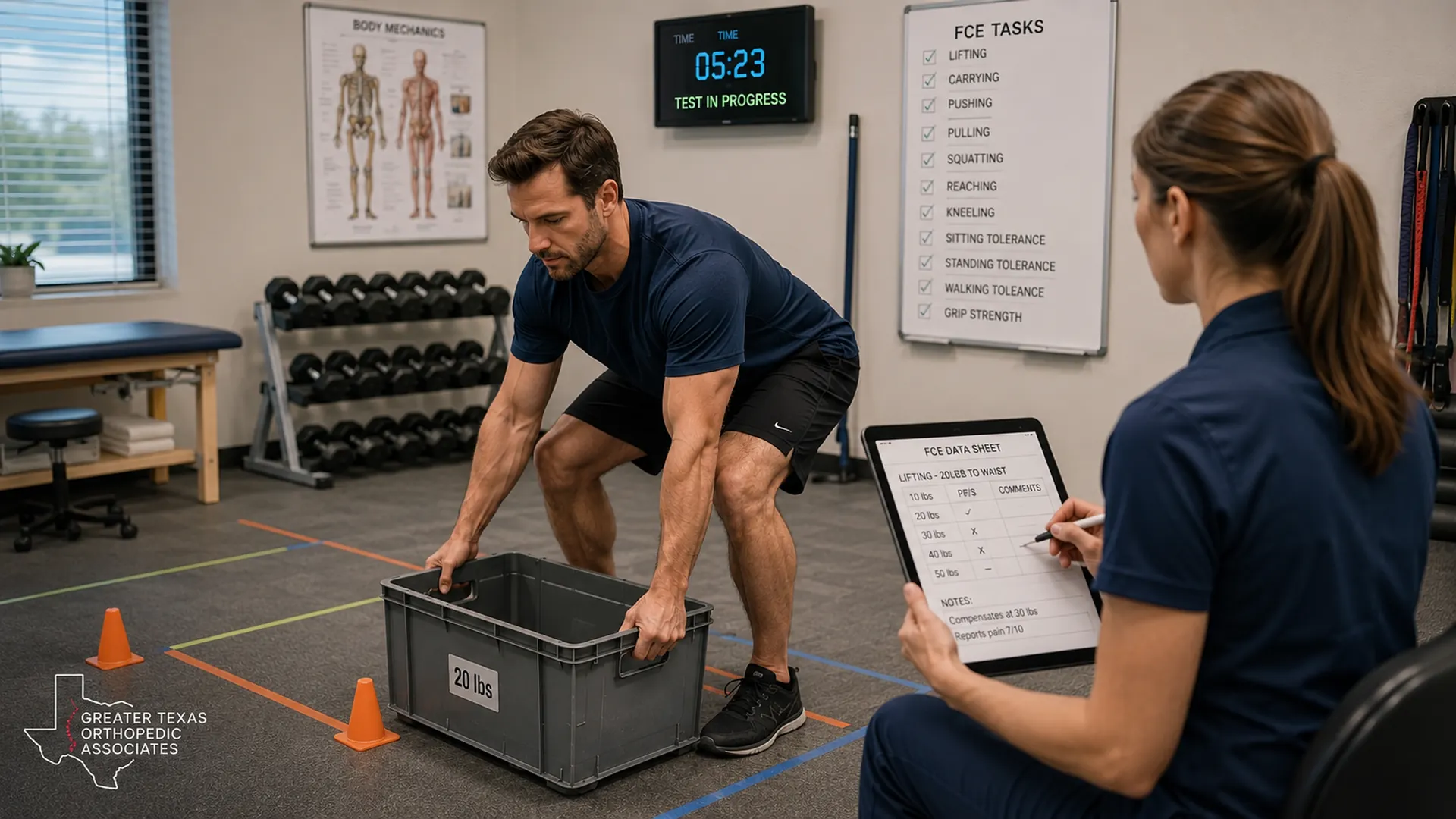
An FCE is not a single strength test. It typically involves several hours of standardized tasks performed under the observation of a qualified physical or occupational therapist. The exact length and format vary based on the injury, the referral question, the testing protocol, and the physical demands being assessed.
Each task is designed to measure a specific functional demand. The evaluator records not only the result, but also movement quality, symptom response, tolerance, and whether performance remains reasonably consistent across related activities.
Consider a warehouse worker in Houston who was rear-ended while commuting. Weeks later, imaging may show that a fracture is healing, yet lifting a loaded box still causes sharp back pain or loss of grip. An FCE may help document where the task becomes unsafe, the amount of weight involved, and the positions that reproduce symptoms.
What Does an FCE Measure?
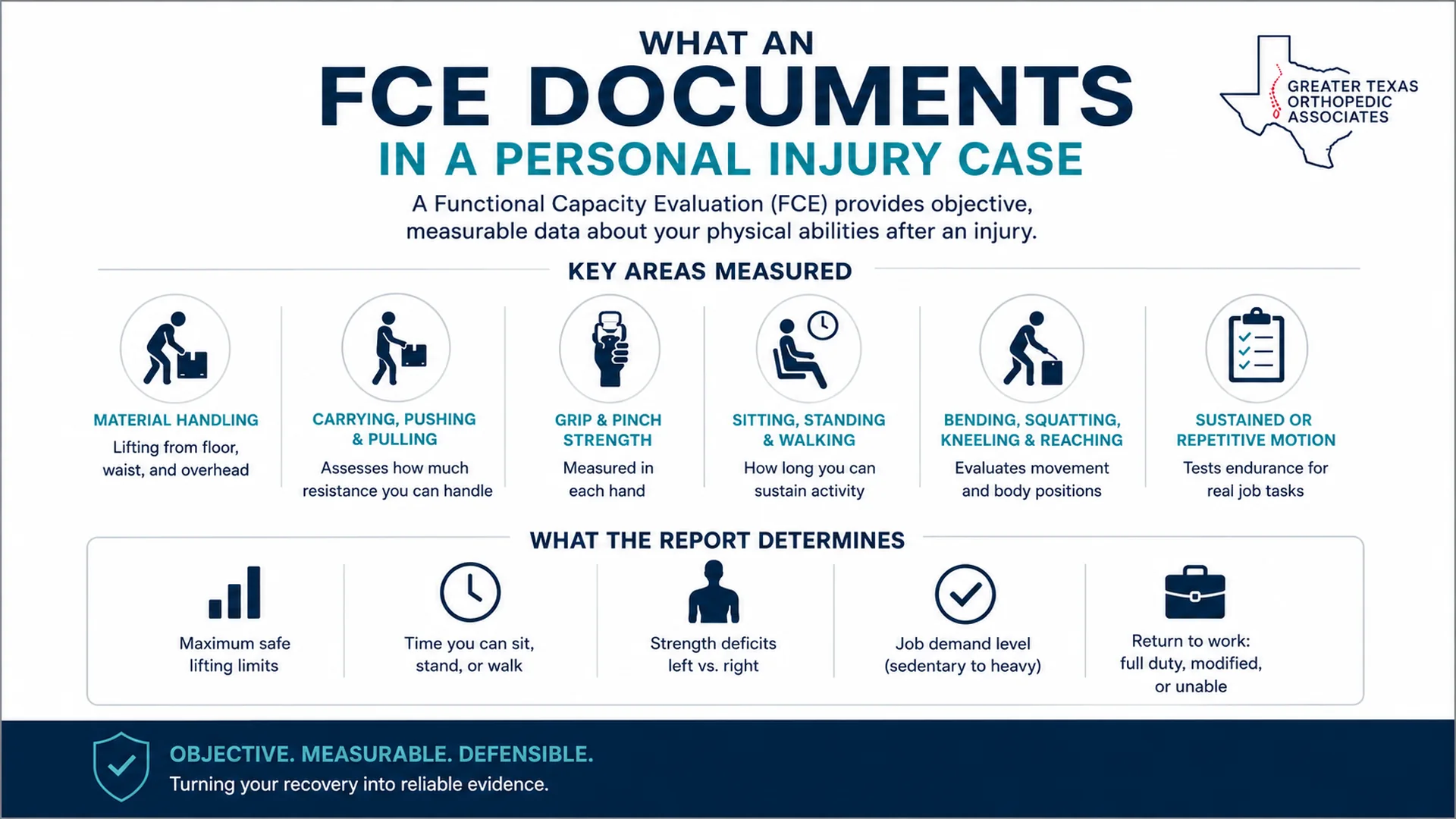
The activities selected should reflect the patient’s condition and, when relevant, the demands of the patient’s job. A functional capacity evaluation may assess:
- Material handling, including lifting from floor, waist, shoulder, and overhead levels
- Carrying, pushing, and pulling against measured resistance
- Grip and pinch strength in each hand
- Sitting, standing, walking, and stair-climbing tolerance
- Bending, squatting, kneeling, balancing, and reaching
- Sustained or repetitive movements that resemble work activities
- The ability to maintain safe body mechanics as fatigue develops
The goal is to translate reported symptoms into measurable activity limits that may guide treatment, rehabilitation, workplace restrictions, and return-to-work planning. Cleveland Clinic describes FCEs as assessments of functional abilities that may include material-handling capacity, consistency and reliability measures, and return-to-work status.
How an FCE May Support a Personal Injury Claim
In many injury claims, the disputed issue is not whether an accident occurred, but how the injury continues to affect the person’s ability to work and complete daily activities. Pain and fatigue may be real even when they are not fully reflected on an X-ray or MRI.
An FCE can add structured, performance-based data to the broader medical record. Its findings may be reviewed alongside diagnostic imaging, physician examinations, treatment history, job-demand information, and other objective medical findings. The evaluation does not determine the outcome or value of a claim, but it may help explain the practical consequences of an injury.
What Consistency and Reliability Measures Mean
Many FCE protocols include measures designed to evaluate whether performance remains reasonably consistent across repeated tasks. Depending on the protocol, the evaluator may consider movement patterns, physiological responses, repeated strength measurements, symptom behavior, and observed task performance.
These measures help the evaluator interpret the reliability of the results. However, no single measurement should be treated as definitive proof of a patient’s motivation or intent. The final report combines measured performance with the evaluator’s professional interpretation.
What an FCE Documents After an Injury
The central value of an FCE is detailed documentation. A completed evaluation may identify specific functional abilities and restrictions that a treating physician, rehabilitation team, employer, attorney, or case manager can consider.
- The maximum weight demonstrated for lifting at floor, waist, shoulder, or overhead levels
- How long the patient tolerates sitting, standing, or walking before symptoms or safety concerns limit performance
- Grip-strength or upper-extremity differences when clinically relevant
- Positions or movements that reproduce pain, weakness, instability, or altered mechanics
- The physical-demand level demonstrated during the evaluation, such as sedentary, light, medium, or heavy
- Whether the demonstrated ability appears compatible with the demands of the prior job
- Recommended restrictions, accommodations, or a graduated return-to-work plan
FCE findings may help inform work-capacity, disability, rehabilitation, and accommodation decisions. They may also supplement a physician’s impairment assessment, but the FCE itself does not necessarily assign an impairment rating or make a legal disability determination.
Work Limitations and Return-to-Work Recommendations
For many patients, the most useful result is a clear description of work limitations after injury. An FCE may recommend a maximum lifting weight, limits on overhead activity, reduced tolerance for prolonged sitting or standing, or scheduled opportunities to change position.
These recommendations may assist the treating physician, rehabilitation team, employer, and patient when considering modified duty, workplace accommodations, or a gradual return-to-work plan. They may also help reduce the risk of returning to tasks that exceed the patient’s demonstrated capacity.
For example, a San Antonio office worker recovering from a shoulder injury may be able to type and perform desk work but remain unable to sustain overhead filing or carry boxes to storage. An FCE can document that difference and compare it with the essential demands of the job.
When a job cannot be modified to fit documented restrictions, the report may provide useful context for vocational planning. It does not, however, require an employer, insurer, or court to reach a particular decision.
What a Functional Capacity Evaluation Report Includes
The written report is the lasting product of the appointment. Rather than simply repeating the test results, a thorough functional capacity evaluation report explains how the measured performance should be interpreted. It commonly identifies:
- The testing protocol, referral question, and activities performed
- Consistency and reliability observations
- A comparison between demonstrated abilities and the physical demands of the patient’s job
- Specific restrictions, accommodations, or return-to-work recommendations
- The evaluator’s opinion regarding the patient’s demonstrated physical-demand level
The report provides a documented snapshot of the patient’s functional abilities at the time of testing. An FCE cannot predict every future workday, independently determine legal disability, or replace the medical judgment of the treating physician.
Its usefulness depends on the quality of the protocol, the evaluator’s qualifications, the availability of accurate job-demand information, and how well the findings align with the broader medical record. A systematic review of FCE methods found that reliability and predictive validity vary among testing systems, which makes protocol selection and careful interpretation important.
How an FCE Differs From an Independent Medical Examination
Patients sometimes confuse an FCE with an independent medical examination, or IME. The two evaluations serve different purposes.
An IME is performed by a physician and generally produces a medical opinion regarding diagnosis, causation, treatment, prognosis, or impairment. An FCE focuses on demonstrated physical function through performance testing. It is usually performed by a physical or occupational therapist trained in the selected testing protocol.
The two assessments may complement each other. A physician may consider FCE findings when forming an opinion about work restrictions or functional ability, but the FCE does not replace a medical diagnosis or physician examination.
Why the Timing of an FCE Matters
The best timing depends on the purpose of the evaluation. An FCE may be used during rehabilitation to measure progress, guide treatment, or plan a safe return to work. When the goal is to document stable or potentially permanent restrictions, testing may be more useful after recovery has plateaued or maximum medical improvement has been determined.
Testing too early may capture temporary limitations that change as healing continues. Waiting too long may delay useful rehabilitation or return-to-work planning. The treating physician and qualified evaluator should determine whether the timing is appropriate for the patient’s condition and the reason for the referral.
In a personal injury matter, timing also affects how the results fit with the rest of the record. An FCE test for an injury claim is generally most useful when the referral question is clear, the relevant diagnosis has been established, and the evaluator has access to accurate medical and job-demand information.
When to Consider an Orthopedic Evaluation
An FCE is usually one step in a broader care plan rather than the starting point. Before functional testing is ordered, the injury generally needs an appropriate diagnosis, treatment plan, and medical assessment. An orthopedic specialist evaluation can assess the injury, order imaging or nerve testing when warranted, and determine whether functional testing may add useful information.
Signs an Injury Is Limiting Daily Function
Consider requesting an orthopedic evaluation when symptoms after an accident include:
- Pain that repeatedly prevents lifting, carrying, or routine work tasks
- Numbness, tingling, or weakness that does not improve
- A grip that gives way or a leg that feels unstable
- Symptoms that worsen with activity and force the person to stop
- New limitations that prevent safe performance of essential job duties
- Difficulty progressing through rehabilitation as expected
A thorough orthopedic evaluation can help identify the source of the limitation, guide treatment, and establish the clinical baseline that later functional testing may build upon.
Final Thoughts
An injury may continue to limit work and daily activity even when imaging does not fully explain the patient’s symptoms. A functional capacity evaluation can help translate those effects into measurable findings by documenting what the patient can safely lift, carry, tolerate, and sustain.
For patients, that information may support safer decisions about work and rehabilitation. For physicians, attorneys, and case managers, it may provide additional context regarding the relationship between the injury, treatment history, and documented functional loss.
Greater Texas Orthopedic Associates evaluates orthopedic injuries, documents functional concerns, and helps determine whether additional testing or rehabilitation assessment may be appropriate.
FAQs About Functional Capacity Evaluations
How long does an FCE take?
Many evaluations take several hours. Some protocols may use more than one session or testing day, depending on the referral question, the patient’s condition, and the type of work being assessed.
When is an FCE test for an injury claim ordered?
An FCE may be ordered when a physician, employer, insurer, attorney, or case manager needs clearer information about physical abilities and work restrictions. The timing should match the purpose of the evaluation and the patient’s stage of recovery.
Can an FCE identify work limitations after injury?
Yes. The report may document limits involving lifting, carrying, overhead activity, prolonged positioning, walking, bending, or repetitive tasks. These findings may assist with treatment, rehabilitation, accommodations, or modified-duty planning.
Can you fail a functional capacity evaluation?
An FCE is not generally considered a pass-or-fail test. It documents the physical abilities, tolerances, symptoms, and limitations demonstrated during testing. The evaluator may also explain whether the results were consistent and how they compare with the physical demands of the patient’s job.