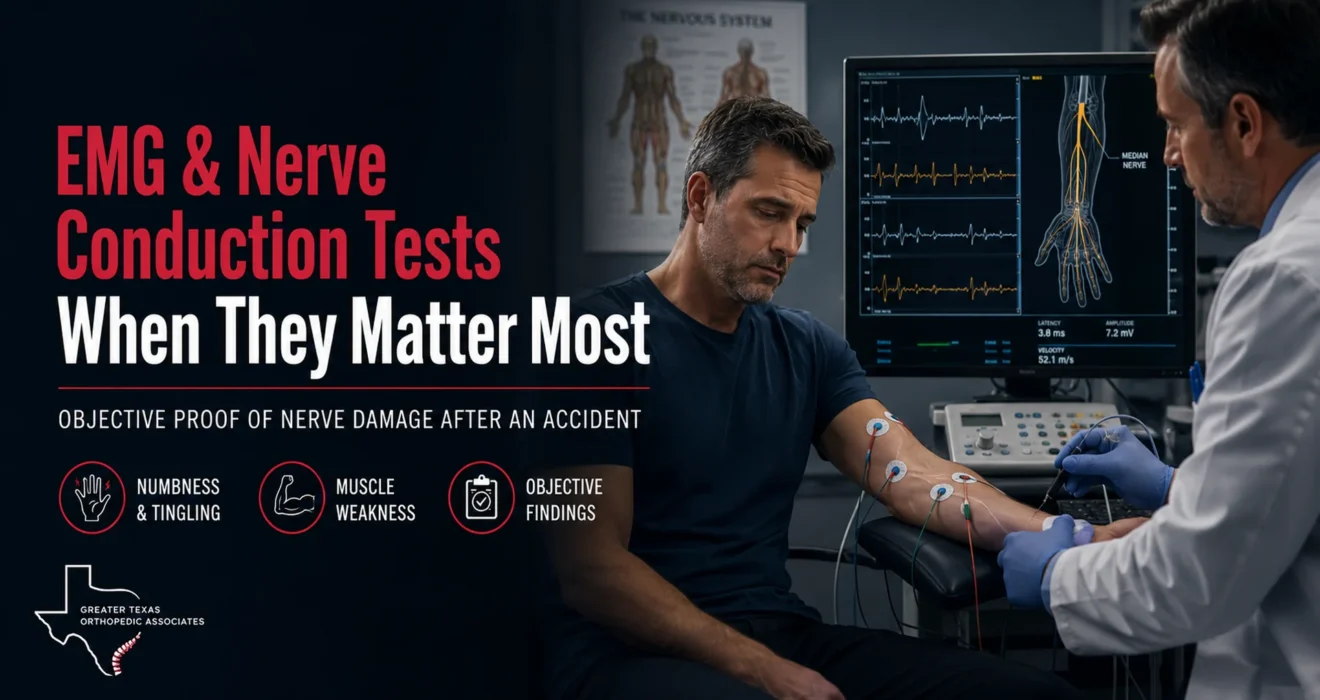
EMG & Nerve Conduction Tests: When They Matter Most
After a serious crash, pain is easy to see, but nerve damage often hides. Numbness in the hand, a weak grip, or a foot that drags can point to an injured nerve that a standard X-ray will not show. An EMG nerve conduction test after accident measures how well electrical signals travel through the nerves and muscles, giving providers a way to confirm what a patient is feeling.
For patients, the concern is why symptoms keep spreading long after the visible bruises fade. For attorneys, case managers, and legal teams, the concern is whether the medical record contains objective proof that a nerve was actually damaged in the event. This article explains what these tests measure, how they are used after trauma, and when the results carry the most weight.
What an EMG and Nerve Conduction Study Measure
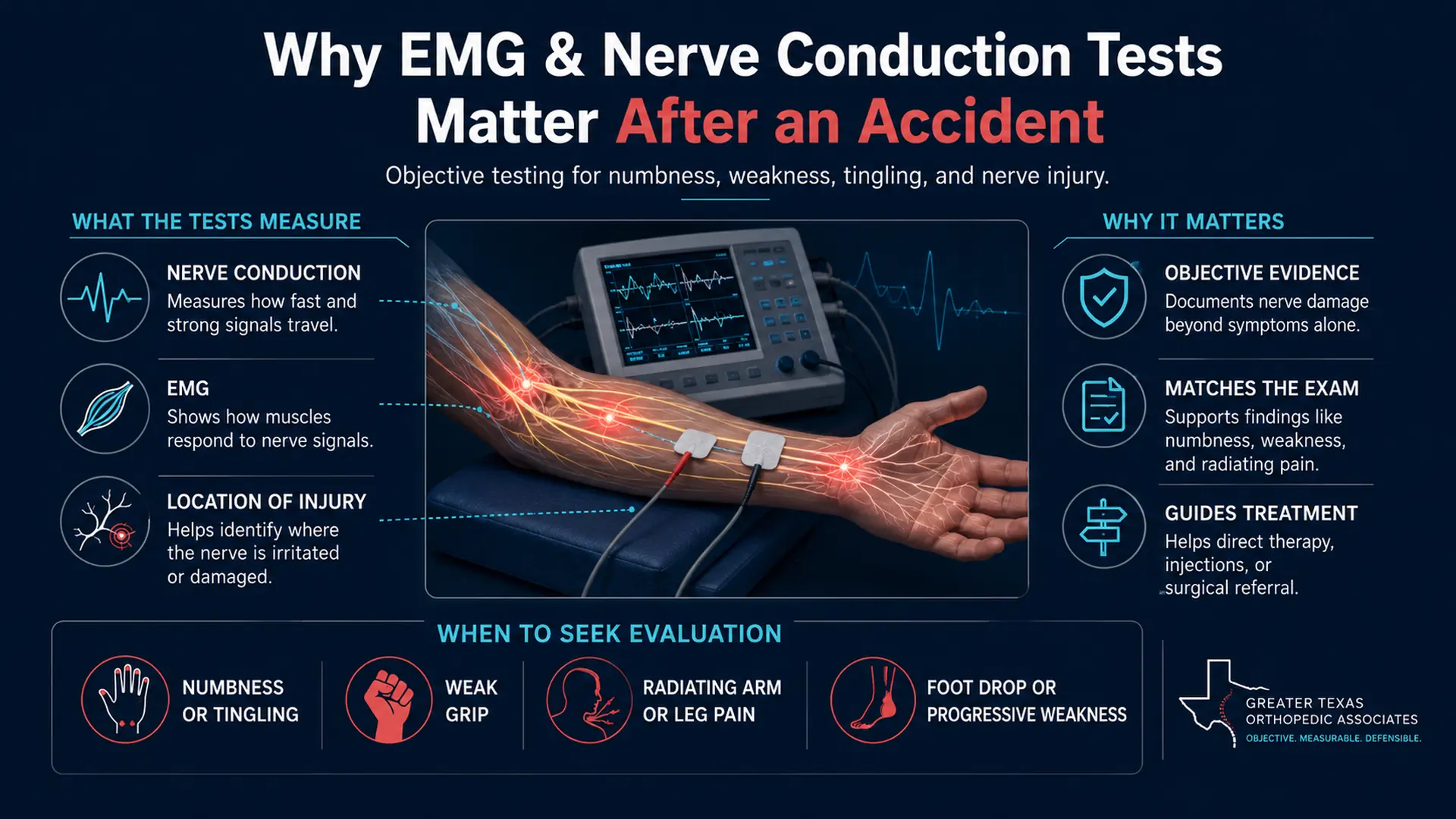
Two related tests are often ordered together. Electromyography (EMG) records the electrical activity inside a muscle, both at rest and during movement. A nerve conduction study (NCS) sends a mild electrical pulse along a nerve and times how fast and how strongly the signal travels. Together, they show whether a nerve is intact, irritated, or damaged, and roughly where the problem sits.
Consider a driver rear-ended at a stoplight in Houston. The neck feels stiff at first, which seems ordinary. A week later, the thumb and index finger stay numb, and the grip feels unreliable when lifting a coffee cup. That pattern, numbness in a specific finger group paired with weakness, is exactly the kind of finding these tests are built to explain.
What These Tests Mean in Plain English
Nerves work like electrical wiring. When a nerve is compressed or torn, the signal slows down, weakens, or stops reaching the muscle it controls. Based on Cleveland Clinic’s explanation of electrodiagnostic testing, a nerve conduction study measures the speed and strength of those signals, while the EMG portion checks how the muscle responds when the nerve fires. A nerve conduction study for injury can therefore separate a nerve that is merely bruised from one that has lost function.
This distinction matters because symptoms alone can be misleading. Radiating pain down the arm or leg may come from an irritated nerve root, which is a common finding in cases of lumbar radiculopathy after a crash or its counterpart in the neck. Testing helps confirm which nerve is involved rather than leaving the answer to guesswork.
Why it feels different from an ordinary strain
A pulled muscle tends to ease within days and stays in one area. Nerve injury behaves differently. The symptoms often follow the path of the nerve, so pain, tingling, or numbness may travel from the neck into the hand, or from the lower back into the foot. When symptoms spread along a line rather than staying in one spot, a nerve source becomes more likely, and electrodiagnostic testing becomes more useful.
How Nerve Damage Can Happen After a Crash
Trauma injures nerves through several mechanisms. The forces involved in a collision or a hard fall can affect a nerve directly or through the structures around it.
- A herniated disc pressing on a nerve root as it exits the spine
- Stretching or traction of a nerve when the head, arm, or leg is forced beyond its normal range
- Swelling and inflammation that compress a nerve inside a tight space
- Direct bruising of a nerve against bone during impact
- Scar tissue that forms during healing and tethers a nerve in place
Electromyography after a car accident helps identify which of these patterns fits the patient, because each one tends to leave a slightly different signature on the test.
Symptoms That Point Toward Nerve Testing
Not every ache calls for an EMG. Providers usually consider nerve testing when symptoms suggest the nerve itself, not just soft tissue, is involved. Persistent numbness, muscle weakness, or a burning, electric quality to the pain are common reasons for referral.
Red-flag symptoms that should not wait
- Progressive weakness in a hand, arm, or leg that keeps getting worse
- Numbness that spreads or covers a widening area
- Loss of grip strength or a foot that catches when walking
- Muscle wasting or visible shrinking in a limb
- Loss of bladder or bowel control, which is a medical emergency
Any of these signs deserves prompt evaluation. The last one in particular can signal serious spinal cord involvement and should be treated as urgent.
Why an EMG Nerve Conduction Test After an Accident Matters
This is where the focus on objective findings becomes central. Pain is real, but it is subjective, and a pain complaint by itself is difficult to verify. An EMG test for nerve damage produces measurable data: signal speed, signal strength, and the muscle’s electrical response. Those numbers do not depend on how well a patient describes the problem.
A thorough workup combines the physical exam and the testing. Range of motion, reflexes, strength grading, and sensory testing point toward a suspected nerve, and the electrodiagnostic study then confirms or rules it out. This layered logic mirrors how orthopedic causation in injury cases is established, tying a specific finding to a specific event rather than to guesswork. When the exam and the test agree, the clinical picture becomes far harder to dispute.
What the Test Results Can Show
The two parts of the study answer different questions, which is why they are usually paired.
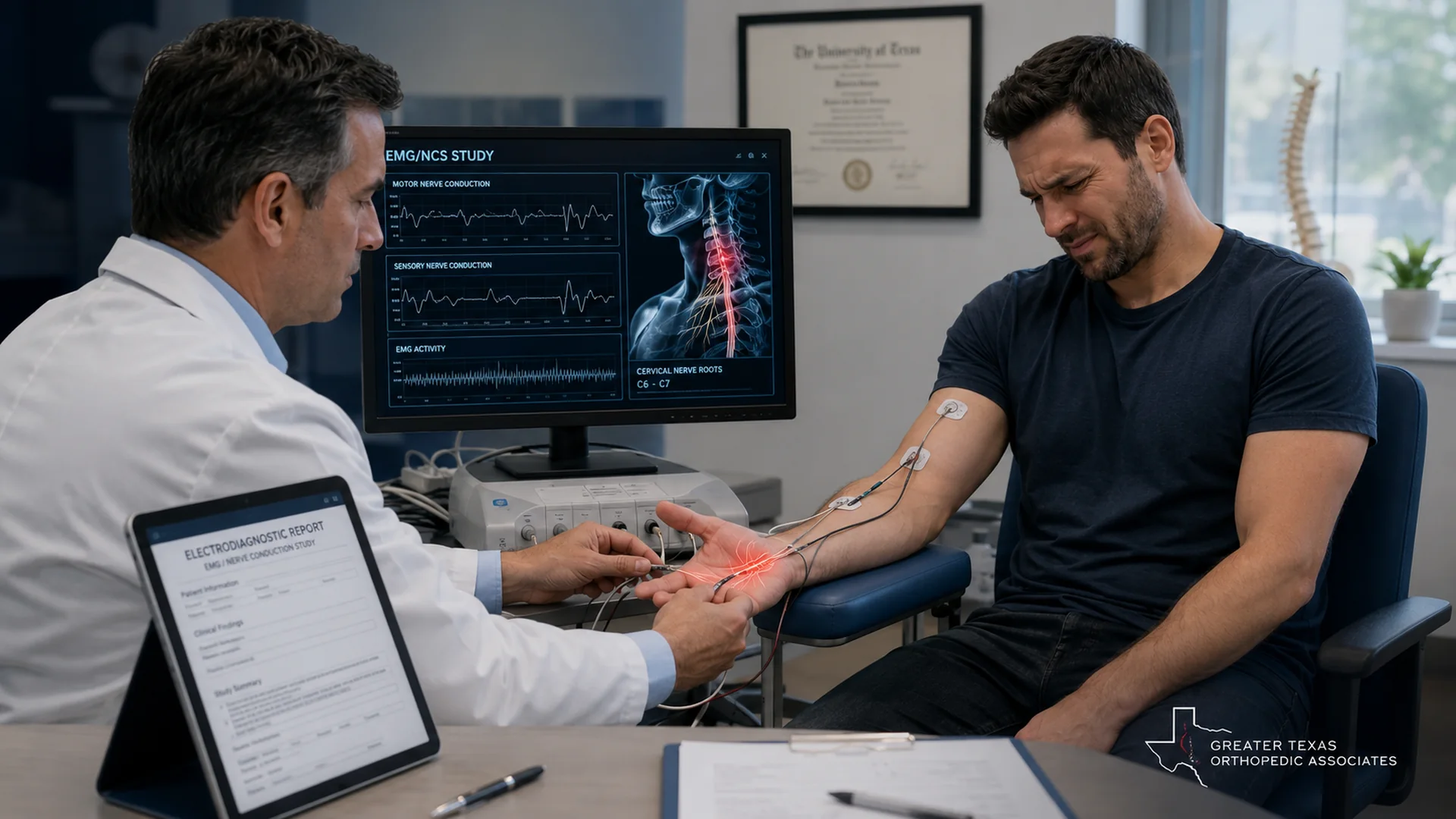
- Nerve conduction study: how quickly and strongly a signal moves along the nerve, which helps locate where a signal is blocked or slowed
- EMG: how the muscle behaves when the nerve fires, which can reveal damage that has already begun to affect muscle control
- Timing clues: certain changes appear only after days or weeks, so the timing of testing can hint at how recent the injury is
Why results must match the clinical picture
A test result means little on its own. It gains value when it lines up with the patient’s symptoms, the physical exam, and any imaging. A scan or a nerve study carries the most weight when it explains the exact symptoms the patient reports, not a symptom the patient does not have. Electrodiagnostic testing and imaging work best as a pair, each one checking the other.
Causation, Pre-Existing Wear, and Nerve Findings
Many people already have some age-related changes in the spine before a crash ever happens. That reality raises a hard question in injury claims: is the nerve problem new, or was it there all along? An EMG nerve conduction test after accident can help separate a fresh nerve injury from long-standing wear, because active nerve damage often produces findings that differ from chronic, stable changes.
Nerve testing rarely settles this question by itself, but it adds an objective layer that supports or challenges the rest of the record. Read alongside the physical exam and MRI findings in injury claims, it helps show whether the accident produced a new problem or simply brought an older one to the surface.
Treatment Paths After Nerve Damage Is Confirmed
Confirming the problem is the first step. Treatment then ranges from conservative to surgical, depending on severity.
- Activity modification and anti-inflammatory medication in milder cases
- Physical therapy to protect strength and range of motion
- Targeted injections for nerve-related pain and inflammation
- Repeat testing to track whether the nerve is recovering
- Surgical referral when compression is severe or weakness is progressing
AAOS notes that many nerve-related injuries improve with nonsurgical care, and surgery is generally reserved for cases that do not respond or that show worsening weakness. For complex spine and nerve injuries, care from a neurosurgeon such as Dr. Yi Michael Li can clarify whether decompression is warranted and what the timeline of recovery may look like.
When to Schedule an Evaluation
A single episode of numbness that clears within a day is usually not a cause for alarm. Symptoms that linger, spread, or come with weakness are a different matter and deserve a professional look, and cases pointing to the spine often benefit from neurosurgical spine and nerve care. Prompt evaluation also protects the medical record, since a clear timeline of when symptoms began and how they progressed is valuable for both recovery and any injury claim. With decades of combined experience, GTOA can evaluate lingering nerve symptoms, order the right testing, and document findings for patients and their legal teams.
FAQs About EMG and Nerve Conduction Testing
How soon after an accident should nerve testing be done?
Timing depends on the symptoms. Some findings only appear days or weeks after the injury, so testing too early can miss them. A provider usually decides the right window based on the exam, which is one reason a prompt first evaluation matters even when the test itself comes later.
Can these tests tell whether an injury is new or old?
They can help. Active nerve damage often looks different from long-standing, stable changes, which supports the effort to separate a fresh injury from pre-existing wear. The result is read alongside the exam and imaging, not in isolation.
What is the difference between an EMG and a nerve conduction study?
A nerve conduction study measures how signals travel along the nerve. Electromyography measures how the muscle responds when the nerve fires. Ordered together, they show both the wiring and the endpoint it controls.
Do normal results mean nothing is wrong?
Not necessarily. Nerve tests are sensitive, but some injuries, especially very early or purely painful ones, may not register. Normal results are one piece of information, and they are weighed against the full clinical picture.
Final Thoughts
Nerve injuries can be invisible on standard imaging while quietly disrupting strength, sensation, and daily function. That gap between how a patient feels and what a basic scan shows is exactly why electrodiagnostic testing exists. An EMG nerve conduction test after accident can document nerve injury objectively, locate where the problem lies, and help distinguish a new injury from older changes.
For patients, that clarity guides the right treatment sooner. For attorneys and case managers, it strengthens the record with measurable findings rather than symptoms alone. If numbness, weakness, or radiating pain continues after a crash or fall, Greater Texas Orthopedic Associates can evaluate the symptoms, coordinate the appropriate testing, and document what the results mean for the next step in care.
This article is for educational purposes and is not a substitute for individual medical evaluation.