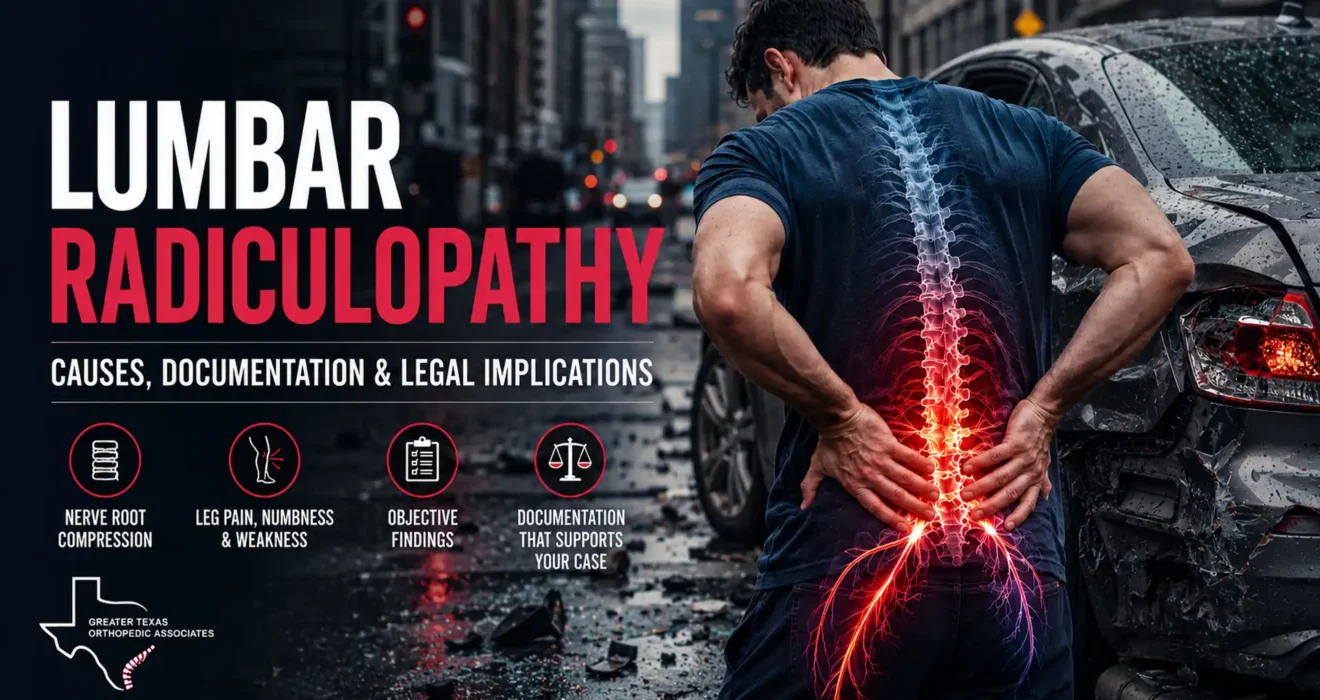
Lumbar Radiculopathy: Causes, Documentation & Legal Implications
Lumbar radiculopathy occurs when a nerve root in the lower spine becomes compressed or irritated, often sending pain, numbness, tingling, or weakness into the buttock, leg, or foot. After a car accident, this condition can be easy to miss at first because early soreness is often blamed on bruising, muscle strain, or general stiffness.
For patients, the main concern is why lower back pain has started to travel into the leg and whether the symptoms may improve or worsen over time. A careful orthopedic evaluation can help identify whether the symptoms are coming from a lumbar nerve root, document objective findings, and guide the next step in treatment.
The sections below explain how lumbar radiculopathy can develop after trauma, which symptoms deserve attention, how diagnosis works, and why timely documentation matters for both recovery and any related injury claim.
How Lumbar Radiculopathy Develops After a Car Accident
A driver rear-ended at a stoplight in Houston may walk away feeling only stiff and sore. Over the next few days, that stiffness can turn into a sharp, electric pain that travels from the lower back into one leg. By the end of the week, the leg may feel numb or weak, and sitting for long periods becomes difficult.
This pattern often points to nerve root involvement. When a disc, bone, or swollen tissue presses on a nerve where it exits the lower spine, the result can be pain that follows the path of that nerve. Understanding how a lumbar disc herniation develops helps explain why back pain after a car accident sometimes refuses to stay in the back.
What Lumbar Radiculopathy Means in Plain English
Lumbar radiculopathy is the medical term for a pinched or irritated nerve root in the lower (lumbar) spine. Based on Cleveland Clinic’s explanation, the problem develops when something compresses or inflames a nerve root, triggering pain, tingling, or weakness wherever that nerve travels. Because the lower spinal nerves feed the hips, legs, and feet, symptoms often appear far from the spine itself.
The lower back contains five lumbar vertebrae, labeled L1 through L5, stacked above the sacrum. Nerve roots exit between these bones. When the L4, L5, or S1 root is affected, pain frequently radiates down the back of the leg, a pattern many people recognize as sciatica.
Why It Feels Different From Ordinary Back Pain
Ordinary muscle strain tends to stay local. It feels sore, tight, and tender to the touch, and it usually eases with rest and gentle movement. Nerve-related pain behaves differently. It can feel sharp, burning, or electric, and it tends to travel, sometimes reaching the calf or foot. Tingling, numbness, or a sense that the leg is giving out points toward nerve involvement rather than a strained muscle.
How a Crash Can Injure a Lumbar Nerve Root
The forces in even a moderate collision can affect the lower spine in several ways. A lumbar nerve injury after a car accident does not require a dramatic, high-speed crash. Common mechanisms include:
- Disc herniation, where sudden loading pushes part of a spinal disc against a nearby nerve root
- Compression forces that narrow the small opening where a nerve exits the spine
- Aggravation of an existing disc bulge or arthritic change that was previously silent
- Swelling and inflammation in the days after the crash that crowd the nerve
- Small shifts in alignment that change how the spine bears load
Each of these can leave a nerve root irritated, even when the first X-ray looks unremarkable.
Symptoms to Watch After a Lower Back Injury
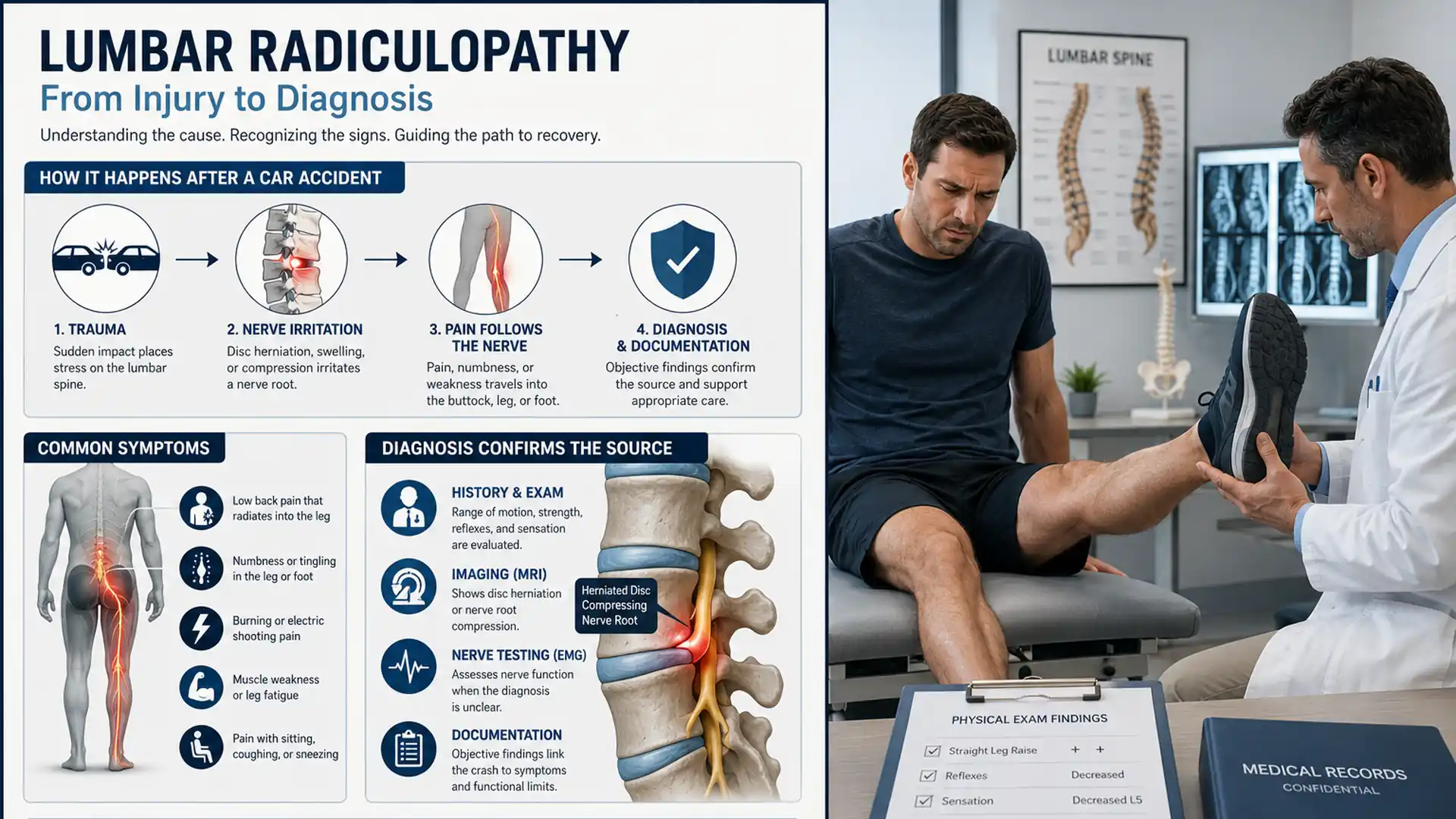
Symptoms vary depending on which nerve root is involved, but they tend to follow a recognizable pattern. Many people first notice low back discomfort, then realize the pain is reaching into the buttock, thigh, or calf. Leg numbness after a car accident, tingling in the foot, or a heavy, weak feeling in one leg are all common signals that a lower spinal nerve is involved.
When Leg Numbness After a Car Accident Needs Evaluation
Most nerve-related symptoms improve with appropriate care. Certain signs, however, call for prompt evaluation:
- Numbness or weakness that spreads or worsens over hours
- Difficulty lifting the foot or frequent tripping, sometimes called foot drop
- Loss of bladder or bowel control, which can signal a medical emergency
- Numbness in the groin or inner thighs, often described as a saddle pattern
- Severe, unrelenting pain that does not ease with changes in position
Loss of bladder or bowel control along with saddle numbness can indicate cauda equina syndrome, a rare condition that needs immediate emergency care.
Why Diagnosis Takes More Than a Pain Complaint
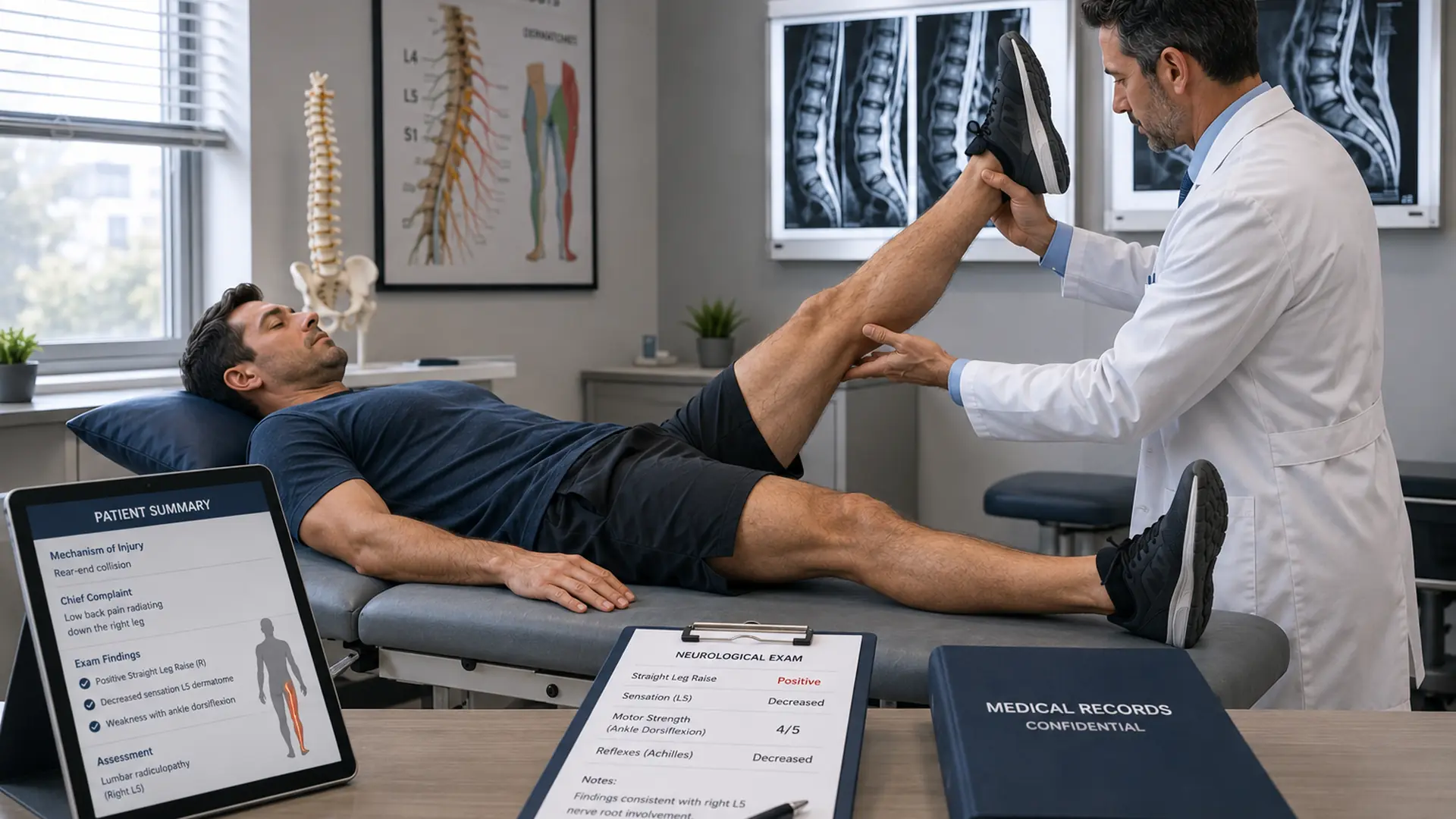
Pain is real, but on its own it is invisible. A clear diagnosis depends on objective findings that an examiner can observe and record. During an exam, a provider may check range of motion, muscle strength, reflexes, and sensation, and may use provocative tests such as the straight leg raise to reproduce the nerve pain in a controlled way.
These exam findings carry weight for both care and documentation. Objective medical findings that strengthen injury claims give a treating provider, and later any reviewer, a way to connect the reported symptoms to a measurable physical pattern.
What Imaging and Nerve Testing May Show
Imaging and nerve studies help confirm the clinical picture rather than replace it. Magnetic resonance imaging (MRI) is the most useful tool for seeing soft tissue, including discs and the nerve roots themselves. X-rays show bone alignment but not nerve compression directly, which is why a normal X-ray does not rule out a nerve problem. When the diagnosis is unclear, electromyography (EMG) and a nerve conduction study can measure how well the affected nerve is working. The guiding principle is that imaging must match the clinical picture, since a disc bulge on a scan means little unless the symptoms and exam point to the same nerve.
Causation, Degeneration, and Accident-Related Nerve Pain
Many adults have some degree of disc wear by middle age, often without any symptoms. This raises a common question after a collision: did the crash cause the nerve problem, or simply reveal something that was already there? The honest answer is often a mix of both, and that nuance matters.
A previously silent disc bulge can become painful when a crash adds force and inflammation. In documentation terms, this is the difference between a pre-existing condition and an accident-aggravated one. From an orthopedic perspective, the timeline of symptoms, the mechanism of injury, physical exam findings, and imaging results all help clarify whether the crash contributed to the patient’s current condition.
Treatment Options for Lumbar Radiculopathy
Most cases improve without surgery. The American Academy of Orthopaedic Surgeons (AAOS) notes that many nerve-related back conditions respond to nonsurgical treatment over a period of weeks. Care usually starts conservatively and advances only if symptoms persist:
- Activity modification and short-term medication to calm the initial flare
- Physical therapy to restore movement, build core support, and reduce nerve tension
- Image-guided injections, such as an epidural steroid injection, to lower inflammation around the nerve root
- Repeat exams to track strength, reflexes, and sensation over time
- Surgical referral when weakness progresses or symptoms do not respond to conservative care
At GTOA, pain management department specialists such as Dr. John Hall and neurosurgeons such as Dr. Yi Michael Li can coordinate this range of care.
Why Clear Medical Documentation Matters
Clear documentation helps show how symptoms developed, what objective findings were present, what imaging revealed, and how the condition affected the patient’s function. This matters for treatment planning and may also support any related injury claim.
Gaps in care, delayed evaluation, or records that list pain without exam findings can make the clinical picture harder to understand. Consistent, time-stamped documentation helps protect both the patient’s care and the accuracy of the medical record.
When to Schedule an Orthopedic Evaluation
Back pain that travels into the leg, numbness or tingling below the knee, or weakness that affects walking are all reasons to consider an evaluation rather than waiting it out. Symptoms that linger beyond a week or two after a crash, or that worsen, deserve a closer look.
A thorough orthopedic evaluation can clarify which nerve is involved, document the findings, and shape a treatment plan before the problem becomes harder to manage.
Final Thoughts
Lumbar radiculopathy is not just back pain. It is a specific pattern in which an irritated nerve root sends symptoms down the leg, and that pattern can develop quietly in the days after a car accident. Recognizing it early, confirming it through exam and imaging, and recording it carefully all matter for recovery and for any claim that follows.
If lower back pain, leg numbness, or weakness continues after a collision, Greater Texas Orthopedic Associates can evaluate the spine, document the findings, clarify whether the crash aggravated or caused the nerve problem, and guide the next step in care.
FAQs About Lumbar Radiculopathy
How long does lumbar radiculopathy take to heal?
Many cases improve within six to 12 weeks with conservative care, though recovery varies with the severity of the nerve compression and how soon treatment begins. Symptoms that persist beyond this window may call for further imaging or a specialist’s input.
Can a car accident cause lumbar radiculopathy?
Yes. A collision can herniate a disc, compress a nerve root, or aggravate an existing disc problem that had not caused symptoms before. Because swelling can build over days, the nerve pain sometimes appears after the initial soreness.
Is lumbar radiculopathy the same as sciatica?
They overlap but are not identical. Sciatica describes pain along the sciatic nerve, usually from an irritated L4, L5, or S1 root. The broader term covers any compressed or irritated nerve root in the lower spine.
Why does my leg feel numb after a car accident?
Leg numbness can occur when a lumbar nerve root is compressed or inflamed, interrupting the normal signals between the spine and the leg. It is a common sign of nerve involvement and is worth evaluating, especially if it spreads or comes with weakness.
Can lumbar radiculopathy get worse if untreated?
Yes, lumbar radiculopathy can worsen if nerve compression progresses or if weakness is ignored. Some cases improve with conservative care, but worsening numbness, increasing weakness, foot drop, or bladder and bowel changes require prompt medical evaluation.
This article is for educational purposes and is not a substitute for individual medical evaluation.