

Objective Medical Findings in Injury Cases
In a personal injury case, reported symptoms alone are rarely enough. For a claim to hold together, both medically and legally, those symptoms must be supported by objective medical findings: clinical evidence that can be measured, documented, and independently verified. Without them, the connection between the accident and the injury is far easier to dispute. This article explains what objective medical findings are, why they carry so much weight, and how proper documentation protects both the patient and the legal record.
What Are Objective Medical Findings in a Clinical Context?
Subjective findings are those reported by the patient, including pain, stiffness, fatigue, and dizziness, and while clinically useful, they cannot be independently verified. Objective findings, by contrast, are measurable, observable, and reproducible through physical examination, clinical testing, and diagnostic imaging. In a personal injury case, they provide the foundation for diagnosis, causation analysis, treatment planning, and prognosis.
Common Types of Objective Findings in Orthopedic Evaluations
The most clinically significant objective findings in injury cases include:
- Range of motion deficits measured in degrees.
- Muscle weakness documented through standardized strength testing.
- Positive provocative tests such as the straight leg raise or Spurling’s test.
- Neurological deficits such as reflex changes, sensory loss, and motor dysfunction, which indicate involvement beyond soft tissue.
- Imaging abnormalities on X-ray, MRI, or CT that correspond to reported symptoms.
- Edema, tenderness, and visible deformity on examination.
All of these can be recorded, remeasured at follow-up visits, and compared over time.
Why Objective Evidence Is Central to a Personal Injury Claim
Establishing Causation Between the Accident and the Injury
One of the most contested issues in any personal injury claim is causation. Proving that the accident caused or significantly contributed to the injury is rarely straightforward, and insurance companies and defense teams regularly challenge this connection, particularly with soft tissue, spinal, or nerve injuries. Objective medical findings answer the causation question in a way that subjective reports cannot. GTOA’s overview of orthopedic causation explains how imaging, examination findings, and mechanism of injury work together to build that clinical connection.
Quantifying Injury Severity in Measurable Clinical Terms
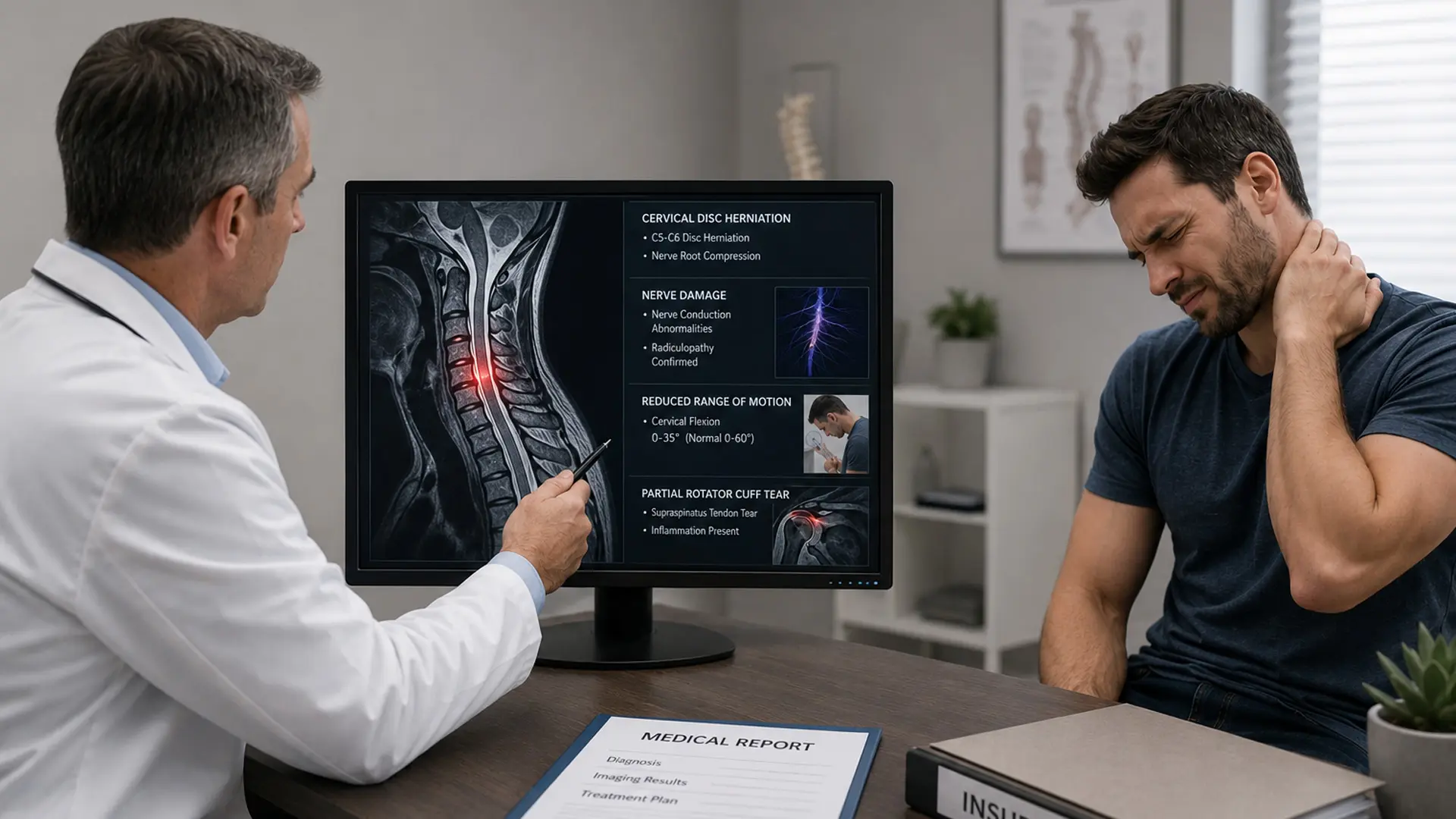
A patient describing pain as a “seven out of ten” gives the physician useful information, but it gives an adjuster or judge nothing measurable to evaluate. Objective findings translate severity into clinical language that carries weight in both medical and legal settings. A documented loss of 40 degrees of cervical rotation, a positive Neer’s impingement sign with MRI evidence of a partial rotator cuff tear, or electromyographic evidence of nerve conduction abnormalities each communicate severity in terms that are difficult to dispute.
Supporting Ongoing Treatment and Future Medical Needs
Objective findings justify the treatment a physician recommends. Documented deficits in strength and range of motion make the need for physical therapy, specialist referral, or interventional procedures clinically supported rather than speculative. For cases involving long-term impairment, findings that identify structural damage or nerve involvement help establish whether future surgery, injections, or chronic pain management is medically necessary and causally tied to the accident.
How Physicians Document Objective Findings in Injury Evaluations
Orthopedic evaluations should be structured to produce documentation that clearly captures objective clinical findings alongside the patient’s reported history. This approach ensures that the medical record is complete, defensible, and useful to everyone involved in the case.
Clinical History and Mechanism of Injury
The physician records how the injury occurred, when symptoms appeared, and how they have changed over time. Documenting the mechanism contextualizes the objective findings and provides the foundation for a causation opinion. An injury documented immediately after a rear-end collision with progressive cervical and radicular symptoms tells a very different story than one reported weeks later.
Physical Examination With Measurable Parameters
The examination documents range of motion values in degrees, strength grades on a standardized scale, sensory and reflex findings, and the results of specific provocative tests. All findings are recorded in a way that allows direct comparison at future visits. A reduction in lumbar flexion from 45 to 30 degrees is a clinical fact; a pain score change is not.
Diagnostic Imaging Correlation
The physician correlates imaging findings with examination findings. An MRI showing a labral tear means significantly more when matched to an examination demonstrating reproducible clicking, pain with loading, and reduced internal rotation. Imaging in isolation carries less evidentiary weight than imaging supported by corresponding physical examination findings.
Functional Assessment and Real-World Impact
The evaluation documents how the injury affects daily activities, work tasks, and self-care. Translating clinical findings into functional terms makes the record meaningful for legal review and helps establish the full scope of the patient’s impairment.
Causation Opinion Grounded in Objective Evidence
When appropriate, the treating physician provides a documented causation opinion based on the objective evidence, not the patient’s account alone. A causation opinion supported by imaging, examination findings, and a documented temporal relationship to the accident is far more durable under legal scrutiny.
Documentation Quality and the Medical-Legal Record
Why the Quality of Clinical Notes Shapes Case Outcomes
The strength of medical evidence in injury cases is shaped as much by how findings are recorded as by what is found. A note stating “patient reports pain, advised to follow up” contributes little to a legal record. A note documenting specific range of motion measurements, named provocative test results, correlating imaging findings, and a clear causation opinion tells a complete clinical story that can withstand scrutiny at any stage of the case.
The Problem With Documentation Gaps in Personal Injury Cases
Interruptions in the medical record can weaken even a legitimate claim. When objective findings are not documented consistently, it becomes harder to demonstrate how the injury progressed and whether it remained causally connected to the original event. This is why consistent follow-up matters as much as the initial evaluation.
When Objective Findings Are Not Immediately Present
Not every injury produces immediately visible objective findings, particularly in early-stage soft tissue injuries, whiplash-associated disorders, and certain nerve-related conditions. A patient with acute cervical strain may have a normal MRI in the first days after a collision, yet still have a legitimate and significant injury. Experienced physicians understand that findings evolve over time: serial examinations, repeat imaging when clinically indicated, and ongoing functional assessment often reveal deficits that were not apparent at the initial visit. Consistent follow-up is essential for both patient care and accurate medical-legal documentation.

Objective Medical Findings at Key Milestones in a Personal Injury Case
At the Initial Evaluation
The initial evaluation establishes the clinical baseline. It documents the injury’s status at the point closest in time to the accident, which is the most critical evaluation for causation. A thorough initial examination that captures objective findings in measurable terms creates the reference point against which all future evaluations are compared.
During Active Treatment
Objective findings documented throughout the course of treatment track measurable progress or plateau. They support justification for continued or modified treatment and demonstrate to insurers, attorneys, and courts that the patient’s care is medically driven rather than speculative.
At Maximum Medical Improvement (MMI)
The evaluation at MMI provides the final documented picture of what permanent deficits, if any, remain. Objective findings at this stage establish the extent of lasting impairment and directly inform the value of the claim. For a complete explanation of how maximum medical improvement is determined and why it matters in injury cases, see the GTOA article on MMI in orthopedic cases.
In Independent and Causation Evaluations
In independent medical examinations or causation-focused evaluations, objective findings provide the clinical basis for opinions regarding whether the injury is consistent with the reported mechanism, and whether pre-existing conditions were aggravated by the accident. These evaluations carry significant weight because they are grounded in measurable clinical evidence rather than patient narrative alone.
Conclusion
Objective medical findings are the foundation of a defensible personal injury claim. They connect symptoms to structure, mechanism to diagnosis, and treatment to need. The strongest medical records go beyond describing pain. They document measurable deficits, correlate imaging with examination, and provide a clinically grounded causation opinion that holds up at every stage of the case.
If you have sustained an injury in an accident and need a detailed orthopedic evaluation that produces clear, objective documentation, GTOA provides structured evaluations for both patients and personal injury attorneys throughout Texas.
Schedule an Orthopedic Evaluation →
Note: This article is intended for general informational purposes and does not constitute medical or legal advice. Patients should consult a qualified healthcare provider for evaluation and treatment of any injury.
FAQs About Objective Medical Findings in Injury Cases
What are objective findings in an injury case?
Objective findings are measurable, clinically verifiable signs identified during a physician’s examination or diagnostic testing, including limited range of motion, positive provocative test results, or imaging abnormalities, that support and document the presence and severity of an injury.
Why do insurance companies focus on objective medical findings?
Insurance adjusters and defense teams evaluate the medical record to determine whether reported symptoms are supported by clinical evidence. Objective findings provide measurable documentation that is harder to dispute than subjective pain reports alone, which is why they play a central role in how claims are evaluated and settled.
Can a soft tissue injury produce objective findings?
Yes. While soft tissue injuries may not always appear on early imaging, physical examination can identify objective signs such as palpable muscle spasm, restricted range of motion, positive orthopedic tests, and tenderness that are reproducible across visits. These findings carry meaningful clinical and legal weight even in the absence of structural imaging abnormalities.
How soon after an accident should I get an evaluation?
As early as possible. An evaluation close in time to the accident establishes the strongest baseline for causation and captures findings before they change. Delays in evaluation can introduce uncertainty about whether findings are related to the accident, and opposing parties will not hesitate to exploit that uncertainty.
Can a personal injury case proceed without objective findings?
It is possible, but significantly more difficult. Claims relying solely on subjective reports are more vulnerable to challenge. Strong objective evidence in a personal injury claim provides a more defensible foundation and typically produces a stronger outcome for the patient.