
Hip Labral Tear: Symptoms, Diagnosis, and Treatment
Hip pain after a fall, collision, twist, or repeated activity can be misleading. It may start as a deep pinch when getting into a car, a catch while turning, or groin pain that appears after sitting, pivoting, or climbing stairs. When that pattern keeps returning, a hip labral tear should be considered.
Labral pain can resemble a strain, back referral, bursitis, arthritis, or soreness after an injury. The key is not just where the pain occurs, but whether the symptoms, exam findings, imaging, and movement-related limitations point back to the hip joint.
For patients, the goal is answers and the right treatment path. For attorneys and case managers, the record needs to show how the injury happened, why the diagnosis fits, and how the condition affects normal function.
What Is a Hip Labral Tear?
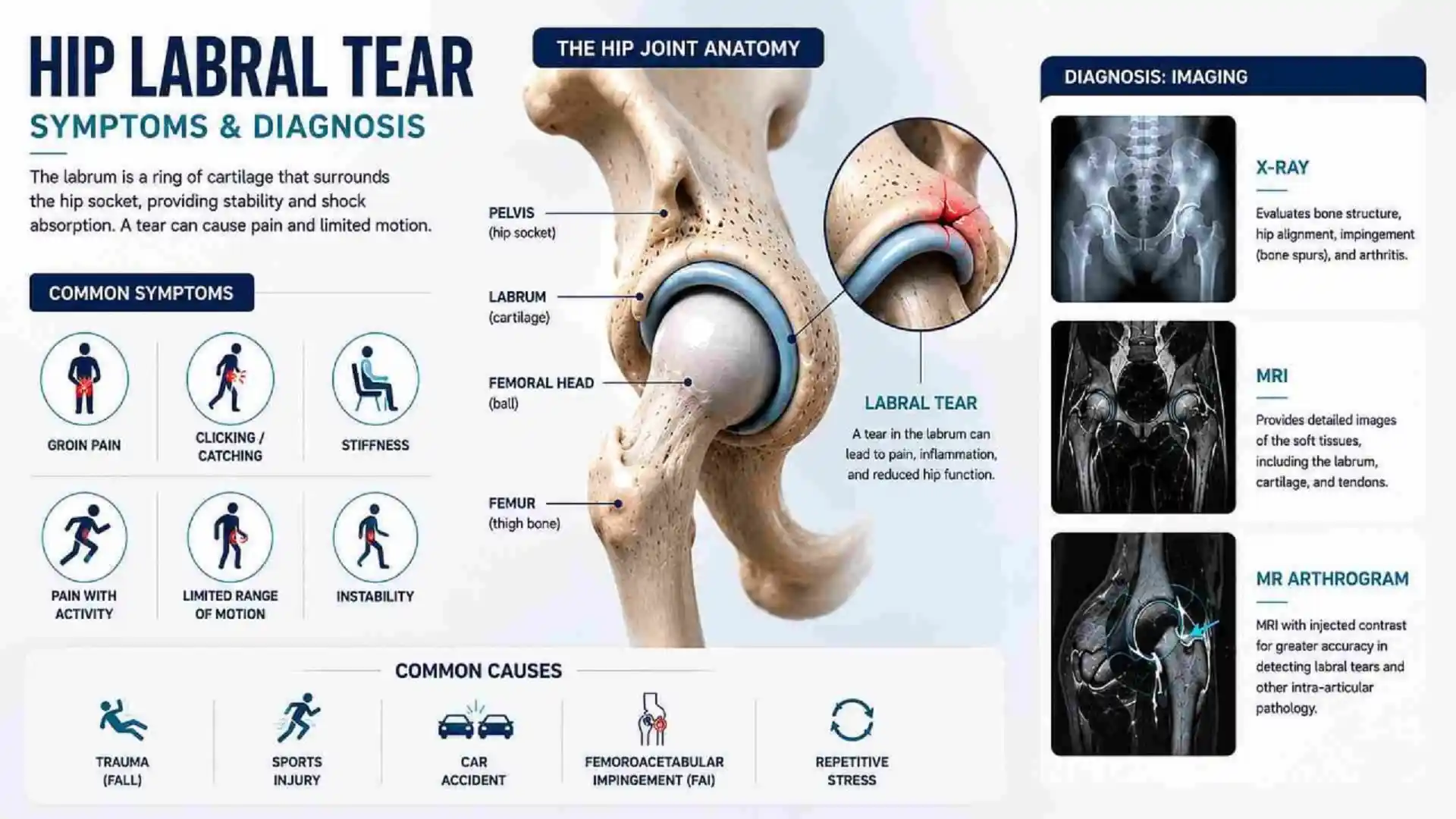
A labral tear involves damage to the ring of cartilage around the edge of the hip socket. The hip is a ball and socket joint. The labrum helps deepen the socket, support stability, and guide smoother motion as the femoral head moves inside the acetabulum. Based on Johns Hopkins Medicine, the hip labrum helps hold the ball and socket together, and tears may cause pain, limited motion, or locking.
Some tears happen after a specific injury, such as a car crash, fall, sports pivot, or workplace twist. Others develop over time because of repeated stress or hip mechanics. For patients whose injury needs to be evaluated in context, GTOA’s orthopedic evaluations for legal cases can help connect symptoms, objective findings, imaging, and function in a clinically clear way.
When the labrum is torn, the hip may catch, pinch, or feel restricted during sitting, squatting, pivoting, or getting out of a low chair.
Hip Labral Tear Symptoms Patients Often Notice First
Hip labral tear symptoms often feel deep rather than superficial. Patients may point to the front of the hip or describe pain inside the joint. Some feel clicking or catching. Others mainly notice stiffness, reduced range of motion, or pain that shows up only during certain movements.
Common symptoms include:
- Deep front hip pain, groin pain, clicking, catching, locking, stiffness, or painful pinching.
- Pain with pivoting, squatting, sitting, running, stairs, driving, or getting out of a low chair.
- A feeling that the hip is unstable, restricted, or not moving smoothly during activity.
Based on Cleveland Clinic guidance, labral tears may be linked to sports injuries, falls, car accidents, and repeated hip stress. That point matters because a patient may walk normally during a short exam but still have sharp pain when the hip rotates under load.
Groin Pain and Hip Labral Tear: Why the Pain Feels Deep
Groin pain related to a hip labral tear often feels deeper than a typical muscle strain. Patients may use a C-shaped grip around the front and side of the hip while describing pain with sitting, turning, or getting into a vehicle. That pattern becomes more significant when it is paired with clicking, catching, stiffness, or loss of motion.
Labral pain can overlap with hip flexor strain, low back referral, sacroiliac pain, bursitis, arthritis, or sports hernia. The trigger often gives better clues than the pain label; pain with repeated hip flexion and rotation deserves closer joint-based evaluation.
Why Hip Labral Tear Diagnosis Can Be Missed or Delayed
Diagnosis can be delayed because the first complaint is often vague. A patient may describe tightness, upper thigh pain, low back discomfort, or general soreness after a crash. If the hip pain becomes clearer only when the patient returns to driving, stairs, or work activity, the record should explain that sequence.
Based on Yale Medicine’s approach to hip evaluation, the process commonly starts with medical history, physical examination, and imaging when needed. A strong hip labral tear diagnosis looks at the overall pattern, not one isolated finding.
Hip Labral Tear Diagnosis: History, Exam, and Imaging
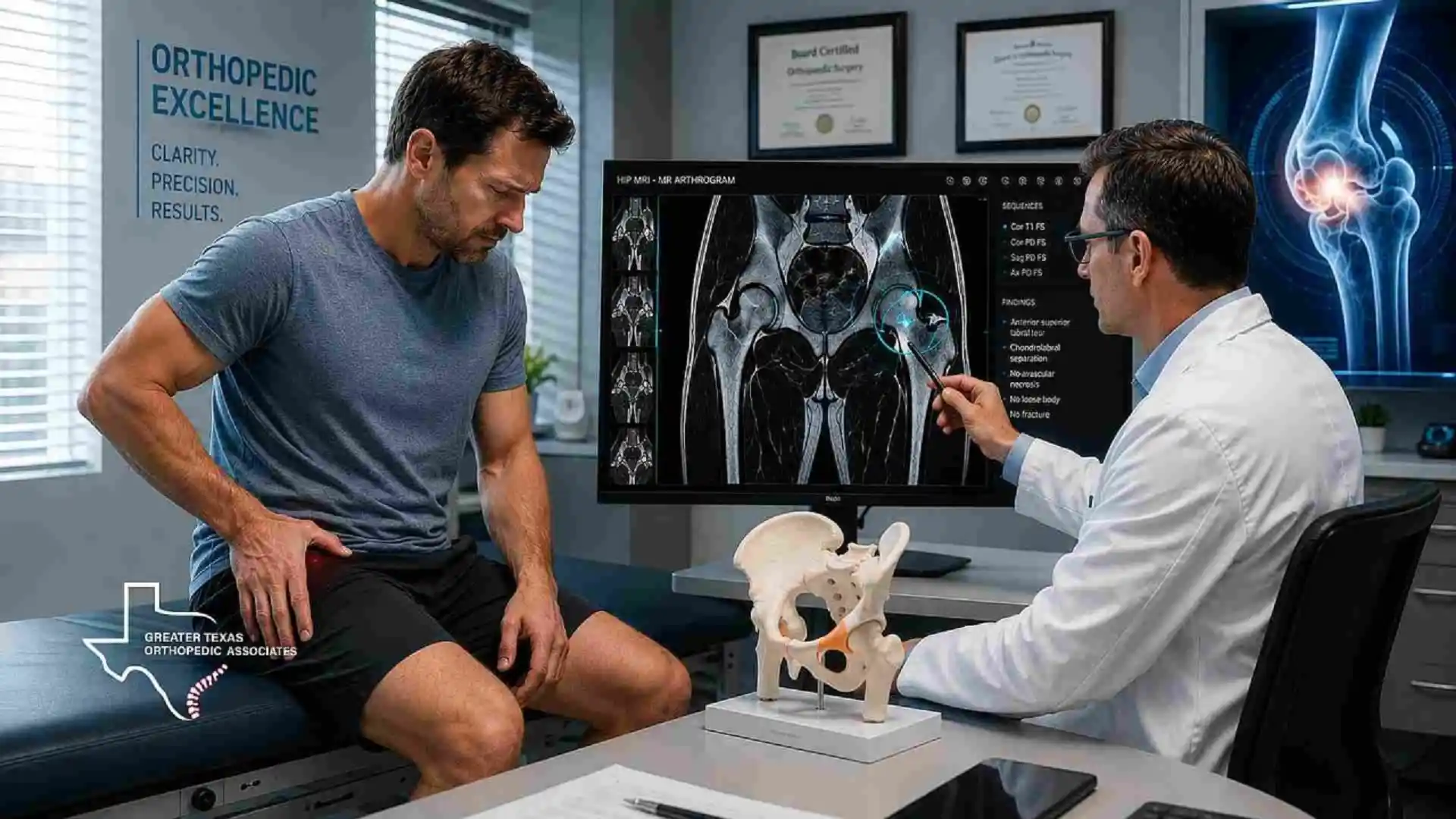
The review becomes stronger when the history, exam, and imaging point in the same direction. The clinician may evaluate gait, hip rotation, range of motion, strength, tenderness, and pain with provocative hip positions. X-rays may help assess bone shape, arthritis, or impingement. MRI or MR arthrogram may be used when the labrum or soft tissues need closer review.
A careful diagnostic review may include:
- When symptoms began, which movements trigger pain, and whether a fall, collision, or twist was involved.
- Range of motion, gait, hip rotation, strength, tenderness, and positions that reproduce groin pain.
- X-rays, MRI, MR arthrogram, or other imaging when the labrum or joint mechanics need closer review.
A diagnostic injection can help clarify whether pain is coming from inside the hip joint. If an image-guided intra-articular injection temporarily reduces deep groin pain or painful rotation, that response may support the hip joint as the pain source.
Common Causes of a Hip Labral Tear
Labral injuries may be related to trauma, repetitive stress, hip shape, instability, or degeneration. In an accident-related case, the hip may twist, jam, or flex suddenly. A driver may brace during impact, or a worker may twist while carrying weight, then later notice deep pain or catching.
One important structural cause is femoroacetabular impingement, often called FAI. Based on the American Academy of Orthopedic Surgeons, FAI occurs when extra bone growth gives the hip bones an abnormal shape, causing them to rub during movement. Over time, that friction can damage the labrum and nearby cartilage.
The cause matters because the same MRI finding can mean different things depending on whether the patient had a twisting injury, chronic impingement, or long-standing degenerative change. That is why hip labral tear diagnosis should not rely on imaging alone. Treatment should not only reduce pain but also address the mechanical reason the joint is being irritated.
Hip Labral Tear Treatment Options
Treatment should match hip labral tear symptoms, imaging, activity demands, hip mechanics, and response to conservative care. Not every tear needs surgery. At the same time, persistent joint pain, mechanical catching, and functional limitation should not be ignored.
Conservative Care Comes First When Appropriate
Conservative care may include activity modification, guided physical therapy, hip strengthening, mobility work, and anti-inflammatory medication when medically appropriate. Physical therapy often focuses on hip control, gluteal strength, core stability, and movement patterns that reduce painful pinching.
Treatment may include structured physical therapy, image-guided injections when the pain source is unclear, or hip arthroscopy when mechanical symptoms persist and imaging, exam findings, and function support surgery.
When deep hip pain continues despite activity changes or therapy, coordinated pain management and relief services may help patients manage symptoms while the orthopedic team continues to evaluate the source of pain, function, and next steps.
When Surgery May Be Considered
Surgery may be considered when pain persists despite appropriate conservative care, when catching or locking continues, or when imaging and examination support a treatable labral problem. Based on Mayo Clinic’s treatment guidance, surgery may involve removing damaged labral tissue or repairing the labrum with sutures, depending on the cause and extent of the tear.
The decision should not be based on MRI alone, especially when the diagnosis depends on symptoms, function, and exam findings. A stronger surgical discussion considers cartilage health, impingement, failed therapy, mechanical symptoms, and whether the patient’s limitations match the tear.
Why Documentation Matters After an Accident or Injury
After an accident, documentation can change how the hip injury is understood. A patient may first focus on back, neck, or knee pain, then notice deep hip pain once walking, stairs, or driving resumes. That does not automatically mean the hip problem is unrelated. The timeline needs to be clear.
Delayed Hip Pain Should Be Explained, Not Ignored
Delayed hip pain needs context. Adrenaline, multiple injuries, medication, reduced activity, or more severe pain elsewhere may hide the hip complaint early. If deep groin pain appears when normal movement resumes, the record should explain that pattern. GTOA discusses this same issue in orthopedic causation in personal injury cases, where timing, mechanism, imaging, and symptoms all matter.
In some patients, groin pain from a hip labral tear only becomes obvious after regular movement and weight-bearing activity returns.
The record should also describe how the symptoms affect sitting, stairs, pivoting, squatting, driving, lifting, or returning to sports.

The GTOA Perspective on Hip Injury Evaluation
At GTOA, hip pain is evaluated through the full clinical picture. The goal is to explain how the symptoms, imaging, and function fit together in the context of the injury.
Connecting Symptoms, Imaging, Mechanism, and Function
A strong report should not simply say “labral tear on MRI.” It should explain whether the tear fits the pain pattern, the injury mechanism makes medical sense, imaging matches the exam, conservative care helped or failed, and the condition affects function. The medical record becomes clearer for treatment decisions, injury documentation, and claim review.
Frequently Asked Questions
What does a hip labral tear feel like?
A hip labral tear often feels like deep pain in the front of the hip or groin. Some patients also notice clicking, catching, locking, stiffness, or a painful pinching sensation during movement. The pain may become worse with sitting, pivoting, squatting, climbing stairs, driving, or getting out of a low chair.
Can a hip labral tear cause groin pain?
Yes. A hip labral tear can cause deep groin pain because the labrum is part of the hip joint. Groin pain related to a hip labral tear may feel different from a muscle strain because it is often deeper and may be triggered by hip rotation, sitting, pivoting, or weight-bearing activity.
How is a hip labral tear diagnosed?
A hip labral tear diagnosis usually starts with a review of the patient’s symptoms, injury history, and physical examination. The clinician may evaluate hip rotation, range of motion, strength, gait, and positions that reproduce groin pain. Imaging such as X-rays, MRI, or MR arthrogram may be used when the labrum or hip joint needs closer evaluation.
Can a hip labral tear heal without surgery?
Some patients improve without surgery, especially when symptoms respond to activity modification, physical therapy, anti-inflammatory medication when appropriate, and guided rehabilitation. However, persistent deep hip pain, mechanical catching, locking, or functional limitations may require further orthopedic evaluation.
When should I see an orthopedic specialist for a possible hip labral tear?
You should consider seeing an orthopedic specialist if deep hip or groin pain continues after a fall, collision, twist, sports injury, or workplace accident. Evaluation is especially important if the pain is associated with clicking, catching, limited motion, difficulty sitting, trouble using stairs, or pain with pivoting.
Can a hip labral tear be missed after an accident?
Yes. A hip labral tear can be missed or diagnosed later because early symptoms may feel like general soreness, a hip flexor strain, low back referral, or another injury. In some cases, deep groin pain becomes clearer only after the patient returns to normal walking, driving, stairs, work activity, or exercise.
Why does documentation matter for a hip labral tear after an injury?
Documentation matters because the medical record should explain how the symptoms, injury mechanism, exam findings, imaging, treatment response, and functional limitations fit together. This is especially important after a fall, collision, or workplace injury where the timeline and cause of hip pain need to be clearly evaluated.
Conclusion
A hip labral tear should not be judged by one MRI finding or one pain complaint. The strongest medical picture comes from the overall pattern: when pain began, what movements trigger it, whether the symptoms match the exam findings, and how the injury affects normal function.
If groin pain related to a hip labral tear appears after a fall, collision, twist, or return to normal activity, the timeline deserves careful attention. A clear diagnosis can help separate joint pain from a strain, back referral, or general soreness.
For patients and legal teams, the next step is clarity. It is a focused orthopedic evaluation that connects symptoms, imaging, mechanism, treatment response, and function so the record better supports treatment decisions and injury documentation.