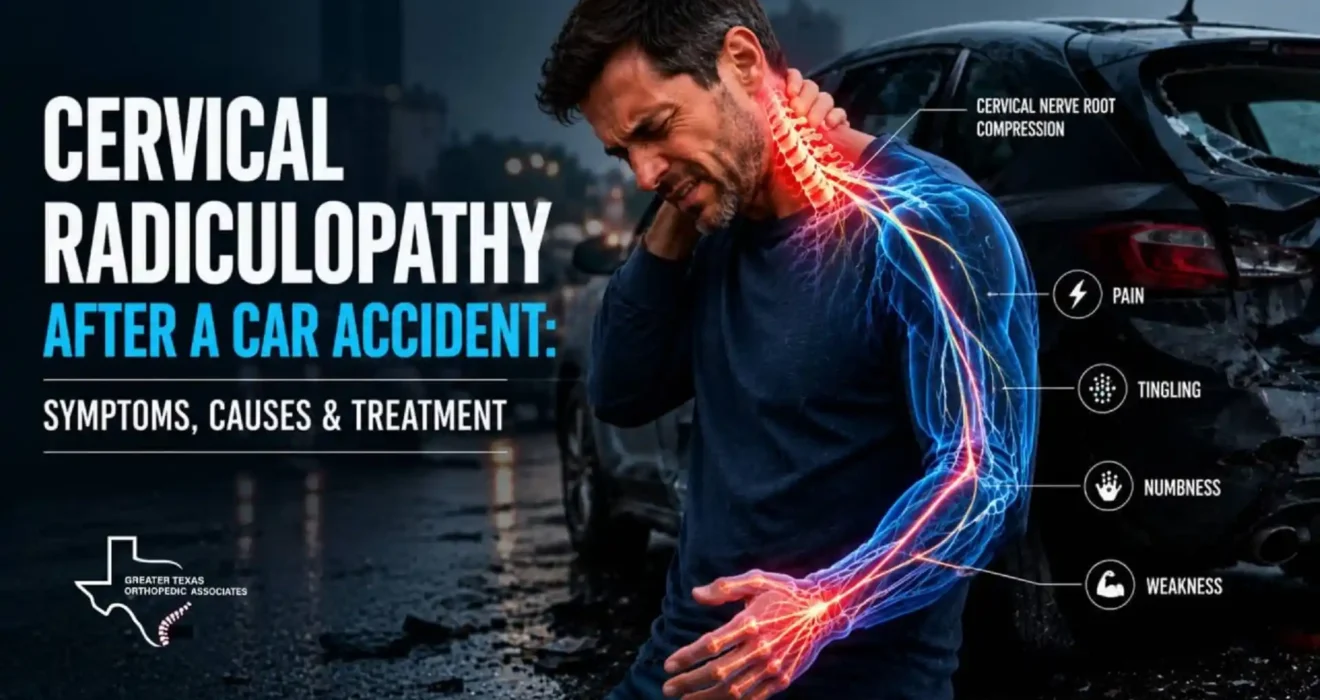
Cervical Radiculopathy After a Car Accident: Symptoms, Causes & Treatment
Cervical radiculopathy after car accident injuries can start as mild neck pain and later develop into radiating arm pain, tingling, numbness, or weakness. That pattern may become more concerning when burning pain, numbness, tingling, weakness, or grip changes appear days after the collision.
For patients, the concern is why a neck injury is affecting the arm. For attorneys, case managers, and legal teams, the concern is whether the medical record connects symptoms, crash details, exam findings, imaging, treatment need, and functional limits.
Cervical radiculopathy is more than ordinary neck soreness. It is a nerve-root condition that can affect sensation, strength, and daily function. Doctors look at whether the symptoms, exam findings, imaging, and daily limitations all point to the same nerve problem after the crash.
Cervical Radiculopathy After a Car Accident: Why Neck Pain Can Travel Into the Arm
A patient rear-ended at a red light may feel neck stiffness on day one, then notice arm pain, finger tingling, or grip weakness a few days later. That delay does not automatically make the symptoms unrelated. Nerve irritation can become clearer as swelling, guarding, and normal movement return.
A crash can force the neck through rapid movement, often described as whiplash. GTOA’s article on whiplash injury after a car accident explains why neck injuries after a collision may involve more than simple muscle soreness.
Early documentation can help explain how symptoms developed after the crash. When cervical radiculopathy after car accident is suspected, the medical explanation should connect the mechanism, symptom timeline, exam findings, and functional impact.
What Cervical Radiculopathy Means in Plain English
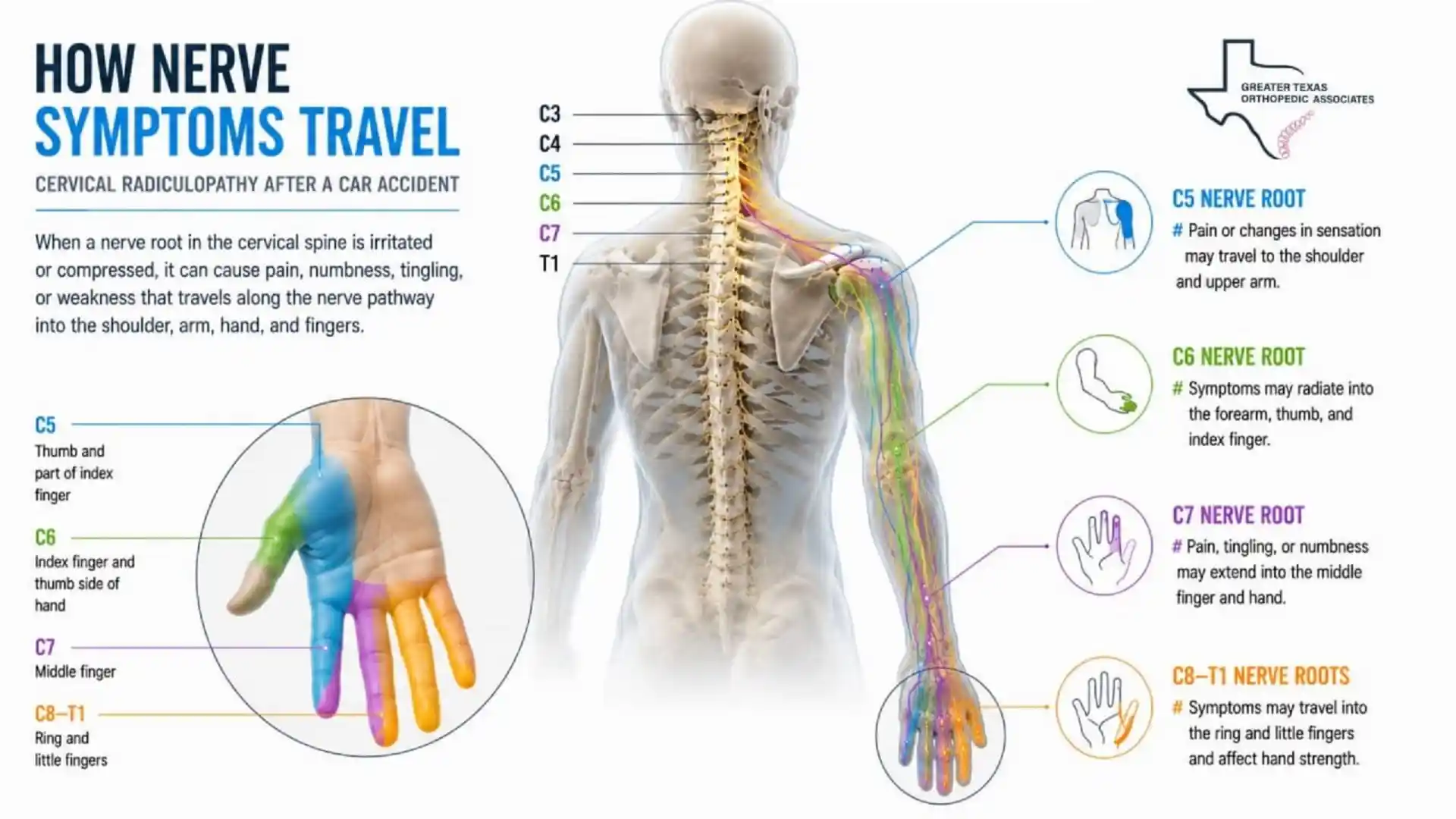
Cervical radiculopathy occurs when a nerve root in the neck is irritated, inflamed, or compressed. Based on Cleveland Clinic’s explanation, cervical radiculopathy can cause radiating pain, numbness, or weakness because the affected nerve root sends signals beyond the neck.
Cervical nerve roots leave the spine and help control sensation and strength in the shoulder, arm, hand, and fingers. If one nerve root is irritated, the pain may follow that pathway.
Why It Feels Different From Ordinary Neck Soreness
General neck soreness may stay in the neck and upper back. Radiculopathy often travels. A patient may describe electric pain, burning, numbness, or weakness that changes with neck position.
Pinched Nerve in Neck After Car Accident: How It Can Happen
A pinched nerve in neck after car accident can occur even when there is no fracture. Trauma may aggravate a disc, inflame tissues around the nerve, or make a previously quiet degenerative condition symptomatic.
Possible mechanisms include:
- Whiplash forces that inflame soft tissues around the cervical spine.
- A disc herniation or disc bulge that irritates a nearby nerve root.
- Foraminal narrowing that becomes painful after swelling or trauma.
- Facet joint or soft tissue injury that increases guarding and nerve sensitivity.
- Aggravation of pre-existing cervical degeneration that was not causing arm symptoms before the crash.
The explanation is stronger when symptoms, exam findings, and imaging point to the same nerve pathway.
Neck Pain Radiating to Arm After Car Accident: Symptoms to Watch
Neck pain radiating to arm after car accident may feel sharp, burning, heavy, or electric. Some patients first feel shoulder blade pain. Others notice numbness in the hand, tingling in the fingers, or weakness while gripping, lifting, typing, or driving.
When Tingling in Arm After Car Accident Matters
Tingling in arm after car accident is more concerning when it follows a repeated pattern, worsens with neck movement, or appears with weakness, numbness, or reflex changes.
Symptoms that deserve evaluation include:
- Pain traveling from the neck into the shoulder, arm, hand, or fingers.
- Numbness, burning pain, or tingling that travels into the hand or fingers.
- Grip weakness, dropping objects, or trouble lifting with one arm.
- Pain worsened by turning the head, looking up, driving, or sleeping position.
- Reduced reflexes, altered sensation, or limited neck range of motion.
Radiating arm pain is not always radiculopathy, but it is a reason to evaluate the cervical spine carefully.
Why Diagnosis Requires More Than a Pain Complaint
A patient’s symptoms matter, but the diagnosis is stronger when the clinical record shows objective support. This is where orthopedic and neurological examination becomes important.
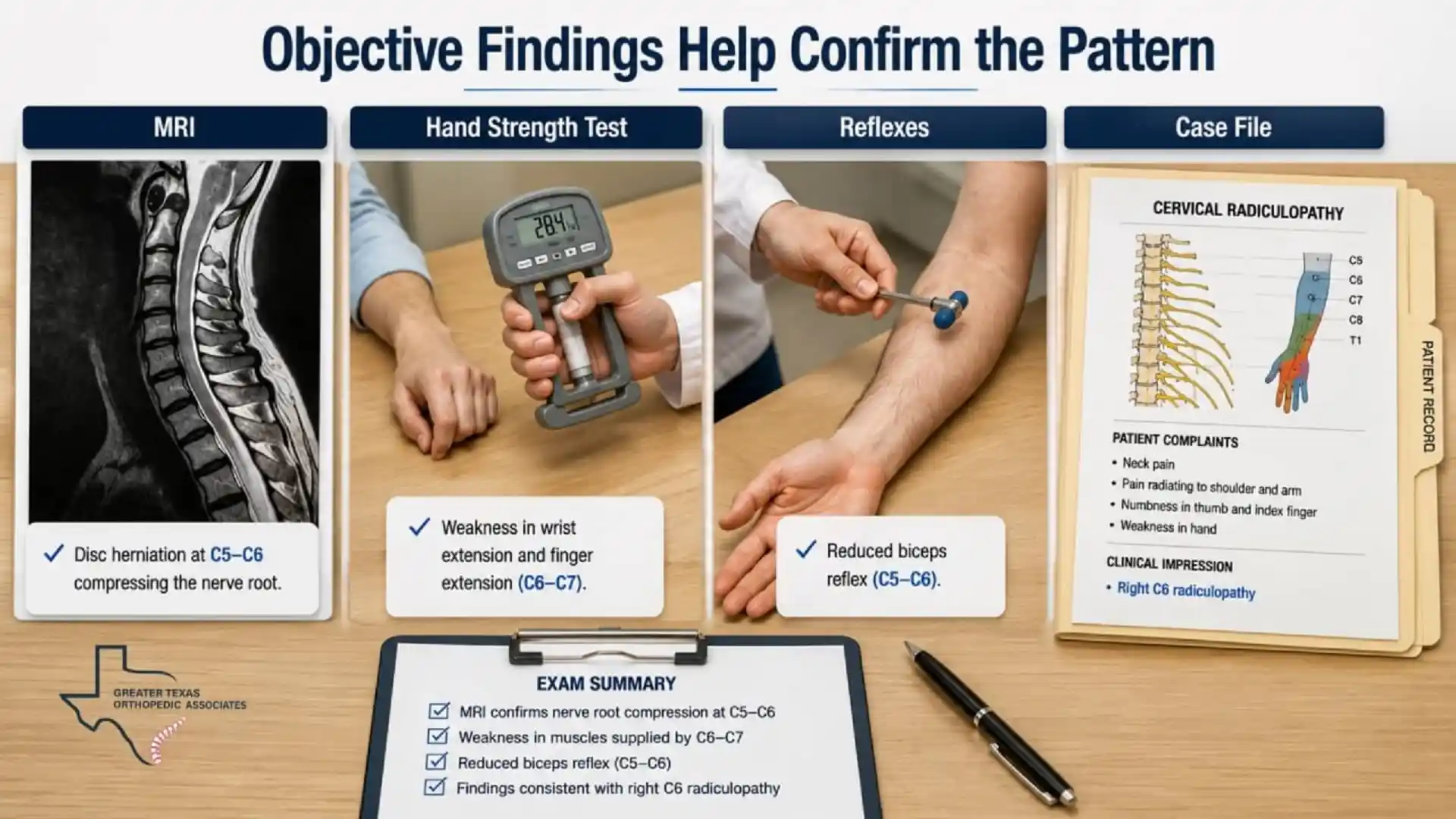
Objective Findings Help Confirm the Pattern
The exam may include cervical range of motion, strength testing, reflex checks, sensory testing, grip assessment, tenderness, posture, and Spurling-type provocative testing when appropriate. Findings such as weakness, sensory change, reflex asymmetry, or reproducible radiating pain can help support the diagnosis.
GTOA’s approach to cervical radiculopathy after car accident documentation focuses on objective findings that help clarify injury pattern, treatment need, and functional impact.
For attorneys and case managers, the condition becomes easier to evaluate when the record explains nerve symptoms, neurological findings, work limits, and response to care. A record that only says “neck pain” is weaker than one that shows how the symptoms affected strength, sensation, work duties, and daily function.
Imaging matters most when it helps confirm the same nerve pattern seen in symptoms, exam findings, and daily limitations.
What Imaging or Testing May Show
Testing is most useful when it answers a specific clinical question. Not every patient needs advanced imaging, and imaging alone does not prove the pain source. The value comes from matching test results to the symptoms and exam findings.
MRI for Cervical Disc or Nerve-Root Problems
X-rays may help assess fracture, alignment, or degenerative changes, but they do not fully show nerve-root compression. MRI may help evaluate disc herniation, disc bulge, foraminal narrowing, spinal canal narrowing, inflammation, or other causes of nerve irritation.
When EMG or Nerve Testing May Help
EMG or nerve conduction studies may be considered when nerve symptoms continue, when weakness is present, or when the diagnosis needs clarification. These tests can help evaluate nerve and muscle function.
Why Imaging Must Match the Clinical Picture
MRI findings can show age-related degeneration in people who had no symptoms before a crash. That does not automatically explain away new arm pain. The key is whether imaging, symptom timing, exam findings, and treatment response fit the same pattern.
Causation, Degeneration, and Accident-Related Nerve Symptoms
Cervical radiculopathy after car accident can raise causation questions, especially when imaging shows pre-existing degeneration. Degenerative findings are common. The medical question is whether the crash caused new symptoms, aggravated a prior condition, or made a previously quiet condition clinically significant.
Causation is clearer when the record explains the crash mechanism, symptom onset, neurological findings, imaging, treatment response, and functional limits. A patient who develops neck pain radiating to arm after car accident with documented weakness or sensory change presents a more specific medical picture than a patient with vague soreness alone.
GTOA’s discussion of orthopedic causation in personal injury cases explains how crash mechanism, symptom timing, and medical findings help clarify accident-related injuries.
Treatment Options for Cervical Radiculopathy After a Car Accident
Treatment depends on symptom severity, exam findings, imaging, and response to care. Not every patient needs surgery. AAOS explains that many cervical radiculopathy cases improve with nonsurgical treatment, although severe or progressive findings may require further intervention.
Treatment may include:
- Activity modification and medication to reduce pain, inflammation, or muscle spasm.
- Physical therapy focused on posture, mobility, strengthening, and nerve-sensitive movement.
- Pain management or epidural steroid injections when radiating pain persists.
- Follow-up exams to track strength, sensation, reflexes, range of motion, and function.
- Surgical referral when severe pain, progressive weakness, or structural compression supports it.
Cervical radiculopathy after car accident should be treated according to the clinical picture, not fear or assumption.
Why Documentation Matters for Patients, Attorneys, and Case Managers
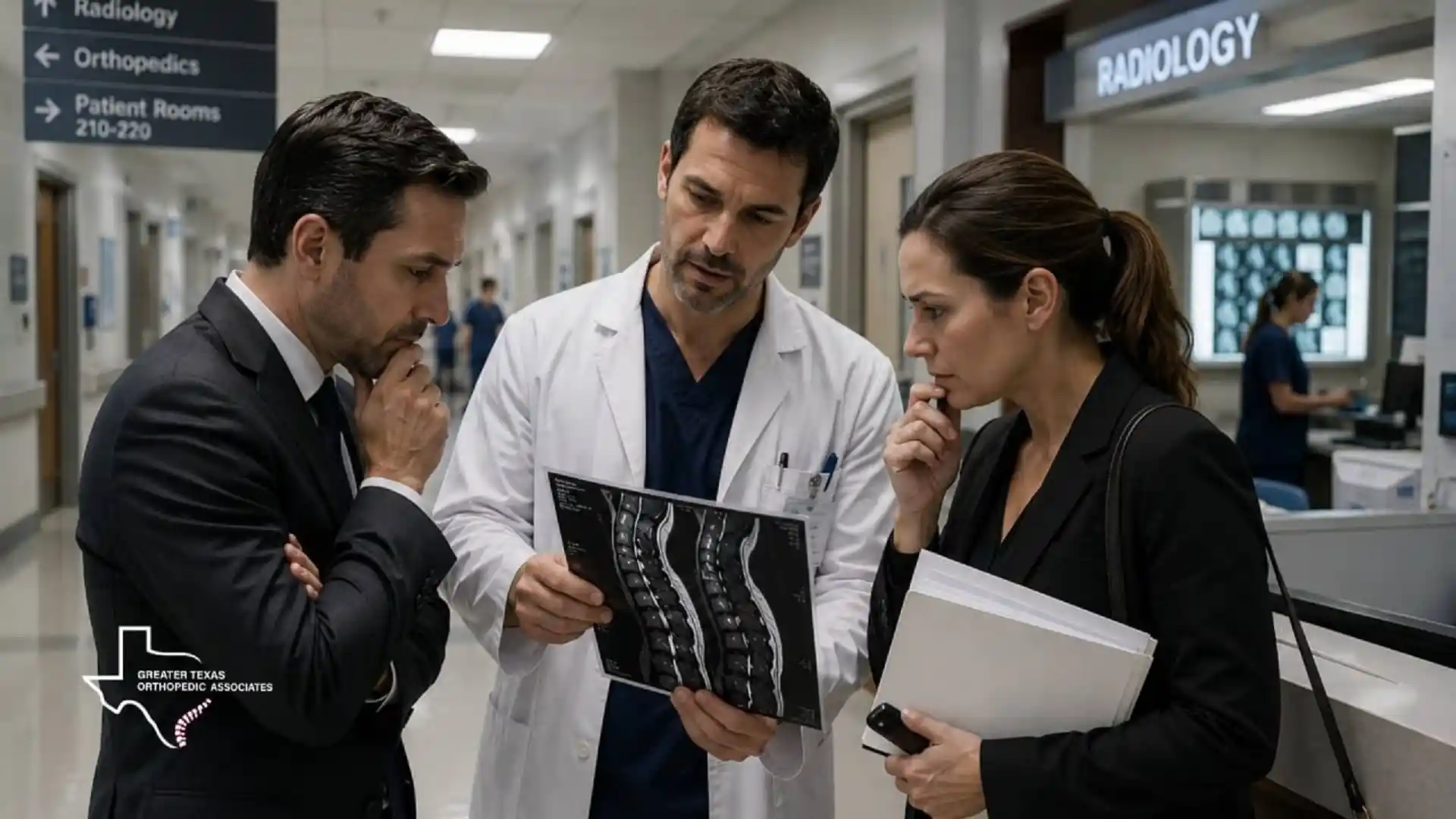
Good documentation helps explain the injury and support treatment decisions. For patients, it helps the care team understand what is improving, what is worsening, and what still limits daily life. For legal teams, it helps explain medical necessity, causation, restrictions, and future care considerations.
A strong record should describe arm tingling, radiating pain, weakness, exam findings, imaging decisions, treatment recommendations, and response to care. It should also document functional limitations such as driving, sleeping, lifting, gripping, typing, turning the neck, and working.
Insurers may oversimplify delayed nerve symptoms, normal initial X-rays, or degenerative MRI findings. A clear orthopedic record explains the medical context without exaggerating the injury.
When to Schedule an Orthopedic Evaluation
A patient should consider orthopedic evaluation when neck pain travels into the shoulder, arm, hand, or fingers, or when symptoms include numbness, tingling, weakness, burning pain, reduced grip, or worsening pain with neck movement.
For attorneys and case managers, referral may be appropriate when cervical radiculopathy after car accident is suspected but the record does not yet explain the symptom pattern, objective findings, causation, work limits, or treatment need. GTOA can evaluate the source of neck and arm symptoms, document neurological and orthopedic findings, and connect symptoms to the crash mechanism when clinically supported.
Final Thoughts
Cervical radiculopathy after car accident can explain why a neck injury causes pain, tingling, numbness, or weakness that travels into the arm or hand. The diagnosis is strongest when symptoms, neurological findings, imaging, treatment response, and daily limitations all point to the same nerve-root pattern.
That clarity matters for treatment, and it also helps attorneys and case managers understand whether the medical record supports injury causation and care needs.
If neck and arm symptoms continue after a crash, Greater Texas Orthopedic Associates can evaluate the source of pain, document objective neurological and orthopedic findings, clarify whether the injury pattern fits the crash, and guide the next step in care.