Loading article

Standing at the kitchen counter brings on your backache. For someone else, a walk ends when pain shoots into a calf. You both describe “back pain,” yet your clinicians may discuss different injections. These details guide an examination without establishing a diagnosis. Start by asking: which part of my pain is this injection meant to address?
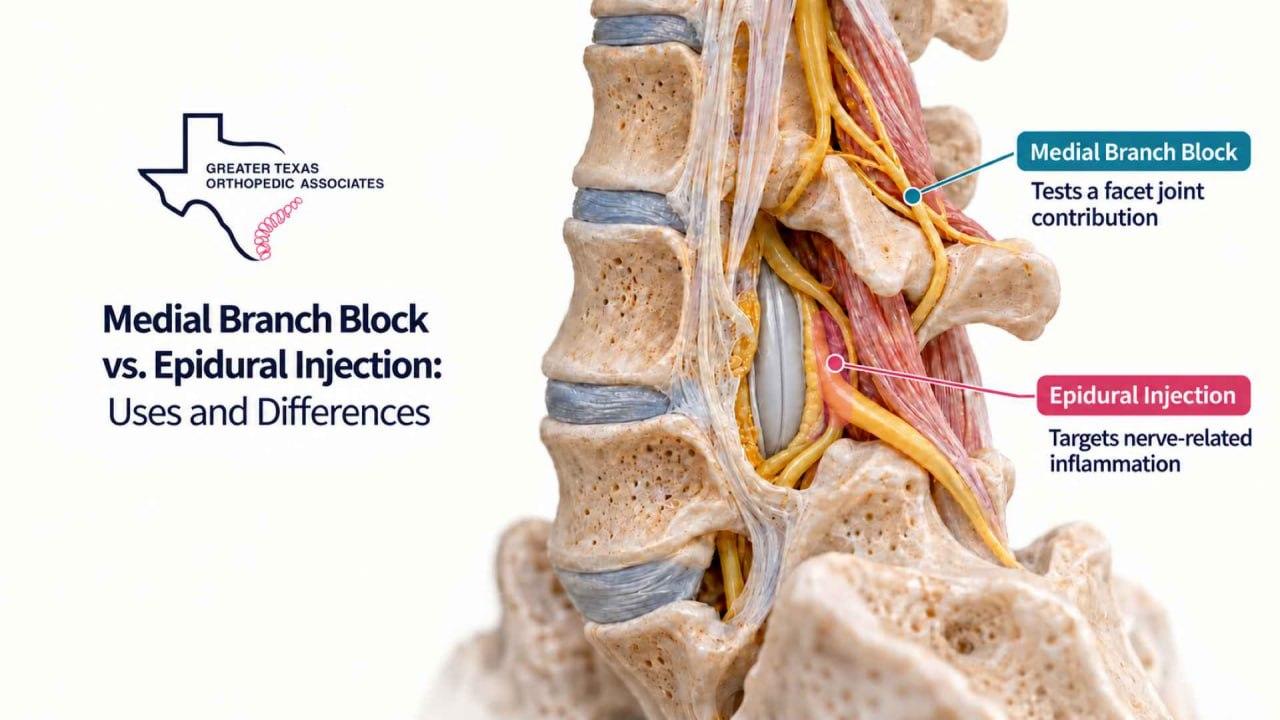
When comparing medial branch block vs epidural steroid injection, start with the purpose of each procedure. A medial branch block commonly tests whether spinal facet joints contribute to pain. An epidural steroid injection aims to reduce inflammation associated with selected nerve root symptoms. That distinction helps you judge the recommendation and, later, the result.
Facet joints sit at the back of the spine and guide movement. Medial branch nerves carry sensation from these joints. Spinal nerve roots connect with nerves extending into the arms and legs. A block places numbing medicine near selected medial branches; an epidural injection places medicine around spinal nerve roots. Neither targets every source of back pain.
The phrase facet pain vs nerve pain can be misleading because both types of pain involve nerve signaling. The more useful distinction is whether the suspected source is a facet joint or an irritated spinal nerve root. Joint-related pain may stay near the spine or be felt in nearby areas. Pain traveling along a nerve root’s distribution is called radicular pain.
Pain during standing, turning, or leaning backward can suggest a facet contribution. Shooting limb pain, tingling, or numbness can suggest nerve root involvement. Neither pattern is exclusive, and weakness deserves assessment. Muscles, discs, and other structures can also contribute to discomfort.
Describe what happens during ordinary tasks: where pain starts, how far it travels, and whether it limits walking, sitting, or sleep. Evaluating facet pain vs nerve pain means matching that account with an examination and relevant imaging. An MRI can show changes that do not explain your symptoms. Bring your symptom history to an evaluation at Greater Texas Orthopedic Associates so the discussion starts with what you experience.

For suspected facet-related pain, the medial branch block purpose is to temporarily numb selected nerves and observe what changes. The medication is placed near the medial branches, not directly inside the facet joint. Local anesthetic is central to a diagnostic block; steroid is not automatically part of the injection.
Brief relief after a diagnostic medial branch block does not necessarily mean the procedure failed. With a diagnostic block, the clinician may learn from that response even when pain returns. If familiar standing pain eases during observation, the timing and degree of change help assess a facet contribution. Lasting relief is not the immediate aim of this test.
Your clinician may use the response to assess whether radiofrequency ablation is worth considering. RFA uses heat to interrupt selected nerve signals and is a separate treatment. A helpful block does not guarantee that RFA will work or that you meet its selection criteria.
Medication spreading to neighboring tissues, sedation, and changes in activity can influence a block response. Guidance and coverage policies differ on relief thresholds and the number of blocks required. GTOA’s medial branch block guide offers procedure background; your clinician should explain the criteria used for your care.
The epidural space lies outside the protective covering around the spinal cord and nerve roots. An injection delivers corticosteroid into this space, sometimes with local anesthetic. The epidural steroid injection purpose is to reduce inflammation associated with selected nerve-related symptoms, such as radicular pain linked to a disc herniation.
One practical difference between the two procedures is the response being evaluated: evidence that a facet joint contributes to pain, or improvement in targeted nerve-related symptoms. An epidural injection does not mend a disc or reverse spinal narrowing. Some routes target a particular nerve root; others allow broader medication spread. Anatomy and safety help determine the approach.
The American Academy of Neurology’s 2025 review found modest short-term benefits for some patients with radiculopathy, while evidence for sustained pain relief was limited. Results differed for spinal stenosis, where narrowing crowds the nerves. Most evidence concerned the lower back; it cannot predict your individual response.
A 2025 BMJ guideline recommended against routine use of epidural injections for chronic non-cancer spine pain lasting at least three months, including chronic radicular pain. Finding some benefit and recommending a procedure are different judgments. Ask how the evidence applies to your diagnosis and symptom duration, and whether the likely benefit justifies proceeding.
Researching medial branch block vs epidural steroid injection does not commit you to either procedure. Persistent pain alone does not identify an injection target. Examination, treatment history, and daily limitations help determine whether an injection fits your care. Further evaluation or continued nonsurgical treatment may be more useful.
An injection can accompany physical therapy, appropriate medication, and activity adjustments. Set a practical goal, such as tolerating rehabilitation exercises, while recognizing that a diagnostic block tests a specific question. Discuss what changes in the plan if the procedure helps or fails, and your alternatives if you defer it.
Before treatment, identify the symptom being targeted and how the team will assess the response. Someone with both backache and leg pain may notice improvement in one without a change in the other. Be specific about what improved and what remained.
The follow-up plan should be clear before either procedure is performed. A block is assessed during the anesthetic’s expected effect. After an epidural injection, steroid benefit may take several days to appear. Immediate relief from any local anesthetic used does not establish the steroid’s effect. Ask when the team wants your report.
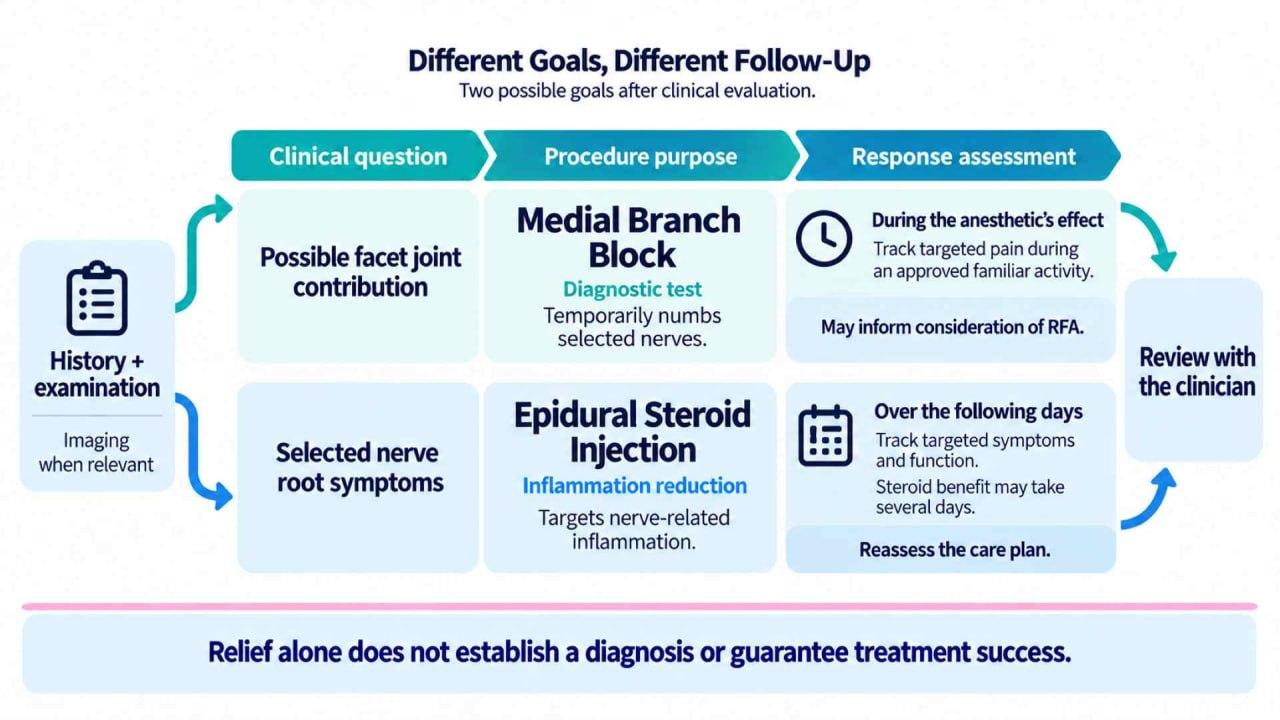
A diary supports the medial branch block purpose by connecting relief with the symptom being tested. If standing at the counter usually hurts, describe what changed during that same task, if the team approves it for observation. Record the timing and degree of relief as instructed. Avoid heavy lifting or movements you were told to restrict; the test does not require pushing through pain.
Tracking the targeted limb pain and an agreed activity keeps the epidural steroid injection purpose in focus. For example, record whether you can walk farther before that pain begins, rather than noting only that your back feels better. Follow individualized instructions about driving and work; being ready to leave the clinic does not establish the treatment’s effect.
Partial or absent relief warrants reassessment. The team may reconsider overlapping pain sources or other options. The clinician may reconsider whether the symptoms fit a facet-related or nerve-root pattern, but an injection result should not be interpreted in isolation. Repeating the procedure is not an automatic next step.
Before treatment, disclose medicines and supplements, blood thinners, allergies, possible pregnancy, and recent infection. Do not stop prescribed medication independently. If steroid is planned, discuss diabetes and glucose monitoring. Ask about image guidance and transportation requirements, particularly if sedation is planned. The team should give you procedure-specific preparation and recovery instructions.
When reviewing the risks of medial branch block vs epidural steroid injection, ask which apply to the planned medication and approach. Both carry risks of bleeding, infection, allergic reactions, and nerve injury. Epidural injections also carry a risk of headache from puncturing the protective covering. Steroid may affect blood sugar or sleep; rare serious neurological complications have been reported with epidural corticosteroids.
Corticosteroids are not FDA-approved specifically for epidural administration, so this use is considered off-label. Off-label use can still occur in clinical practice, but the expected benefits, alternatives, and risks should be discussed before consent. Ask for an explanation if any part of the recommendation remains unclear.
Mild injection-site soreness can occur, but certain new symptoms need urgent or emergency assessment after a spinal procedure.
Report fever, drainage, increasing redness, or a significant headache promptly; severe symptoms or neurological changes warrant emergency care. Ongoing stable pain calls for reassessment through your pain management pathway, including whether the original target still fits your symptoms and what to consider next.
Return to the kitchen counter or the walk that pain interrupts. A useful comparison of medial branch block vs epidural steroid injection should explain which symptom your clinician is addressing and why. Neither procedure follows automatically from where you feel pain. Before scheduling, agree on how the response will be assessed and what happens next if that everyday task is still difficult.
Still Unsure Which Injection Matches Your Symptoms?
Greater Texas Orthopedic Associates can evaluate your symptoms, examination findings, imaging, and treatment history to help determine whether a diagnostic medial branch block, an epidural steroid injection, or another approach may be appropriate.
A medial branch block is commonly used to test whether facet joints contribute to pain by temporarily numbing selected medial branch nerves. An epidural steroid injection is intended to reduce inflammation associated with selected nerve-root symptoms, such as radicular pain.
Not necessarily. When the block is being used diagnostically, the timing and degree of temporary relief can help the clinician assess whether a facet joint contributes to the pain. Lasting relief is not the immediate goal of the diagnostic test.
No. An epidural steroid injection may be used to reduce inflammation associated with selected nerve-related symptoms, but it does not repair a disc or reverse spinal narrowing.
Track the specific symptom and activity the procedure was intended to address, including when relief begins, how much the symptom changes, and what remains unchanged. Follow the instructions your treating team gives you for reporting the result.
This information supports informed discussion and does not replace individual medical evaluation. Your treating team’s instructions take precedence over general descriptions of preparation, recovery, or follow-up.
Every comment is reviewed before publication. Do not include medical details, personal identifiers, or information about an active claim. This form is not monitored for medical questions or emergencies.
Three more from the same thread.
Showing the first 3 of 3 articles
Comments are reviewed before they appear. For appointments, records, or medical questions, use the contact page.
No comments have been published on this article yet.