Loading article

An emergency note records full leg strength. Two weeks later, a specialist documents weakness when the patient lifts the foot. Is that a contradiction, a new deficit, or simply a more focused examination? The answer depends on which muscles were tested, when symptoms began, and what the clinicians actually wrote. For an attorney, neurological exam findings in injury records are most useful when read as a sequence of dated observations, not as isolated labels of “normal” and “abnormal.” This guide explains how to compare strength, reflexes, and sensation without turning a medical note into a diagnosis or a conclusion about causation.
A neurological examination can include strength, reflexes, sensation, gait, and coordination. A brief emergency screening and a later specialist assessment may document different details. Before comparing them, identify the components each clinician recorded. “Neurologically intact” offers less detail than named muscles, reflexes, and sensory areas.
If a note says nothing about ankle reflexes, it does not establish that they were tested and found normal. “Patellar reflexes 2+ bilaterally,” by contrast, records a specific comparison. The same distinction applies to sensation: “intact to light touch” is an affirmative finding, but its usefulness depends on whether the area examined is identified. In neurological exam findings in injury records, the first question is often whether two entries describe the same examination component at all.
An incomplete note is not proof of an abnormality. A later, detailed examination may add information without reversing an earlier finding.
Every comment is reviewed before publication. Do not include medical details, personal identifiers, or information about an active claim. This form is not monitored for medical questions or emergencies.
Three more from the same thread.
Showing the first 3 of 3 articles
Manual muscle testing usually grades performance from 0/5, no detectable contraction, to 5/5, normal strength against resistance as judged by the examiner. The grade describes performance during that test. It is not a numerical measure of pain, a complete account of function, or a stand-alone diagnosis of nerve injury.
When examining strength testing in medical records, ask which side, muscle group, and movement received the grade. “Upper-extremity strength 5/5” provides a broad summary. A later note specifying reduced ankle dorsiflexion addresses a different movement and may not conflict with it. Even a fully documented 5/5 result in a relevant muscle does not rule out intermittent symptoms, a painful orthopedic condition, or a problem outside the area tested.
A lower grade also requires context. Pain, guarding, a tendon or joint injury, difficulty following instructions, and neurological weakness can influence performance. If the record does not explain the limitation, its cause remains an open medical question.
Imagine a first note saying “leg strength normal” and a follow-up recording left ankle dorsiflexion at 4/5. The entries differ in specificity; they do not automatically establish worsening. A documented 5/5 for that same movement at the first visit would show a more direct change, although examination conditions still matter. This is the value of reading neurological exam findings in injury records longitudinally.
Deep tendon reflexes are involuntary responses assessed at particular sites. A note may use grades or words such as reduced, absent, brisk, or symmetric. A finding is more interpretable when the record names the reflex, states the side, and gives a comparison where appropriate. A reduced response in one location is not interchangeable with a generally reduced response on both sides.
For reflex findings after injury, look for the associated strength, sensory, and symptom pattern. A single diminished reflex does not establish when a condition began or what caused it. Some variation occurs between people and examinations; technique and the rest of the clinical picture influence interpretation. The medical question is whether the finding fits a coherent pattern that a clinician can evaluate, not whether an attorney can assign a diagnosis from a reflex grade.
If notes appear to disagree, check whether both examiners tested the same reflex and documented the same side. “Reflexes normal” and “left ankle reflex reduced” do not offer the same level of detail. A dated comparison can preserve both statements without pretending that the first note described an ankle-specific test. Neurological exam findings in injury records become more informative when the apparent discrepancy is described precisely rather than called proof that either clinician was wrong.
A patient may report tingling in two fingers, burning down a leg, or numbness that comes and goes. A clinician’s sensory examination records a response to testing at a particular visit. Both pieces of information belong in the record, but they answer different questions. An intact response during a brief office test does not establish that the patient never experienced an intermittent symptom.
Useful sensory exam documentation specifies the affected area, the side, and, when available, the kind of sensation tested. “Decreased sensation in the left foot” is more informative than “sensory deficit”; identifying a particular region and comparison side adds still more context. The wording should not be expanded into a specific nerve or spinal level unless the clinician’s assessment supports that interpretation.
Suppose an initial record describes intermittent hand numbness, while a follow-up says light touch was intact. The symptom may have been absent during testing, or a different area may have been tested. Dates, distribution, and the examination language determine what can be compared.
GTOA’s discussion of objective medical findings in personal injury cases explains the broader role of examination findings in injury documentation. This article addresses the narrower task of reading the neurological entries themselves. For neurological exam findings in injury records, a useful review begins with three checks:
These checks help prevent overinterpretation. A normal result documents the function tested, while an abnormal result does not independently establish diagnosis, causation, or outcome. Findings should be interpreted with the history and examination.
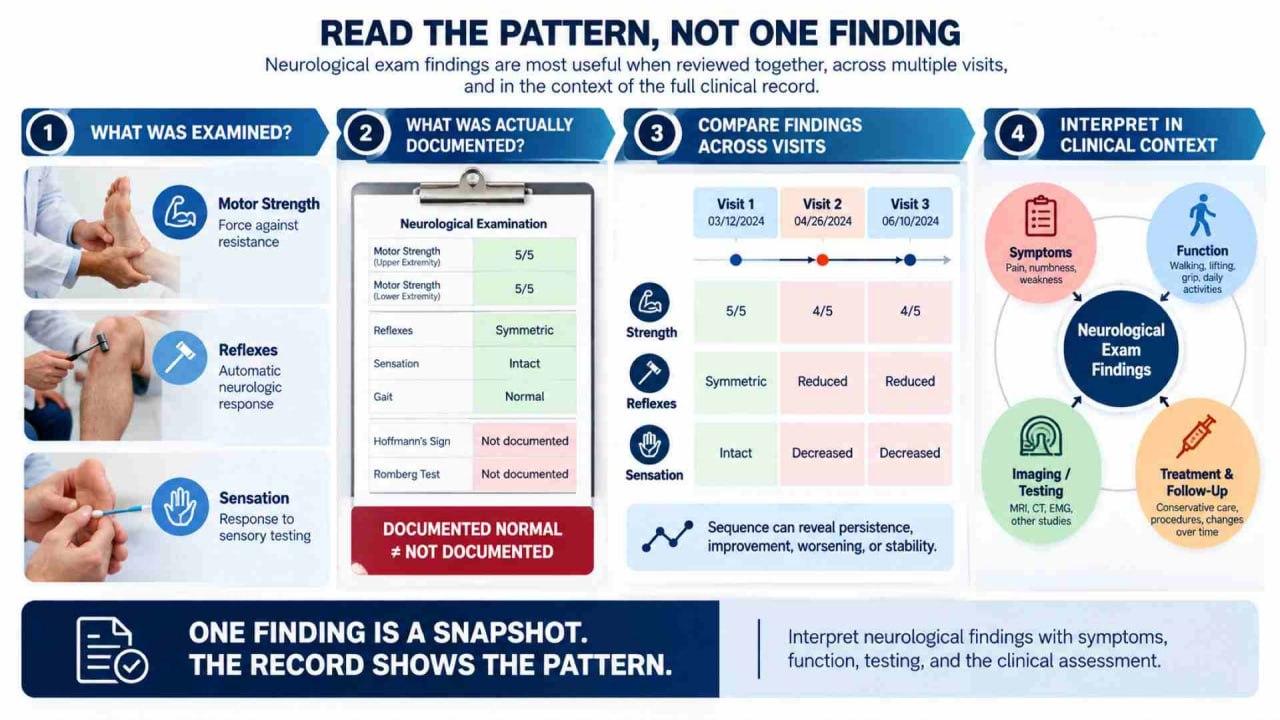
Functional limitations help explain why a neurological finding matters in daily life. For example, weak grip may affect lifting or carrying, while difficulty controlling the foot may interfere with walking or stairs. These reports provide important context but do not, by themselves, establish an objective motor, reflex, or sensory deficit.
Compare the tested movement with the activity the patient reports as difficult. Reflex and sensory findings are most useful when their location, timing, and relationship to other examination findings are clearly documented. Functional complaints provide context but should not be treated as proof of an objective neurological deficit.
Imaging and electrodiagnostic studies can add information when clinically indicated, but neither replaces the history and examination. An image abnormality does not automatically explain a reflex change. Likewise, a normal scan does not erase a documented functional problem. GTOA’s orthopedic evaluation service describes how examination and diagnostic information are considered together.

The chronology matters for care as well as documentation. In neurological exam findings in injury records, new weakness, worsening function, or spreading symptoms should prompt timely communication with the treating clinician. Sudden severe neurological symptoms, or new bladder or bowel dysfunction with relevant spinal symptoms, may require emergency assessment. An attorney should not classify such a development from paperwork alone or delay clinical review while resolving a records question.
The date a symptom was reported, a finding was first documented, and a clinician interpreted it can differ. In neurological exam findings in injury records, those dates should not be collapsed into one assumed onset.
If two notes seem incompatible, ask what differs. Was the same muscle tested? Was the complaint intermittent? Did a specialist examine an area missed in the first screening? With reflex findings after injury, was the same response compared on both sides? The clinician can resolve these questions in the full evaluation.
Precise questions are particularly useful when sensory exam documentation is vague or strength testing in medical records changes without an explanation. A case summary should quote the finding accurately, identify its date and source, and distinguish patient report from observed examination.
Final Thoughts
A careful review of neurological exam findings in injury records begins with what was actually tested. Match the side, location, method, and date before treating entries as a trend or conflict. Then consider symptoms and function alongside the clinician’s assessment. If documentation is incomplete or a finding has changed, identify the missing detail and seek appropriate clinical interpretation rather than drawing a diagnosis or causation conclusion from a single entry.
Need Clarification on Neurological Findings in an Injury Record?
Greater Texas Orthopedic Associates can review injury-related neurological findings in the context of the patient’s history, examination, imaging, and functional limitations, and help determine whether additional orthopedic or specialist evaluation may be appropriate.
No. A normal strength result documents performance in the muscles tested during that visit. It does not rule out intermittent weakness, pain-limited function, or a problem outside the area examined. The muscle group, side, movement, symptoms, and examination conditions all matter.
Different visits may test different reflexes, sensory areas, or levels of detail. Symptoms can also change over time. Compare the same side, location, and examination component before treating two entries as contradictory.
Contact a clinician promptly for new or worsening weakness, spreading numbness, or declining function. New bladder or bowel problems with relevant back or leg symptoms may require emergency evaluation.
Medical disclaimer: This article provides general educational information and does not replace an individual medical evaluation, diagnosis, or treatment plan.
Comments are reviewed before they appear. For appointments, records, or medical questions, use the contact page.
No comments have been published on this article yet.