Loading article


Changing pain ratings can look like recovery, deterioration, or contradiction in a chronology. For attorneys reviewing pain scores in injury records, the first task is to establish what each number describes before characterizing the patient’s course.
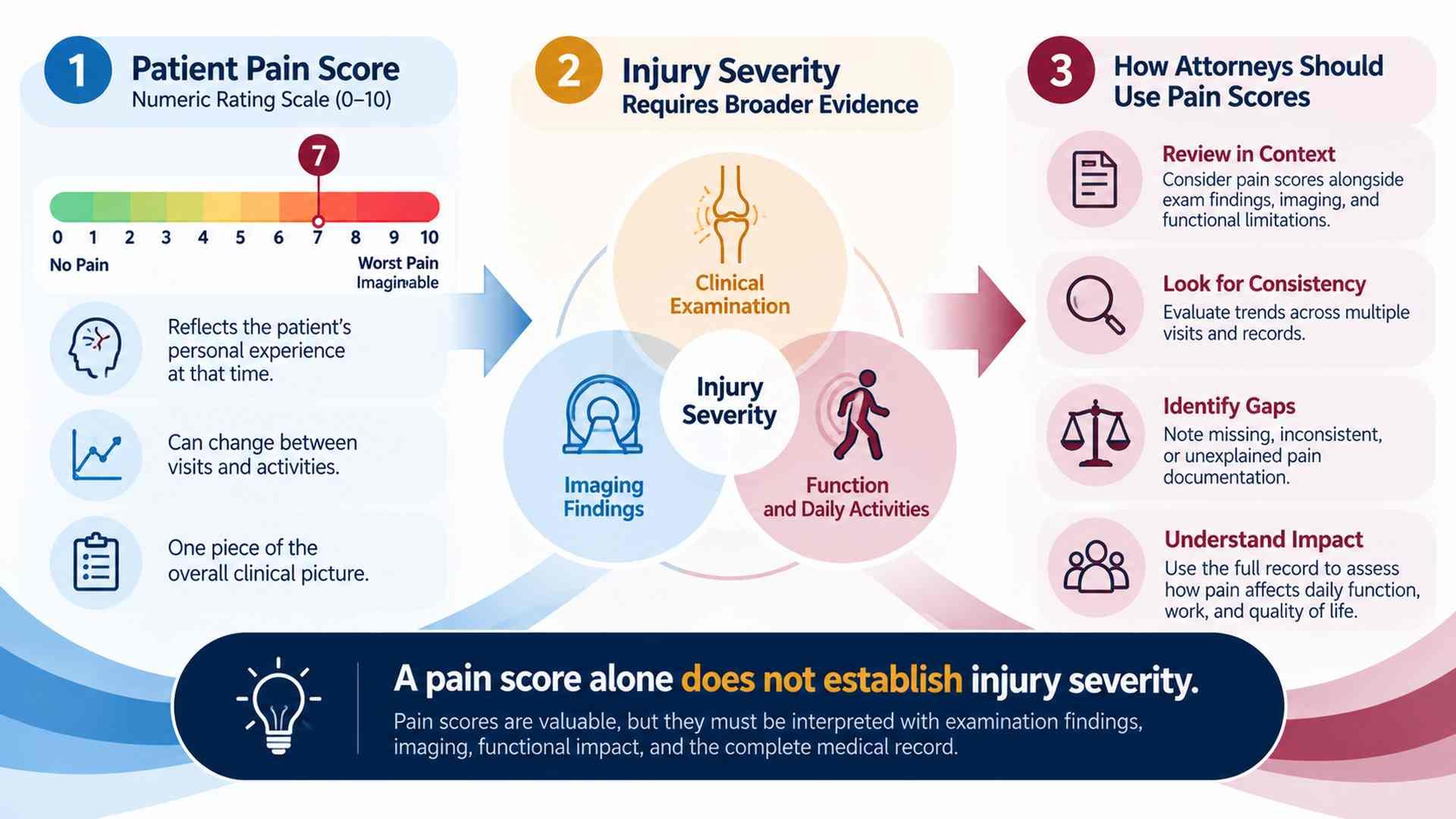
A pain score communicates the patient’s experience and can help track treatment response. It does not, by itself, establish tissue damage, credibility, or work capacity. Those conclusions require examination findings and functional information.
The familiar numeric rating scale usually runs from zero, meaning no pain, to ten, commonly described as the worst pain imaginable. Check the actual anchors and question. Current pain, worst pain during the past week, and average pain during that week are different assessments, even when all use the same numbers.
Scope is central to numeric pain rating scale limitations: a current rating for one body region answers a narrower question than an average covering several symptoms. When comparing ratings, keep the anatomical location and recall period with the result. An unlabeled score leaves those details uncertain.
The International Association for the Study of Pain describes pain as a personal experience shaped by biological, psychological, and social influences. Documented patient-reported pain scores therefore deserve to be recorded accurately. Psychological influences are part of pain assessment; their possible involvement does not establish that symptoms are invented.
Two people selecting six may describe different experiences. If an interpreter, caregiver, or observational assessment was involved, identify how information was obtained. Distinguish the patient’s selected number from a clinician’s estimate of distress.
Every comment is reviewed before publication. Do not include medical details, personal identifiers, or information about an active claim. This form is not monitored for medical questions or emergencies.
Three more from the same thread.
Showing the first 3 of 3 articles
Consider a hypothetical file involving persistent low back pain after an injury. At the first visit, the patient rates current back pain eight after a full work shift and reports stopping after five minutes of walking. At the second, the patient rates current back pain four while resting after medication and reports working shorter shifts.
A third visit records back pain six after increased activity. The patient reports walking fifteen minutes before stopping. Separately, the therapist documents observing a planned ten-minute walk completed without a break. Across these visits, the record shows changing assessment conditions alongside both reported and observed function.
A factual summary should preserve who reported each score, the assessment conditions, reported walking tolerance, observed performance, and reduced work hours.
The ten-minute observation establishes performance during that exercise, not maximum endurance. Comparing pain scores and daily function raises questions about restrictions and activity changes. Neither medication timing nor improved walking alone establishes treatment causation or sustainable full-day work capacity.
Distinguish assessments made under different conditions, comparisons with missing information, and entries that conflict about the same assessment. Each calls for context, an explicit limitation, or provider clarification.
A note containing only “pain 7” leaves body region, timing, and activity uncertain. Do not fill those gaps with assumptions. A blank field differs from zero; it establishes neither a denial of pain nor a completed assessment.
Suppose two sections of one encounter identify the same current back-pain assessment, before treatment, but one records two and the other eight. If no intervening reassessment is documented, the entries remain unresolved. Ask whether there were separate assessments, a transcription problem, or another explanation. The numerical difference alone cannot establish which entry is correct.
A series of sixes may reflect stable symptoms, rounding, or copied documentation; repetition alone cannot identify the explanation. Distinguish numeric pain rating scale limitations from charting problems, and examine assessment details before attributing the pattern to the patient or documentation process.
A reduction from eight to four is a four-point decrease, or fifty percent of the recorded baseline. That arithmetic does not establish an equivalent reduction in experienced pain or disability. Clinical interpretation requires the patient’s broader response.
A large study published in Pain in 2024 examined postoperative ratings and found that response categories were ordered but had unequal widths. Its postoperative setting matters: it was not a study of injury litigation or all chronic pain conditions. It supports caution about assuming equal intervals, rather than a universal formula for interpreting individual changes.
IMMPACT recommendations for chronic pain trials describe reductions of at least thirty percent as moderately important and at least fifty percent as substantial improvements in individual pain intensity. These benchmarks depend on clinical context; recognizing numeric pain rating scale limitations should not dismiss improvement the patient considers meaningful.
These benchmarks concern improvement in pain intensity, not a corresponding percentage recovery of work capacity or reduction in future care needs. When a note applies a threshold, identify the measure, baseline, and follow-up interval. Any conclusion about lifting, sustained sitting, or treatment duration needs its own supporting clinical information.
For chronic pain, the PEG instrument asks separately about average pain, interference with enjoyment of life, and interference with general activity. That separation helps explain why patient-reported pain scores should be considered alongside interference measures. Neither supplies the detailed task demands needed to decide whether someone can resume a particular job.
Useful descriptions of pain scores and daily function specify the task and its limits. “Returned to work” may mean modified duties, shorter shifts, or assistance with lifting. “Tolerated sitting” could describe a brief examination rather than prolonged desk work. Preserve duration, load, assistance, and the source of the information whenever the record provides them.
GTOA’s article on functional capacity evaluations in personal injury cases explains how structured testing can document demonstrated abilities. Such testing may add information when clinically appropriate; it should not be inferred from an office pain score. Keep patient descriptions, observed task performance, and prescribed work restrictions separately identifiable in the chronology.

Treatment timing also affects interpretation. Immediate relief after a procedure, relief lasting through the evening, and improvement maintained at later visits describe different outcomes. GTOA’s pain management service describes reassessment of pain, range of motion, and function. A useful follow-up note explains what changed and how that affected the plan.
Where pain scores and daily function diverge, describe the divergence precisely. Less pain during reduced activity leaves different questions from persistent pain during improving activity tolerance. Examination findings and imaging provide further clinical context, but a normal scan does not negate pain, and an abnormal scan requires clinical interpretation rather than an automatic conclusion about causation.
When reviewing pain scores in injury records, ask a specific question rather than making a general accusation of inconsistency. Identify the relevant date and entries, preserve their original wording, and ask what was assessed or how the clinician interpreted the findings.
When available, compare the original questionnaire with the narrative and any reassessment. Preserve assessment time separately from note date; a later signature should not become the symptom assessment date. If the original form is unavailable, state that limitation rather than reconstructing its question from the score.
GTOA’s information for referring attorneys outlines its referral and records process. Request relevant evaluation, treatment, and follow-up notes through authorized, secure channels, rather than the general referral form. Identify any later clarification as a subsequent entry so readers can distinguish the original assessment from the provider’s explanation.
An accurate chronology lets another reader trace each statement to its source. Present patient-reported pain scores as reported measurements, retain the conditions of assessment, and distinguish them from observed findings and clinical opinions. Where two entries remain incompatible, identify the unresolved issue rather than selecting the number that best fits a preferred narrative.
For attorneys, pain scores in injury records are most informative when the summary preserves both their value and their limits. Use them to describe symptoms over time, then look to the broader assessment for explanations of function, diagnosis, and treatment. This is general medical documentation education, not a substitute for individual clinical evaluation or case-specific legal judgment.
No. They describe reported intensity; diagnosis and severity require broader clinical assessment in the context of each visit.
Not alone. Medication, rest, reduced activity, and assessment timing can affect the comparison.
No. Imaging findings require interpretation alongside symptoms, examination results, and functional information.
Activity tolerance helps describe practical impact and may improve while reported pain remains substantial.
Check timing, body region, scale wording, and reassessments; seek clarification when differences remain unresolved.
Comments are reviewed before they appear. For appointments, records, or medical questions, use the contact page.
No comments have been published on this article yet.