Loading article

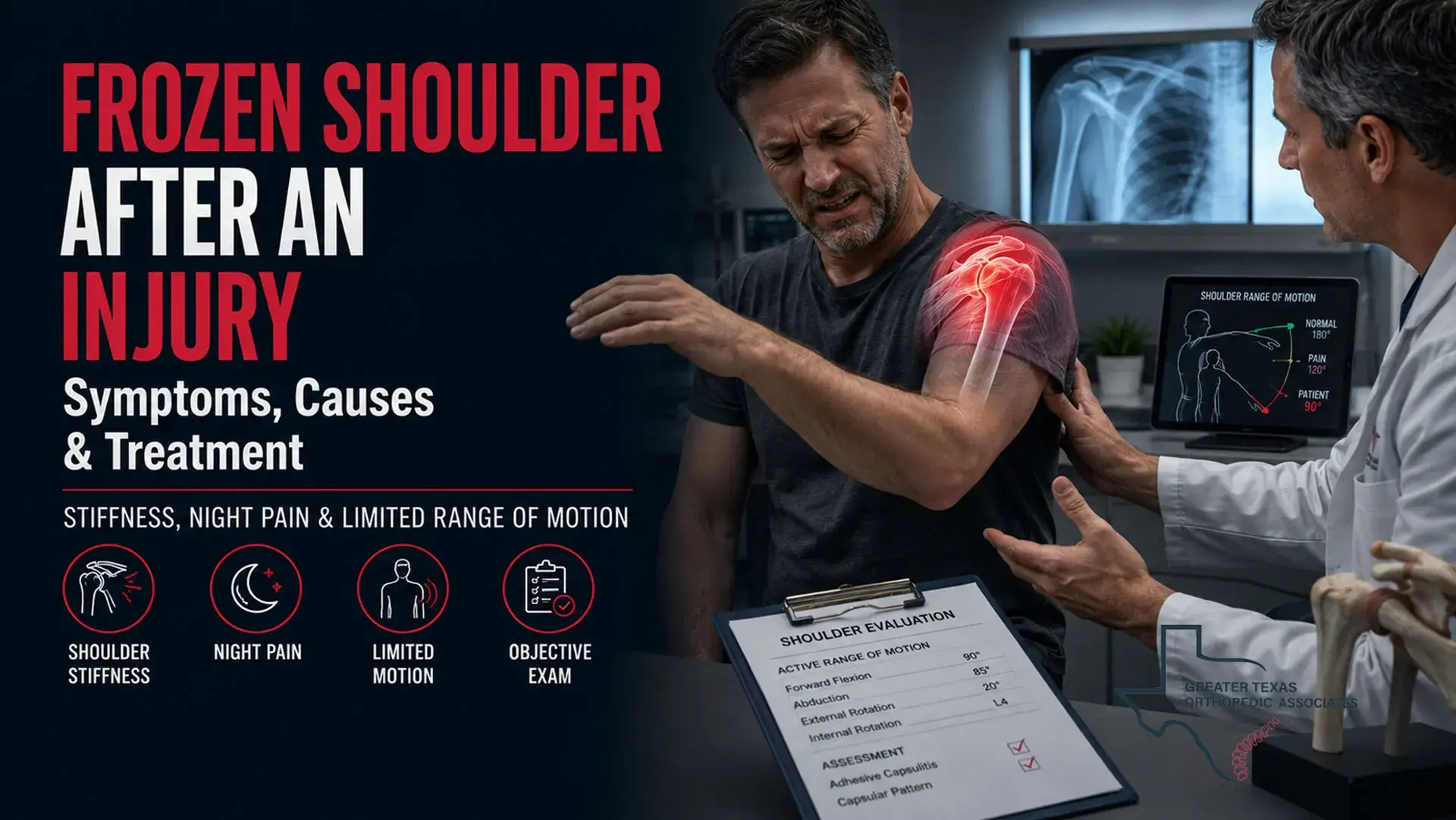
Frozen shoulder after injury can develop when pain, trauma, surgery, or a period of limited shoulder movement leads to progressive stiffness. Also called adhesive capsulitis, the condition causes pain and loss of motion that may make reaching, dressing, driving, and sleeping difficult. Treatment focuses on controlling pain and gradually restoring shoulder movement.
The shoulder depends on a thin, flexible capsule to allow motion in nearly every direction. After trauma, surgery, or prolonged reduction in shoulder movement, the joint capsule can become thick and stiff, gradually restricting motion. The result is a joint that resists movement even when the patient pushes through discomfort.
Common situations associated with frozen shoulder after injury include:
Each of these shares one feature: reduced movement during the early recovery window.
Based on Cleveland Clinic’s explanation, adhesive capsulitis occurs when the connective tissue capsule around the ball and socket becomes thickened and inflamed, forming scar-like bands that limit how far the joint can travel. One of the most important clinical features is restriction of both active motion, when the patient moves the arm, and passive motion, when an examiner moves it. This pattern helps distinguish frozen shoulder from several other causes of shoulder pain.
Risk is higher in people ages 40 to 60 and in those with conditions such as diabetes or thyroid disease. Two patients with similar injuries may follow very different recovery paths.
Frozen shoulder and rotator cuff injuries can both cause pain with reaching. A key difference is that adhesive capsulitis typically limits both active and passive range of motion, especially external rotation. With some rotator cuff disorders, passive motion may remain relatively preserved. Because the two conditions can coexist, persistent stiffness after a rotator cuff injury after trauma should be evaluated rather than assumed to come from the tendon alone.
Adhesive capsulitis symptoms usually develop gradually. During the freezing stage, pain increases and shoulder motion becomes progressively limited. In the frozen stage, pain may lessen while stiffness remains prominent. During the thawing stage, range of motion gradually improves. The entire course can last many months and, in some patients, one to three years.
Patterns commonly reported after trauma include:
Prolonged sling use protects a healing fracture, and it can quietly cost the patient motion at the same time. The tradeoff is well recognized in orthopedics. When medically safe, a clinician may recommend gradual range-of-motion exercises to reduce prolonged stiffness while the original injury continues to heal.
Prolonged reduction in shoulder movement may contribute to progressive stiffness. Documenting the duration of immobilization and when range-of-motion exercises began can help clarify how shoulder stiffness developed during recovery.
Not every stiff shoulder is a contracted capsule, and a few presentations call for faster evaluation:
Structural problems such as labral injuries inside the shoulder can produce mechanical catching and instability that stretching alone will not resolve. An accurate diagnosis changes the entire treatment plan, so persistent mechanical symptoms deserve a closer look rather than more time.
Diagnosis is primarily clinical. AAOS explains that a frozen shoulder is identified largely through history and physical examination, with imaging used to exclude other causes rather than to confirm the capsule itself.
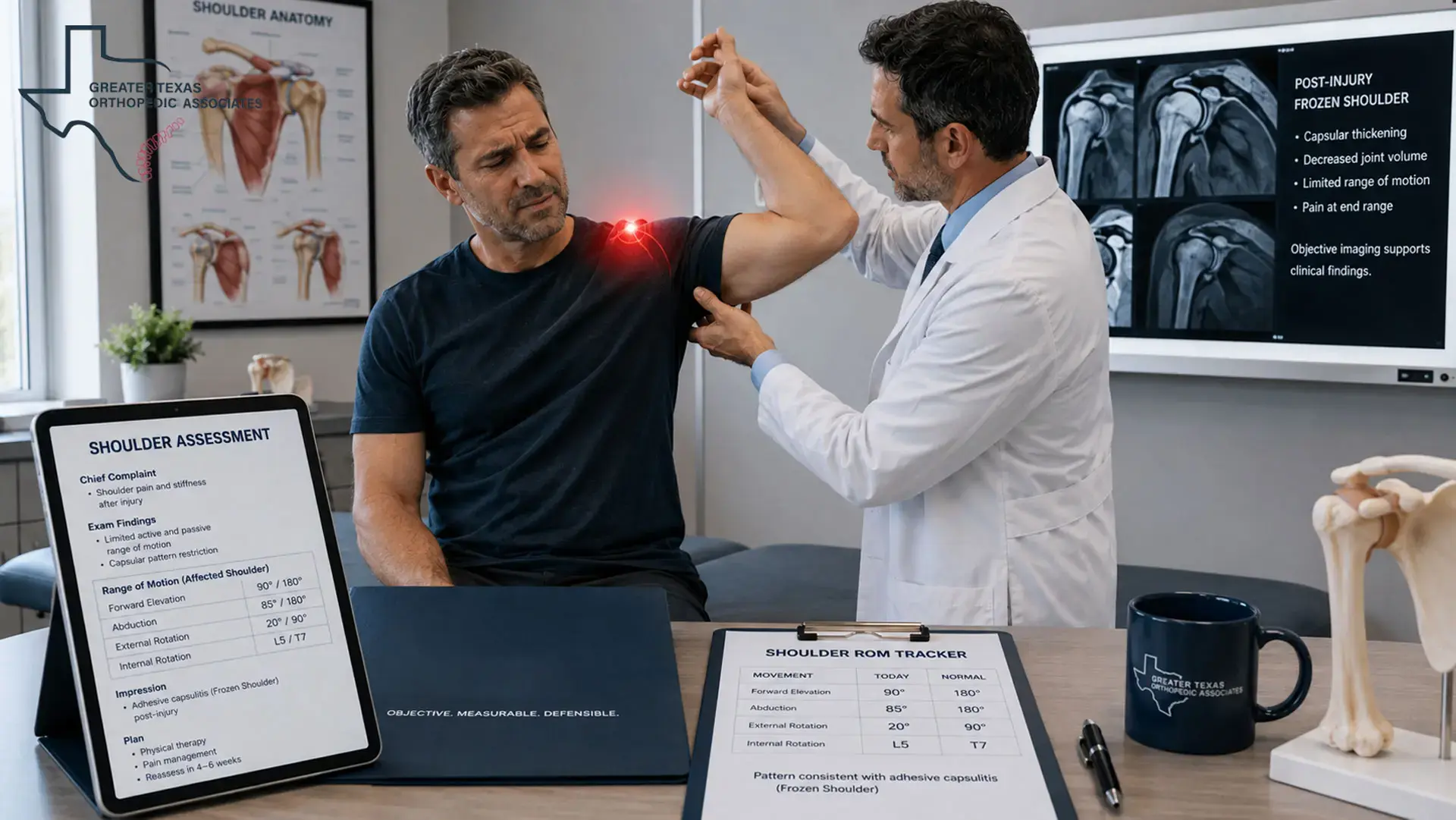
A key finding is restriction of both active and passive range of motion, often with prominent loss of external rotation.
A thorough shoulder exam typically documents:
X-rays are commonly used to rule out problems such as fracture, dislocation, or significant arthritis. MRI is not usually required to diagnose frozen shoulder but may be ordered when another condition, such as a rotator cuff tear, is suspected. Imaging findings should always be interpreted alongside the physical examination.
Frozen shoulder may develop after an injury or surgery that limits normal shoulder movement. In an injury claim, the record should show the sequence from the original event to immobilization or guarded use, the onset of stiffness, measured loss of motion, and subsequent treatment.
Pre-existing rotator cuff wear or arthritis does not necessarily explain new functional loss after an accident. Earlier records, prior function, examination findings, and serial range-of-motion measurements help clarify the clinical timeline. Documented gaps in the treatment timeline may also affect how that sequence is interpreted.
Frozen shoulder treatment usually focuses on reducing pain and gradually restoring range of motion. Most patients are treated without surgery, although improvement may take months.
Treatment options may include:
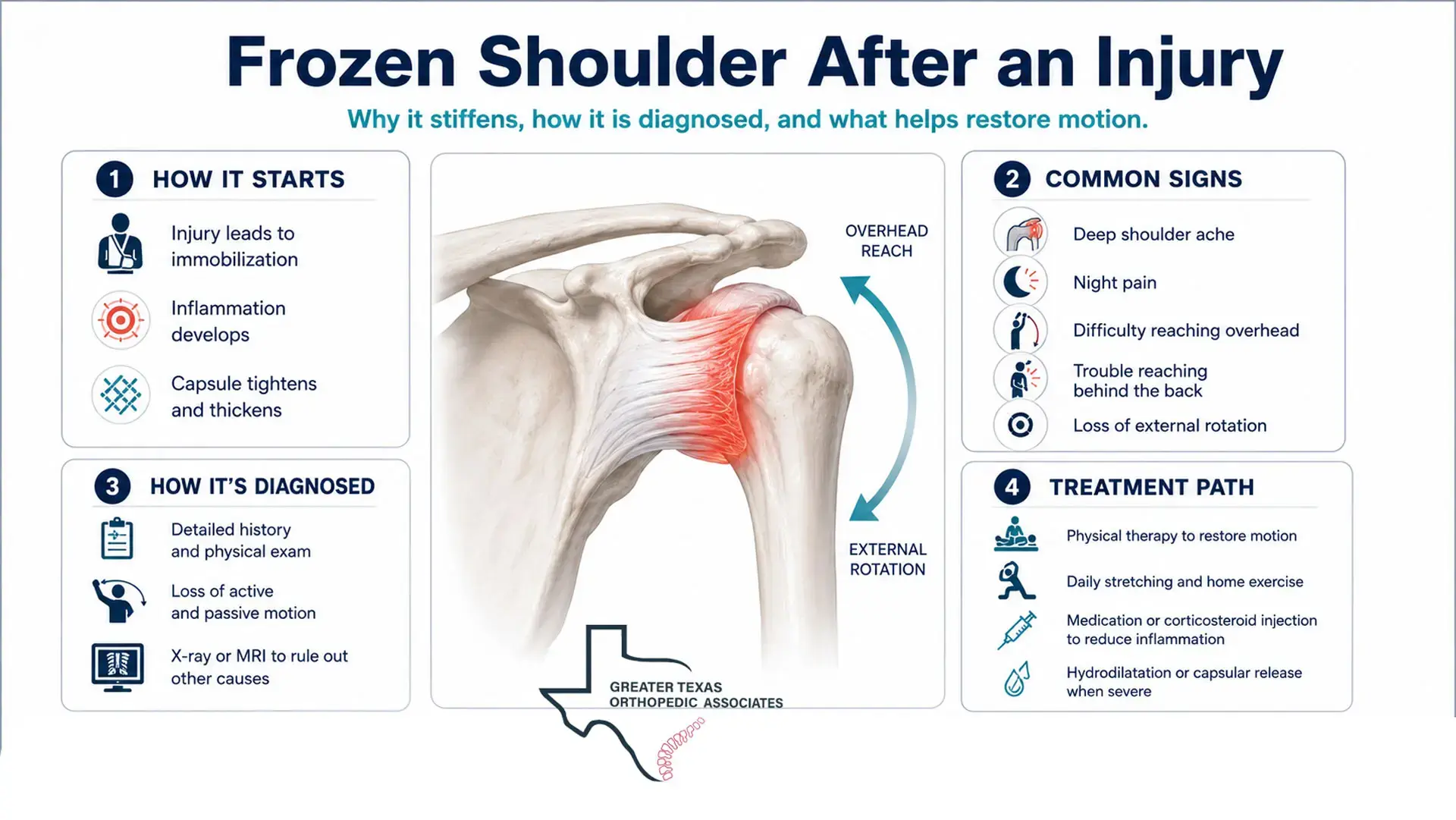
Measuring shoulder motion helps track whether treatment is improving function. For injury-related cases, serial range-of-motion measurements can also document changes over time and show how restrictions affect activities such as reaching, dressing, lifting, and work.
Clear records should connect symptoms, objective findings, treatment, and functional limitations rather than relying on pain scores alone.
Shoulder evaluation may be appropriate when stiffness continues to worsen, night pain disrupts sleep, or loss of motion interferes with dressing, driving, work, or other daily activities. Assessment can help distinguish frozen shoulder from rotator cuff, labral, arthritic, or other shoulder problems and guide an appropriate treatment plan.
Managing Frozen Shoulder After Injury
Frozen shoulder after injury can cause persistent pain and progressive loss of motion, particularly after a period of limited shoulder use. Treatment usually focuses on pain control, stretching, and restoring movement, with injections or procedures considered when conservative care is not enough. Greater Texas Orthopedic Associates can evaluate ongoing shoulder stiffness and discuss appropriate treatment options based on the clinical findings.
Frozen shoulder may develop gradually after an injury, surgery, or period of limited shoulder movement. There is no single timeline that applies to every patient, and symptoms may become noticeable over weeks or months.
It can develop after another injury or procedure if shoulder movement remains limited for an extended period. Immobilization after a fracture or surgery is a recognized risk factor for frozen shoulder.
Many cases improve gradually, but recovery can take months and sometimes one to three years. Physical therapy and range-of-motion exercises are commonly used to improve movement and manage symptoms.
The delay between the event and the stiffness. When the record shows the injury, the immobilization, and measured motion loss in sequence, the connection is easier to support.
Treatment commonly begins with pain control and exercises or physical therapy aimed at preserving and improving shoulder range of motion. A corticosteroid injection may be considered when pain limits progress.
Every comment is reviewed before publication. Do not include medical details, personal identifiers, or information about an active claim. This form is not monitored for medical questions or emergencies.
Three more from the same thread.
Showing the first 3 of 3 articles
Comments are reviewed before they appear. For appointments, records, or medical questions, use the contact page.
No comments have been published on this article yet.