Loading article

You left the emergency department with no fracture on the X-ray. Yet going downstairs still makes your knee feel unreliable. A PCL tear after a car accident is one possible explanation, especially if your bent knee struck the dashboard. You may still be able to walk on level ground while finding stairs unexpectedly difficult.
Describe that difference at your next examination. The clinician needs to identify the damaged structures and assess knee stability to determine whether protection and rehabilitation are appropriate or a surgical opinion is needed.
The posterior cruciate ligament, or PCL, connects the thighbone to the shinbone deep inside the knee. It helps prevent the shinbone from sliding too far backward relative to the thighbone.
In a dashboard knee injury, the impact pushes the upper shin backward while the knee is bent, stretching or tearing the ligament. A PCL tear after a car accident can also result from forceful twisting or excessive bending. Describe what you remember about the impact, even if the exact position of your leg is unclear.
A posterior cruciate ligament injury may involve a partial tear, a complete tear, or a ligament that pulls off a piece of bone at its attachment. That last injury is an avulsion fracture. Other ligaments, cartilage, or the meniscus, which cushions the joint, may also be damaged.
A direct blow to the kneecap can cause a fracture as well as soft tissue damage. GTOA’s article on kneecap fractures after a car accident explains that injury. The contact point helps guide the examination, but the clinician also checks surrounding structures that absorbed the force.
Every comment is reviewed before publication. Do not include medical details, personal identifiers, or information about an active claim. This form is not monitored for medical questions or emergencies.
Three more from the same thread.
Showing the first 3 of 3 articles
PCL tear symptoms can be less dramatic than people expect. You might leave the crash scene walking, then notice that the knee feels wrong during ordinary tasks.
With a PCL tear after a car accident, difficulty may appear only when you put more demand on the joint. Explain whether the knee buckles, hurts, or forces you to use a railing. Similar complaints can accompany other injuries, so the movement pattern helps guide examination.
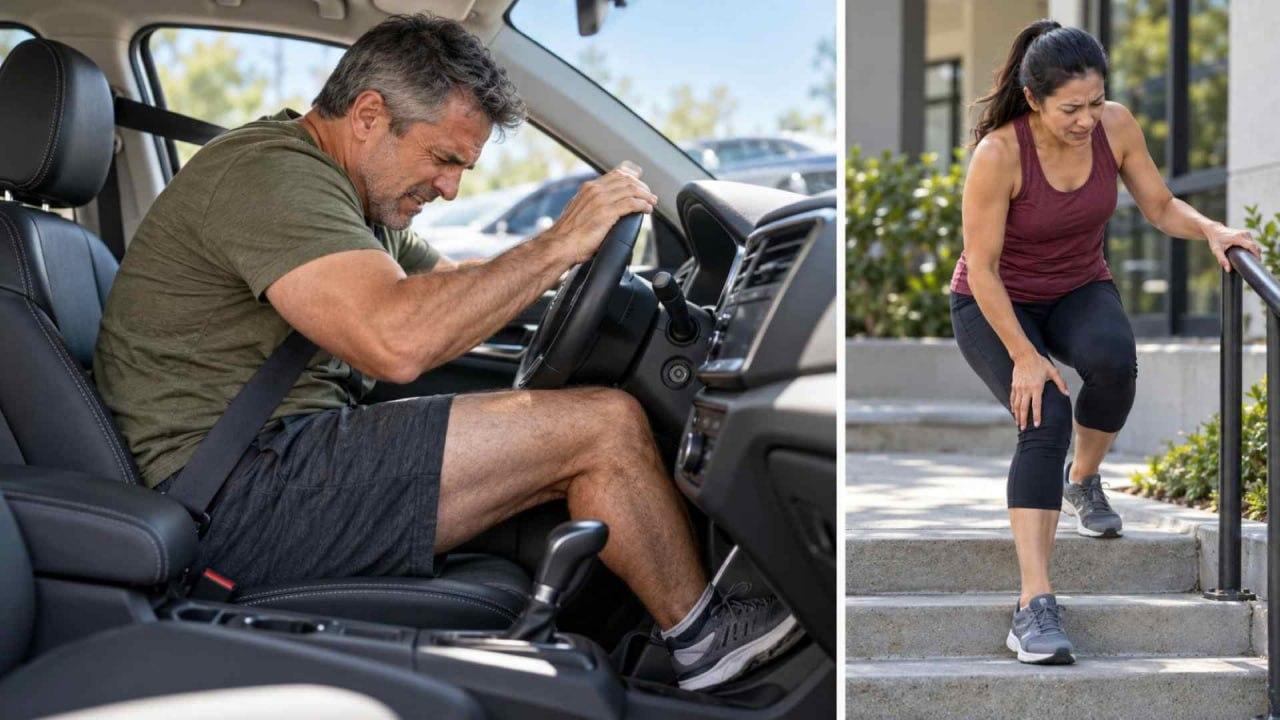
Go to an emergency department immediately if the knee looks deformed or your foot becomes cold, pale, newly numb, or weak after the crash. These changes can indicate a dislocation or injury to nerves or blood vessels. A knee that appeared displaced and then moved back into place also needs emergency assessment.
Get medical advice promptly if you cannot bear weight or the knee swells rapidly. Ongoing pain, repeated giving way, or difficulty with stairs warrants a follow-up appointment even after an initial emergency evaluation. A knee that keeps buckling needs reassessment before you resume activities where losing support could cause a fall.
If PCL tear symptoms emerge after the first visit, explain when you noticed them. Bring the discharge instructions and any available imaging so the next clinician can see what has already been assessed.
To assess a possible PCL tear after a car accident, the clinician compares both knees under controlled testing. Swelling and tenderness help locate the injury. Circulation and nerve findings receive particular attention when a dislocation or damage to several ligaments is suspected.
For a dashboard knee injury, explain which knee was struck and whether swelling appeared right away. Also mention previous knee problems, including any instability that existed before the collision.
The posterior drawer test checks whether the shinbone moves backward excessively relative to the thighbone. The clinician also checks neighboring ligaments. Pain or swelling can make you tense the muscles around the knee, limiting the first examination. A later assessment may clarify those findings. Trying the test yourself cannot reliably establish whether the ligament is torn.
X-rays show bone alignment and may reveal an avulsion fracture, but do not directly show the PCL. A report saying there is no fracture means none was identified on those images. A posterior cruciate ligament injury or another soft tissue problem may still explain the symptoms.
MRI can show the ligament and associated soft tissue damage. In selected cases, stress X-rays help measure abnormal backward movement of the shinbone. In some chronic PCL injuries, MRI may show ligament continuity even when clinical testing still demonstrates residual laxity.
A tear is structural damage; laxity is extra movement detected during testing. Instability describes the knee feeling unreliable during activity. Someone with measurable looseness may function reasonably well, while another person struggles with daily tasks. Your symptoms and examination give the scan its clinical meaning.
If symptoms continue after a dashboard knee injury, an orthopedic appointment can reassess your current limitations. GTOA’s Orthopedic Evaluations page explains the assessment and which records to bring.
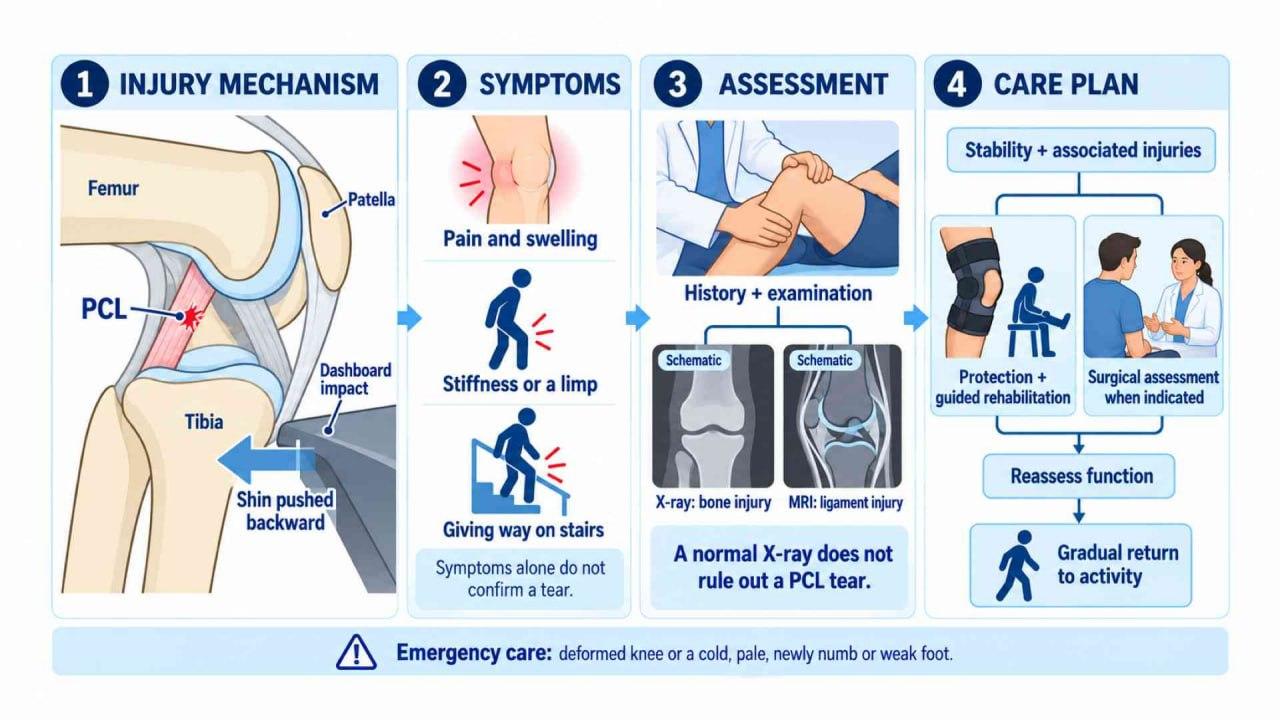
An isolated PCL tear after a car accident may be treated without surgery when the knee remains sufficiently stable for the activities you need to regain. A complete tear does not automatically require reconstruction. Injuries to other ligaments or a displaced bone fragment can change the plan considerably.
Early care may include activity changes, crutches, and a brace designed to support the shinbone and limit backward sagging. Your clinician should specify how much weight you can put on the leg and how to use the brace. A generic knee sleeve may not provide the same support.
A cold pack wrapped in cloth can help with swelling; keep ice off bare skin. Check which pain medicine is suitable if you take prescription medication or have other medical conditions. Follow the agreed activity restrictions even when the medicine makes the knee feel better.
Rehabilitation emphasizes the quadriceps, the muscles at the front of the thigh, alongside controlled movement and gradual strengthening. Because hamstring activation can increase posterior pull on the shinbone, some hamstring exercises may be limited or modified early in rehabilitation depending on the treatment plan. Follow your prescribed program rather than borrowing exercises for a different knee injury.
Useful signs of progress include swelling that stays controlled after activity and walking without a pronounced limp. Your therapist can measure knee motion and strength, then assess control on stairs before increasing demands. Tell them if an exercise brings back giving way or leaves the knee more swollen afterward.
If a PCL tear after a car accident occurs alongside other torn ligaments, an early surgical opinion may be appropriate. Surgery may also be considered when rehabilitation leaves instability that prevents necessary activities. For a displaced avulsion fracture, the surgeon may secure the bone fragment with fixation. Ligament reconstruction instead uses a tendon graft to replace the torn ligament.
Discuss what surgery could improve, what limitations might remain, and risks such as stiffness, infection, or persistent looseness. Understand the rehabilitation commitment. If nonsurgical care remains an option, establish how progress will be assessed and what would prompt reconsideration.
Recovery from a posterior cruciate ligament injury begins with protecting the knee and controlling swelling. As movement improves, rehabilitation gradually adds strength and more demanding tasks. You may feel comfortable sitting or walking briefly before you are ready for a full work shift or an afternoon on your feet.
A PCL tear after a car accident can require months of rehabilitation. After PCL reconstruction, recovery may take at least six months, depending on the injury, associated damage, and rehabilitation progress. Combined injuries can take longer. This is a broad estimate, not a return date for an individual patient.
Work restrictions should match your duties, including lifting or stair use. Discuss driving separately, especially with a right knee injury, brace, or medication that affects alertness. Safe pedal control and emergency braking matter even on a short trip.
For sport, the treating team may assess strength, motion, movement control, and performance on functional tests. Clearance should reflect the demands of the activity. Recurrent swelling or giving way during progression warrants reassessment.
Persistent PCL laxity can alter knee mechanics and may be associated with degenerative joint changes over time. Continued follow-up is useful when function remains limited. An arthritis risk does not mean that deterioration is inevitable or that surgery guarantees prevention.
If PCL tear symptoms persist, bring specific examples to follow-up: a knee that buckles on the last few steps, swelling after a work shift, or difficulty rising from a low seat. These details make it easier to adjust restrictions and rehabilitation.
A care plan for a PCL tear after a car accident should address the activity you are struggling to regain. Before leaving the appointment, agree on how that activity will be assessed at follow-up and which changes should bring you back sooner. You then have a practical way to judge progress between visits.
Still Having Knee Instability or Difficulty With Stairs After a Car Accident?
Greater Texas Orthopedic Associates can evaluate ongoing knee pain, swelling, instability, and difficulty with daily activities after a collision and help determine whether additional imaging, rehabilitation, bracing, or specialist evaluation may be appropriate.
Yes. Some people can still walk with a PCL tear, especially on level ground, but stairs, hills, or sudden changes in direction may reveal pain or instability. Tell your clinician which activities make the knee feel unreliable.
No. X-rays primarily assess bones and alignment. A PCL tear is a soft tissue injury, so physical examination and, when appropriate, MRI may be needed to evaluate the ligament.
Not necessarily. Treatment depends on knee stability, the severity of the tear, associated injuries, and how well function improves with rehabilitation. Some isolated PCL tears can be managed without surgery.
Recovery varies with the severity of the injury and whether surgery is required. Rehabilitation may take several months, and return to work, driving, or sports should depend on strength, stability, motion, and functional progress rather than time alone.
Seek emergency care if the knee appears deformed or if the foot becomes cold, pale, newly numb, or weak after the injury. These findings can indicate a more serious injury involving joint alignment, nerves, or blood vessels.
Medical disclaimer: This article provides general educational information and does not replace an individual medical evaluation, diagnosis, or treatment plan.
Comments are reviewed before they appear. For appointments, records, or medical questions, use the contact page.
No comments have been published on this article yet.