Loading article

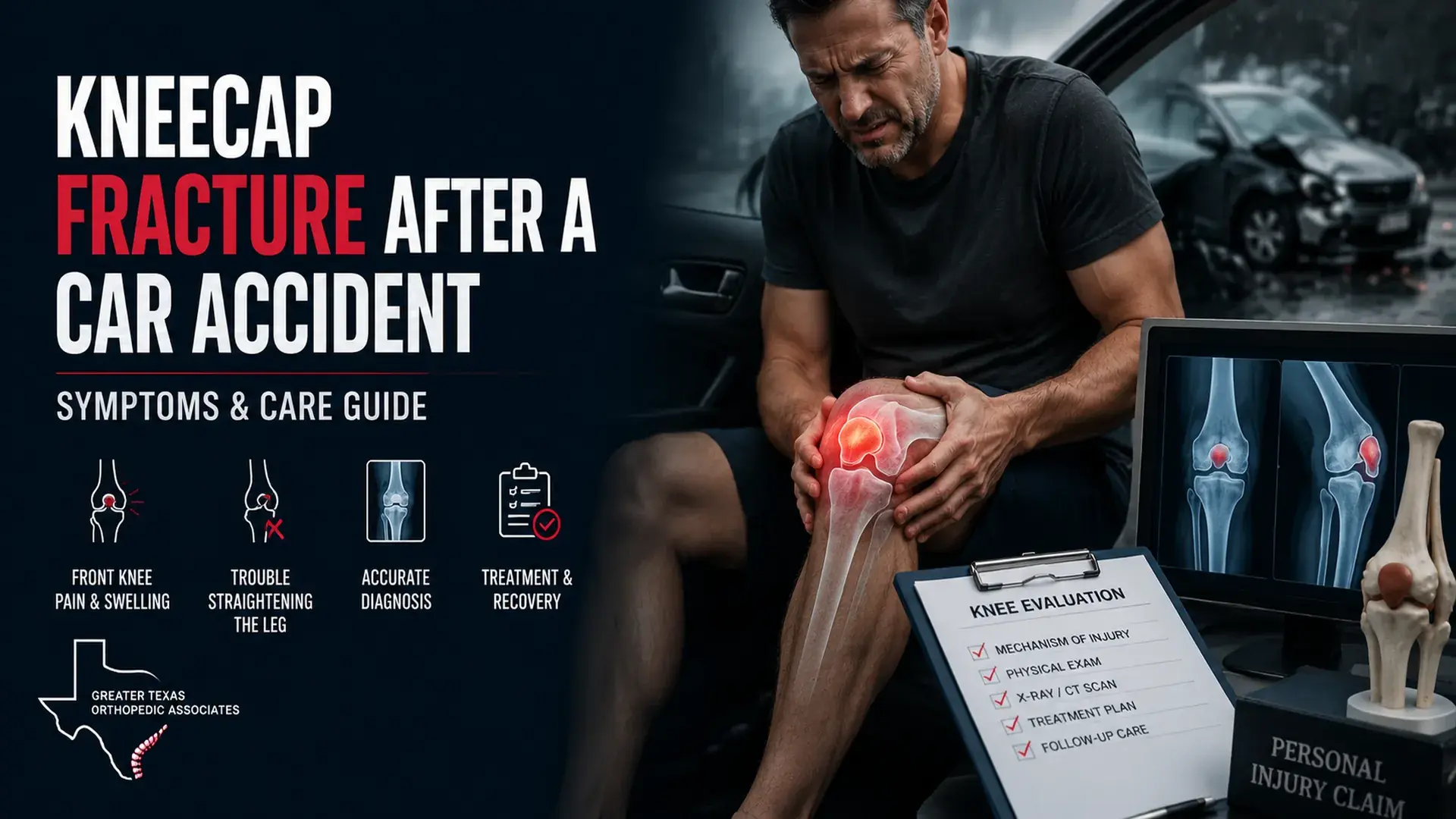
A kneecap fracture after a car accident can occur when the front of the knee strikes the dashboard or another hard surface during a collision. The patella may crack, break into several pieces, or become displaced enough to interfere with the mechanism that straightens the leg. Common concerns include anterior knee pain, swelling, difficulty walking, and trouble actively straightening the knee.
The patella is a small, shield-shaped bone that sits in front of the knee joint and glides in a groove at the end of the thighbone. It functions as part of the extensor mechanism. That chain of quadriceps muscle, quadriceps tendon, kneecap, and patellar tendon allows a person to straighten the leg, climb stairs, and rise from a seated position. When that chain is interrupted, the knee may still bend, yet active extension becomes difficult or impossible.
In a frontal collision, a seated occupant has flexed knees pointed toward the dashboard. In a frontal collision, the front of a flexed knee may strike the dashboard or another rigid surface, transmitting force directly to the patella. Patellar fractures can result from a direct blow to the front of the knee or from force transmitted through the extensor mechanism during a strong muscle contraction.
This mechanism tends to follow one of several recognizable patterns:
The same forward motion can injure structures around and behind the kneecap, so a confirmed fracture does not exclude a concurrent ligament, cartilage, or tendon injury in the same knee. Several of these are among the injuries that surface days later, once swelling and guarding have had time to develop.
Symptoms may be less noticeable initially when other injuries from the collision are more painful or urgent. An important finding is difficulty performing a straight leg raise or actively extending the knee, because these movements depend on an intact extensor mechanism. Pain at the front of the knee, tenderness directly over the patella, and significant swelling are also common.
Bruising may appear later, sometimes tracking down the shin over two or three days. Some patients describe a sensation of the knee giving way, while others report that bending past a certain point produces sharp, focal pain rather than the diffuse ache associated with a bruise.
Radiating pain, calf swelling, or a knee that locks in one position also deserves same-day assessment, since these findings can point to injuries beyond the patella itself.
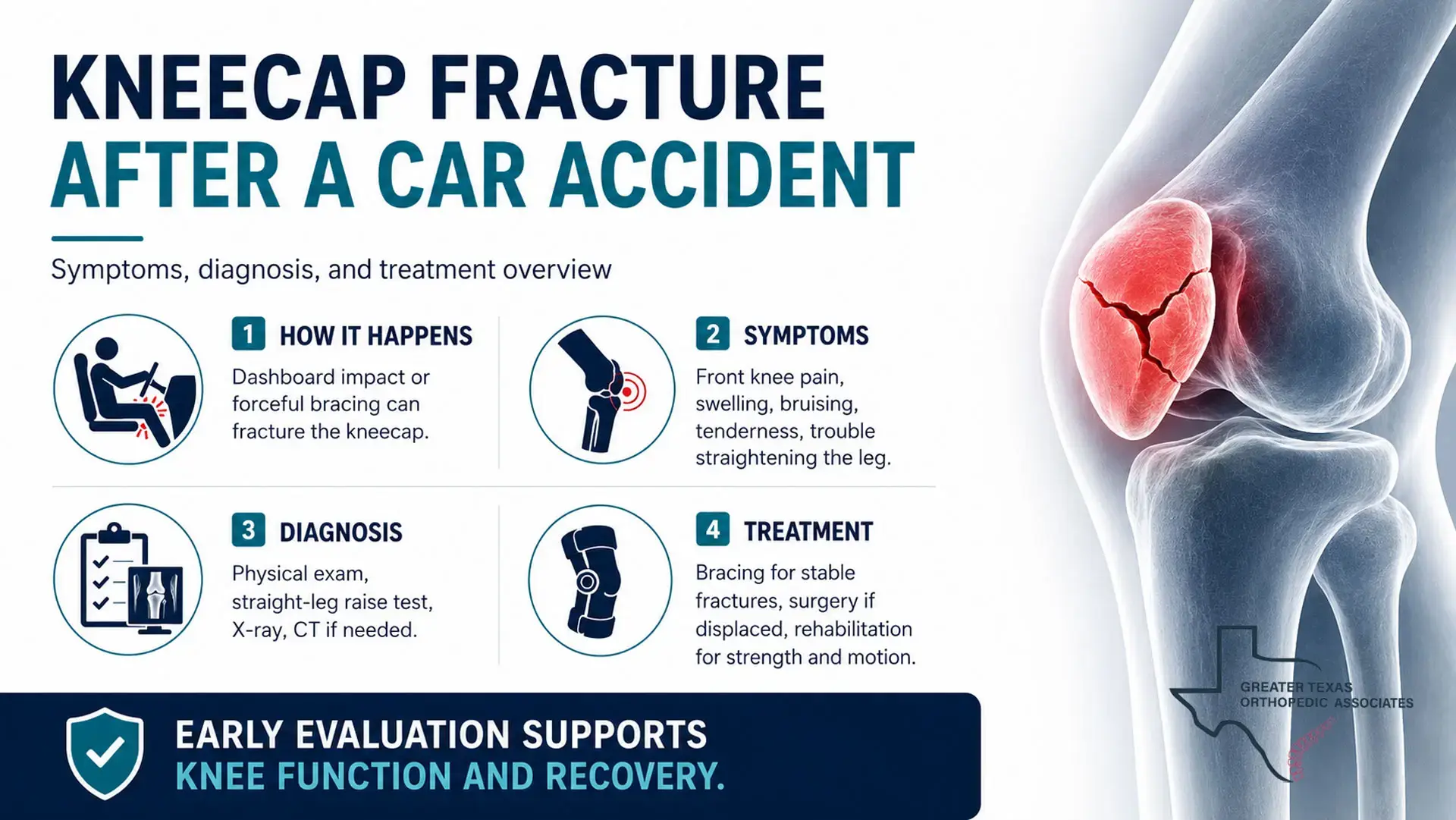
Diagnosis begins with mechanism. The clinician documents the direction of impact, the position of the leg, whether the occupant braced, and what the patient felt at the scene compared with what developed later. The clinician examines the knee for tenderness over the patella, swelling, a palpable defect, and the ability to actively extend the leg. A straight leg raise helps assess whether the extensor mechanism remains functional.
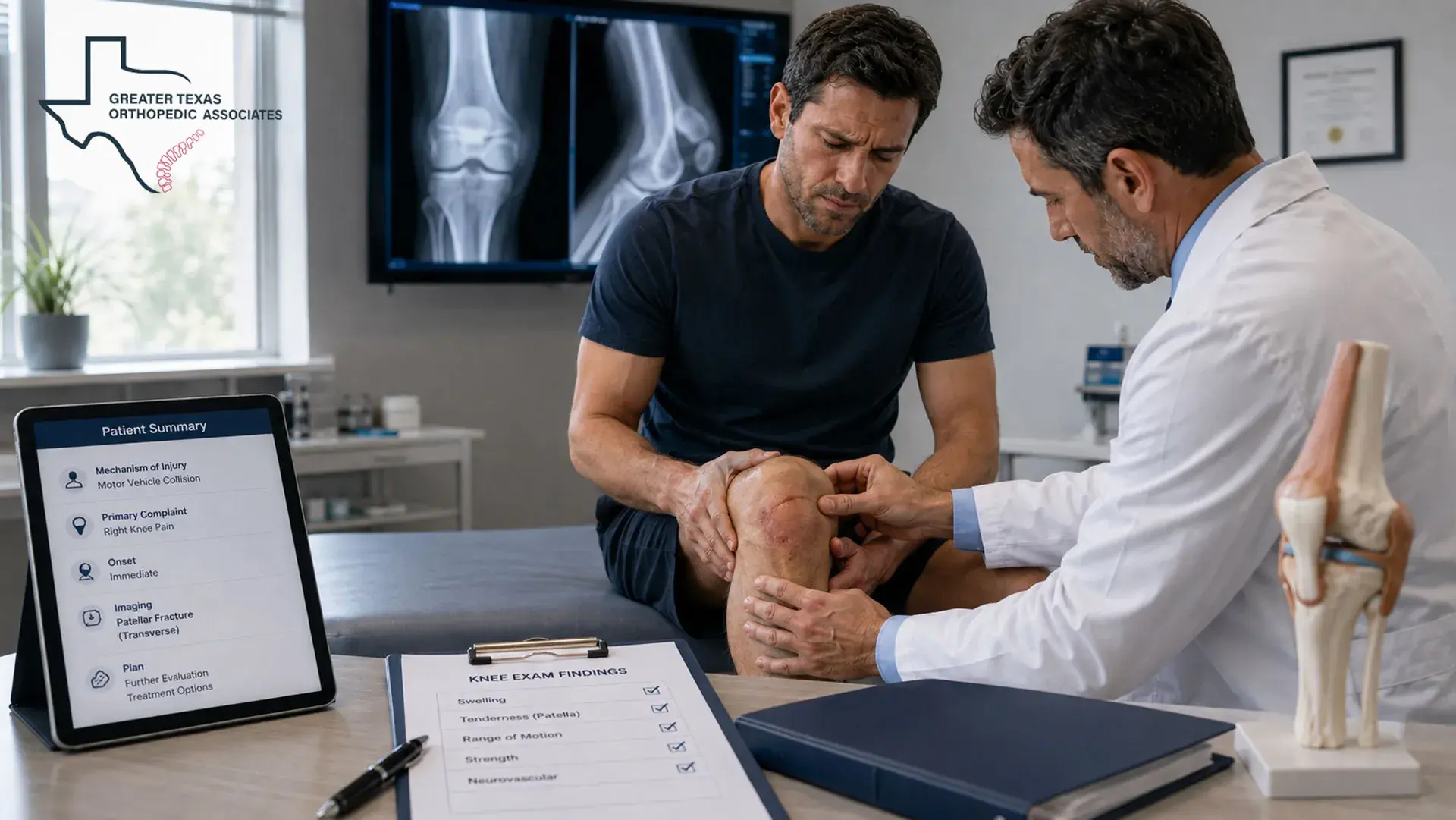
Imaging is selected based on the examination findings and the suspected injury. An initial X-ray that appears normal may not fully explain persistent functional limitations, which is why pain despite clear imaging may warrant reassessment.
Standard knee radiographs are usually the first imaging study after acute trauma. Additional patellofemoral views may help identify suspected patellar fractures. CT can provide more detail about complex fracture patterns, while MRI may be useful when an occult fracture or associated cartilage, ligament, or tendon injury is suspected.
Treatment of a patellar fracture depends on displacement, fragment pattern, skin integrity, and whether the extensor mechanism remains functional. The clinical goal is to restore a smooth joint surface, protect the ability to straighten the leg, and return motion before stiffness sets in.
Surgery may be considered when the fracture is significantly displaced, the joint surface is no longer well aligned, the extensor mechanism is disrupted, or the fracture is open or otherwise unstable. Techniques may include tension band wiring, screw fixation, or plate constructs. In selected severely comminuted fractures, surgical management may include removal of a small non-reconstructable fragment with repair of the surrounding soft tissues, while preserving as much of the patella as possible.
Recovery depends on more than bone healing alone. Physical therapy addresses quadriceps strength, knee flexion, gait mechanics, and confidence on stairs. Many patients regain functional motion over several months, although timelines vary with age, fracture pattern, and adherence to the plan. Persistent pain or weakness after healing may require further orthopedic evaluation and rehabilitation planning.
Pre-existing arthritis, prior knee surgery, or an anatomic variant such as a bipartite patella may already appear on imaging before a collision. These findings do not by themselves rule out an acute injury. The medical record should compare prior function, the reported crash mechanism, examination findings, imaging, and any new functional limitations.
For injury-related cases, objective findings such as fracture pattern, swelling, range of motion, extensor mechanism function, and treatment restrictions help distinguish acute findings from pre-existing changes.
Clear documentation helps explain both treatment decisions and functional limitations. Useful records may include range of motion, quadriceps strength, swelling, extensor mechanism status, imaging findings, assistive devices, rehabilitation progress, and activity or work restrictions.
Persistent swelling, difficulty actively straightening the knee, unsafe weight bearing, or continued pain after initially reassuring imaging may warrant orthopedic reassessment. After acute treatment, follow-up can address fracture healing, knee motion, strength, rehabilitation, and return to activity. GTOA offers orthopedic injury evaluation for patients who need further assessment after a collision.
Final Thoughts
A kneecap fracture after a car accident can affect walking, stair use, driving, work, and the ability to actively straighten the knee. Recovery depends on the fracture pattern, extensor mechanism function, treatment, and rehabilitation. Persistent pain, weakness, or limited motion may warrant further orthopedic evaluation.
This article is intended for general educational purposes and is not a substitute for individual medical evaluation.
Some patients can bear weight with the leg held straight, particularly when the fracture is nondisplaced and the extensor mechanism remains intact. Walking does not rule out a fracture, and continuing to walk on an unstable patella may allow fragments to shift.
Bone healing often takes several weeks, while regaining strength, motion, and confidence with daily activities may take several months. Recovery varies with fracture pattern, treatment, age, and rehabilitation.
Some nondisplaced or occult fractures can be difficult to see on initial radiographs. If symptoms and examination findings remain concerning, additional imaging such as CT or MRI may be considered.
Useful records document the impact mechanism, the timing of symptom onset, measured range of motion, extensor mechanism status, imaging correlated to the examination, treatment rationale, and specific functional restrictions rather than general statements about pain.
Every comment is reviewed before publication. Do not include medical details, personal identifiers, or information about an active claim. This form is not monitored for medical questions or emergencies.
Three more from the same thread.
Showing the first 3 of 3 articles
Comments are reviewed before they appear. For appointments, records, or medical questions, use the contact page.
No comments have been published on this article yet.