Loading article

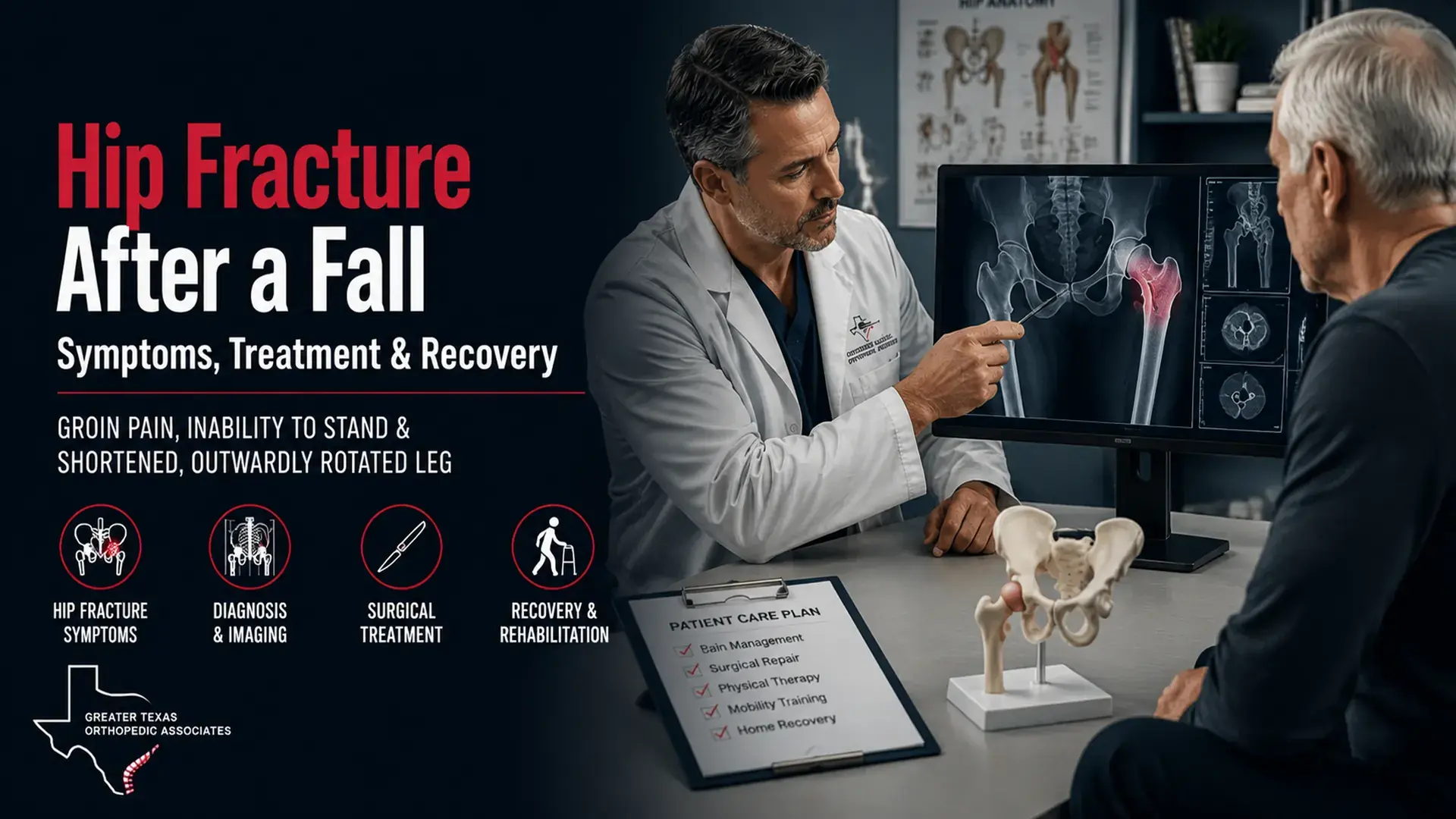
A hip fracture after a fall is a break in the upper part of the femur near the hip joint. It may follow a high-impact injury in a younger adult or a relatively minor fall in someone with weakened bone. Common signs include severe hip or groin pain, difficulty standing or walking, and a leg that may appear shortened or turned outward. Most hip fractures require urgent medical evaluation and often surgery.
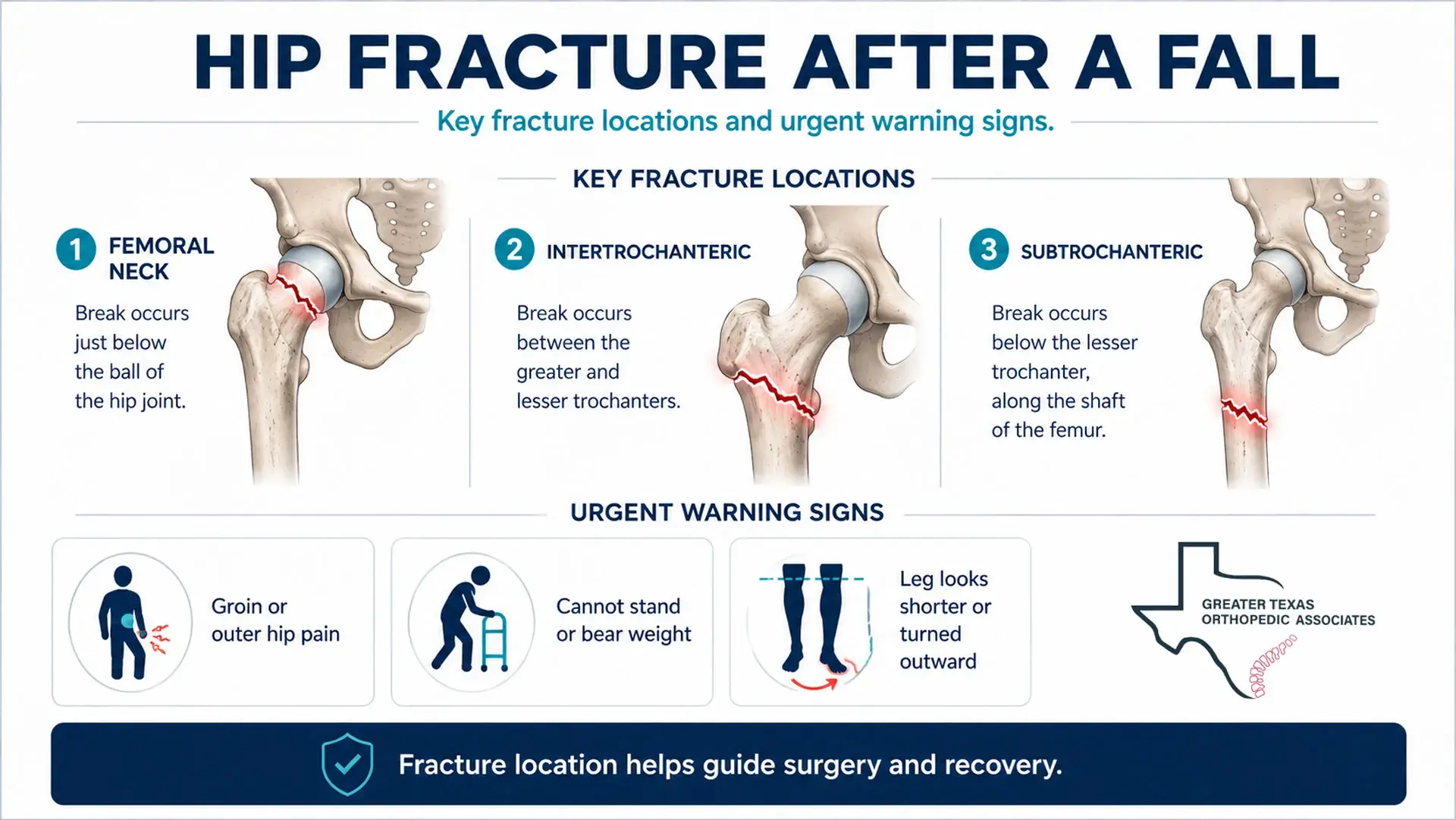
The hip is a ball and socket joint. The rounded head of the femur sits inside the acetabulum, a cup formed by the pelvis. Based on Cleveland Clinic’s explanation, most injuries described as a broken hip involve the upper femur rather than the pelvic bone itself, and they are grouped by where along that segment the bone gives way.
Three regions account for most of these breaks. A femoral neck fracture sits just below the ball and can disturb blood flow to the femoral head. An intertrochanteric fracture occurs slightly lower, through the bony prominences where large hip muscles attach. A subtrochanteric fracture sits lower still, along the shaft beneath those prominences.
Fracture location helps determine the type of treatment that may be needed. The same fall can call for very different surgery depending on where the bone failed and how far the fragments have shifted.
Force, bone quality, and body position at impact all contribute. A sideways landing that drives weight onto the greater trochanter is a common pattern, although a twist during a stumble can be enough when bone is fragile.
Mechanisms seen most often include:
Other causes of hip pain may also need to be considered when initial imaging does not explain the symptoms, particularly when deep hip or groin pain persists.
Symptoms of a fractured hip are usually immediate and difficult to ignore, though a small nondisplaced break can be quieter than expected. Some nondisplaced fractures may cause less obvious symptoms, and limited weight bearing may still be possible in selected cases.
Findings commonly documented at the first evaluation include:
A suspected hip fracture requires emergency evaluation, especially when a person cannot stand or bear weight, has severe hip or groin pain, develops an obvious deformity, or has a shortened or externally rotated leg. Numbness, a cold foot, severe swelling, confusion, chest pain, or shortness of breath also warrant urgent medical attention.
Referred knee pain deserves particular attention. An older adult who reports only knee soreness after a fall may still have a fractured femoral neck, and a knee film alone will not reveal it.
Bone density, balance, medication effects, and vision all change with age, and each raises the chance that a routine stumble ends in a broken hip. AAOS notes that most of these injuries occur in older patients whose bone has been weakened by osteoporosis, and that in fragile bone a simple twist or trip may be sufficient.
Hip fractures can carry additional risks in older adults. Extended time in bed raises the risk of blood clots, pneumonia, pressure sores, delirium, and rapid muscle loss, which is why early mobilization is treated as a goal rather than an afterthought. AAOS guidance supports operative treatment within roughly 24 to 48 hours of hospital admission when the patient’s medical condition allows, since earlier surgery has been associated with better outcomes.
A low-energy hip fracture may also prompt evaluation for osteoporosis and future fall risk, particularly in older adults.
Diagnosis begins with the account of the fall and a focused examination. The examiner checks leg length and rotation, tests whether the patient can lift the heel off the bed, palpates the greater trochanter and groin, and documents whether gentle rotation reproduces the pain.

X-rays of the pelvis and the affected hip are typically the first imaging step, and most hip fractures are visible on those views.
X-rays are usually the first imaging test for a suspected hip fracture. If radiographs are negative or unclear but clinical suspicion remains high, MRI or CT may be used to look for an occult fracture. MRI is particularly useful when a fracture remains suspected despite negative initial imaging.
Most hip fractures require surgery. The procedure depends on fracture location, displacement, bone quality, age, health, and prior mobility.
Common approaches include fixation with screws, plates, or an intramedullary device when the fracture can be stabilized, and partial or total hip replacement for selected femoral neck fractures. Nonsurgical management is generally reserved for situations in which the risks of surgery outweigh the expected benefits.
Mobilization and physical therapy often begin soon after surgery when medically appropriate. Early goals center on safe transfers, weight bearing as directed by the surgical team, and getting upright. Later phases address hip strength, gait mechanics, balance, and endurance. Recovery often continues over several months, and some patients may not return fully to their previous level of independence.
Return to activity depends on the physical demands involved. A desk role may resume far sooner than work requiring climbing, lifting, or prolonged standing. When work restrictions need objective measurement, a functional capacity evaluation can provide performance-based information about strength, mobility, endurance, and physical work capacity.
Osteoporosis and other age-related bone changes can increase susceptibility to hip fracture, but they do not by themselves establish what caused an acute injury. The medical record should document prior mobility, the reported fall, examination findings, imaging, treatment, and any resulting change in function.
For injury-related cases, records should document the fracture pattern, surgical treatment, weight-bearing restrictions, assistive devices, rehabilitation progress, and functional limitations. Any significant gap or delay in care should also be documented when the reason is known.
A suspected hip fracture requires emergency evaluation rather than a routine office appointment. Persistent hip or groin pain after a fall also deserves reassessment when initial X-rays are negative but walking or weight bearing remains difficult. After acute treatment, orthopedic follow-up can address healing, hardware, mobility, rehabilitation, and persistent functional limitations.
Greater Texas Orthopedic Associates offers orthopedic injury evaluation for patients who need follow-up after the acute phase.
Final Thoughts
A hip fracture after a fall is rarely a simple broken bone. It affects walking, independence, work capacity, and, in older adults, overall health. A clear medical record should connect the reported fall, examination findings, imaging, treatment, and changes in function.
Greater Texas Orthopedic Associates can evaluate hip injuries after a fall, document objective findings, clarify how the injury affects daily function, and help guide the next step in treatment.
This article is for educational purposes and is not a substitute for individual medical evaluation.
Limited walking may occasionally be possible with some nondisplaced fractures, so the ability to take a few steps does not rule out a broken hip.
Most patients spend several months in structured rehabilitation. Early weeks focus on transfers and protected walking, while strength, balance, and endurance improve over the following months. Individual timelines vary with age, fracture type, prior mobility, and other medical conditions.
Most do, since stabilization allows earlier movement and reduces complications tied to prolonged bed rest. Nonsurgical management may be chosen when the surgical risk is judged too high, or occasionally for stable patterns in patients who were already minimally mobile.
Yes. Some nondisplaced or occult hip fractures may not appear clearly on initial X-rays. If clinical suspicion remains high, MRI or CT may be used to investigate further.
Every comment is reviewed before publication. Do not include medical details, personal identifiers, or information about an active claim. This form is not monitored for medical questions or emergencies.
Three more from the same thread.
Showing the first 3 of 3 articles
Comments are reviewed before they appear. For appointments, records, or medical questions, use the contact page.
No comments have been published on this article yet.