Loading article


Treatment gaps in personal injury cases can weaken how an injury is documented, evaluated, and connected to the accident. Even when an injury is real, delayed or inconsistent medical care can create questions about severity, causation, and the need for ongoing treatment.
A treatment gap may happen when a patient waits too long to get the first medical evaluation, misses follow-up appointments, stops therapy early, or has a long break between visits. These interruptions can leave missing pieces in the medical record, making it harder to show how symptoms developed and how the injury affected daily life.
Many gaps happen for understandable reasons, including work obligations, cost concerns, transportation issues, or scheduling delays. However, insurance companies often focus on the absence of documentation rather than the reason behind the delay. That is why consistent care and clear medical records are important after an accident.
In treatment gaps personal injury cases, even a small interruption in care can matter—especially if it is not clearly explained. A gap may occur:
These interruptions create periods where symptoms are not documented, making it harder to understand how the condition progressed.
A patient who leaves the emergency room and delays follow-up care for several weeks may see that decision as reasonable. Pain may feel manageable, or symptoms may not seem serious at first.
From a claims perspective, however, that same delay introduces uncertainty.
Without documentation during that time, there is no record showing:
A timely first orthopedic evaluation after an injury helps establish a clear baseline and reduces uncertainty in how the injury is later evaluated.
Delayed symptoms can be medically consistent with certain injury patterns. In some cases, especially involving soft tissue or neurological damage, symptoms may not appear immediately after trauma.
Delayed treatment reflects something different. It means symptoms were not evaluated or recorded during a period of time.
That gap introduces uncertainty into the medical record uncertainty that must later be explained. Even when symptoms are legitimate, the absence of documentation can weaken how the injury is interpreted.
The main problem with a treatment gap is that it interrupts the medical timeline. When care is consistent, the record can show how symptoms started, how they progressed, what treatment was recommended, and how the patient responded. This creates a clearer connection between the accident, the injury, and the need for care.
A strong personal injury claim usually follows a clear sequence:
Accident → Symptoms → Medical Evaluation → Treatment → Documented Progress
Each step helps support the relationship between the injury and the accident. When one part of that sequence is missing, the record becomes less complete.
For example, if a patient reports pain after an accident but waits several weeks before follow-up care, there may be no documentation showing how symptoms changed during that period. This can create questions about whether the condition was improving, worsening, or being affected by another event.
Once a gap appears, the focus may shift away from the injury itself and toward the missing documentation. Instead of relying on a steady treatment record, the claim may require additional explanation about why care stopped or why follow-up was delayed.
This does not mean the injury is not real. However, it can make the injury harder to measure, verify, and connect to the original accident. Over time, unexplained treatment gaps can weaken a claim because the medical record no longer tells a clear and continuous story.

In personal injury cases, insurance companies review the treatment timeline, not just the diagnosis. They look for whether the medical record supports the severity of the injury, the need for care, and the connection between the accident and the symptoms.
Insurance adjusters often focus on:
Even when an injury is real, inconsistent treatment can give insurers a reason to question how serious the injury was or whether ongoing care was necessary.
For example, if a patient develops knee pain after a car accident but waits several weeks to see a specialist, imaging may later confirm a ligament injury. However, the delay can still create room for dispute. The insurer may argue that the injury was not serious at first, developed later, or was caused by something else.
The facts may not change, but the treatment gap can change how those facts are interpreted.
Causation is the connection between the accident and the injury. In a personal injury case, it is not enough to show that a patient has pain or a diagnosis. The medical record must also help show that the condition is reasonably connected to the accident.
Treatment gaps can make that connection harder to prove. When care is consistent, the timeline shows how symptoms began, how they progressed, and what treatment was needed. When there are long delays or unexplained breaks in care, that timeline becomes less clear.
Causation may become more difficult to support when:
Medical experts often rely on the continuity of care when reviewing an injury claim. If the treatment history does not follow a clear pattern, they may question whether the condition is still related to the original accident, whether symptoms were caused by another event, or whether the injury is as severe as claimed.
In more complex cases, a structured orthopedic causation evaluation can help clarify whether the injury pattern matches the reported trauma, whether symptom progression is medically consistent, and whether a pre-existing condition was aggravated. This can help restore clarity when treatment gaps create uncertainty in the medical record.

In treatment gaps personal injury cases, settlement value is closely tied to how clearly the injury can be supported by medical evidence.
When treatment is consistent, the record shows a clear pattern of injury, care, and recovery. This makes it easier to justify both the severity of the condition and the need for continued treatment.
Consistent care provides:
This creates a strong, structured narrative that insurers can evaluate.
When gaps interrupt that timeline, uncertainty increases.
Insurers may question:
Even when the injury is legitimate, the impact of treatment gaps on settlement can significantly reduce how the claim is valued.
In practice, even short delays can lower settlement offers not because the injury is less real, but because it is harder to prove.
Most gaps in treatment personal injury cases happen for practical, everyday reasons:
These situations are common and understandable.
However, what matters is whether the reason behind the gap is documented.
Without context, insurers may interpret the interruption as a lack of severity rather than a real-life constraint.
When cost becomes a barrier, options such as orthopedic treatment on a medical lien can allow patients to continue care without interruption while the claim is pending.
A treatment gap does not automatically invalidate a claim. However, it does require additional effort to clarify both the injury and the timeline.
To rebuild credibility:
Consistency moving forward is essential.
After missed medical treatment personal injury gaps, documentation must do more than confirm symptoms.
It should:
A focused evaluation helps translate clinical findings into a structured explanation that can support the claim.
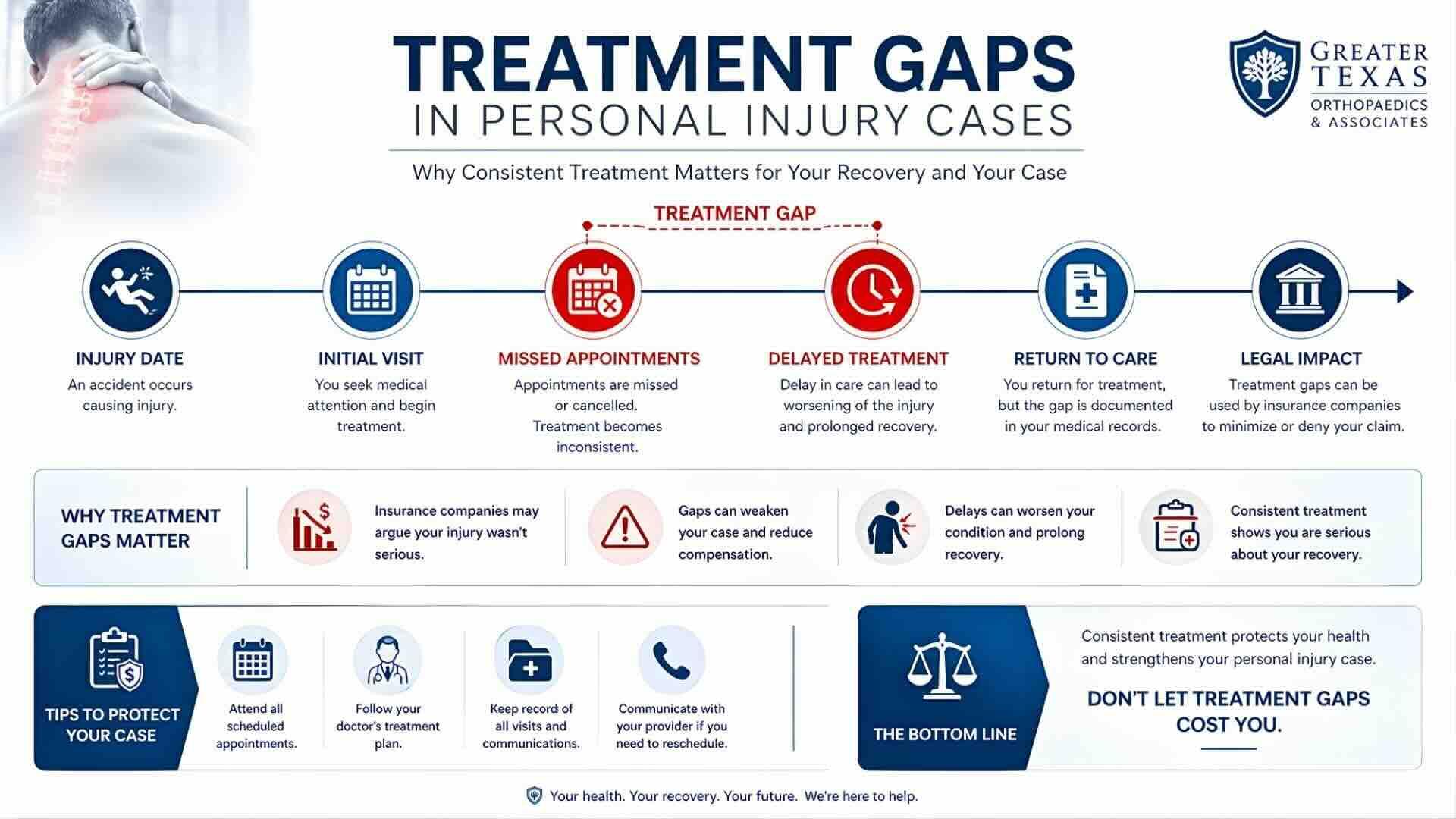
If your treatment history includes delays or interruptions, getting the right evaluation can make a measurable difference in your case.
A detailed orthopedic evaluation can clarify your injury, explain gaps in care, and strengthen the medical record that supports your claim.
Conclusion
Gaps in treatment personal injury cases directly affect how injuries are evaluated and valued.
A personal injury claim depends on a clear medical narrative, and once that narrative is interrupted, the case becomes harder to defend.
Consistent care, accurate documentation, and timely evaluation help reduce the impact of treatment gaps on settlement and claim strength.
Ultimately, the goal is to ensure the injury can be clearly proven over time. In many cases, the difference between a strong and weak claim comes down to how consistent the medical record is. If gaps in treatment are part of your timeline, getting a detailed orthopedic evaluation early can help clarify the record and protect how your case is understood.
Every comment is reviewed before publication. Do not include medical details, personal identifiers, or information about an active claim. This form is not monitored for medical questions or emergencies.
Three more from the same thread.
Showing the first 3 of 3 articles
Comments are reviewed before they appear. For appointments, records, or medical questions, use the contact page.
No comments have been published on this article yet.